A Bond to the Mutation Itself
Read the transcript of “A Bond to the Mutation Itself”
Film transcript: A Bond to the Mutation Itself
Ras was the standard example of an undruggable target. It holds its nucleotide with picomolar affinity. The cell keeps GTP near the millimolar range. So a competitor for that site must beat a very tight ligand, present in vast excess. And the known structures of Ras showed no groove deep enough to hold a small molecule. Kevan Shokat's laboratory went at the mutation itself. Glycine 12 has no side chain. One cancer mutation replaces it with cysteine. That puts a thiol on the surface of the protein: a reactive sulphur-hydrogen group. The group held purified K-Ras G12C in its GDP-bound shape. It passed 480 sulphur-seeking fragments over it, and weighed the protein to see what had attached. Two fragments attached to most of the protein.
Normal K-Ras, which has three cysteines elsewhere, showed no detectable reaction. The crystal structure showed something new. The compound lay in a pocket beneath the switch II loop that no earlier Ras structure had shown. Once bonded, it tilts Ras toward holding GDP and gets in the way of Raf. The bond lasts for the life of that protein molecule, so the compound never has to out-compete GTP. In 2019, Canon and colleagues reported sotorasib, a drug for patients that bonds to the same cysteine. Keep this rule: bond to a residue only the mutant has.
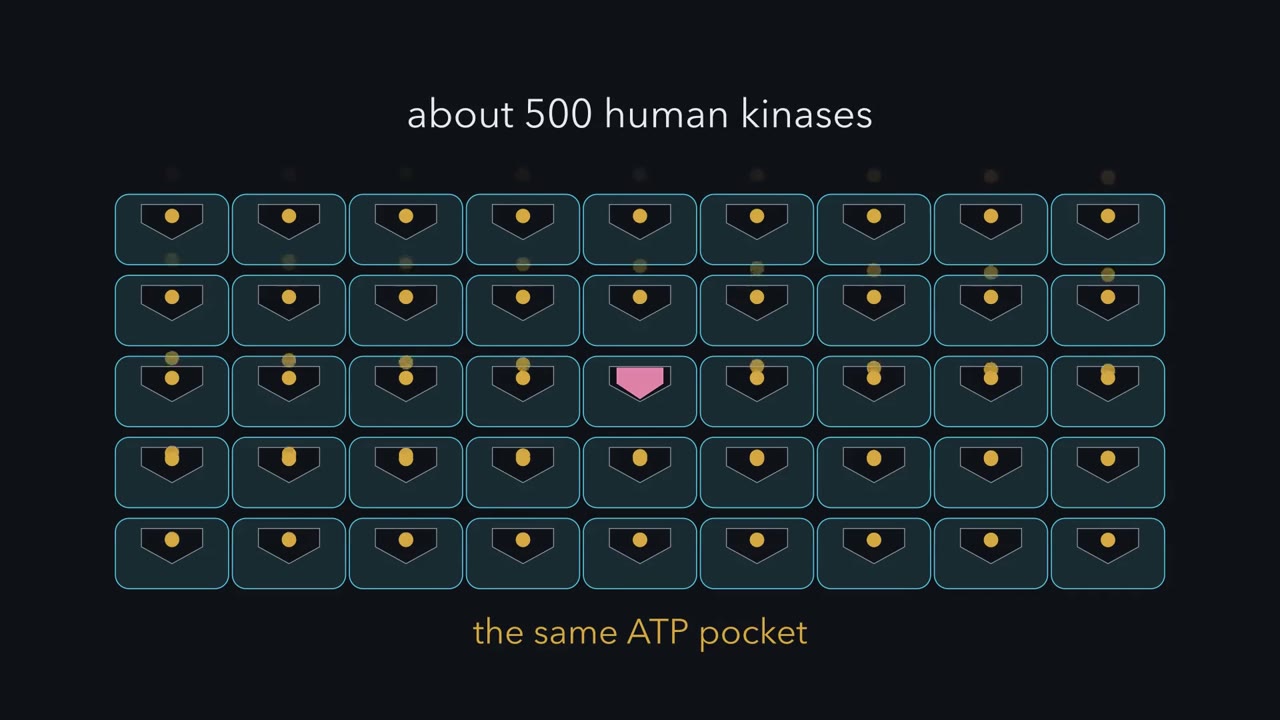
About five hundred human kinases hold ATP in nearly the same pocket. How do you drug just one?
Continue in the lesson: Drugs Against a Part →
1:54 · Free, with captions and a transcript. The lesson has the full text, the questions and the sources.
More films from this lesson
How this film was made. Narration: an AI narrator voice (ElevenLabs, Sarah) reading narration written from this lesson's text. Animation: AI-generated in code (Manim) by Claude, a schematic with no drawn molecular structures. Captions come from the narration script. See something wrong? Report it.