How Many Species Is It Worth?
Read the transcript of “How Many Species Is It Worth?”
Film transcript: How Many Species Is It Worth?
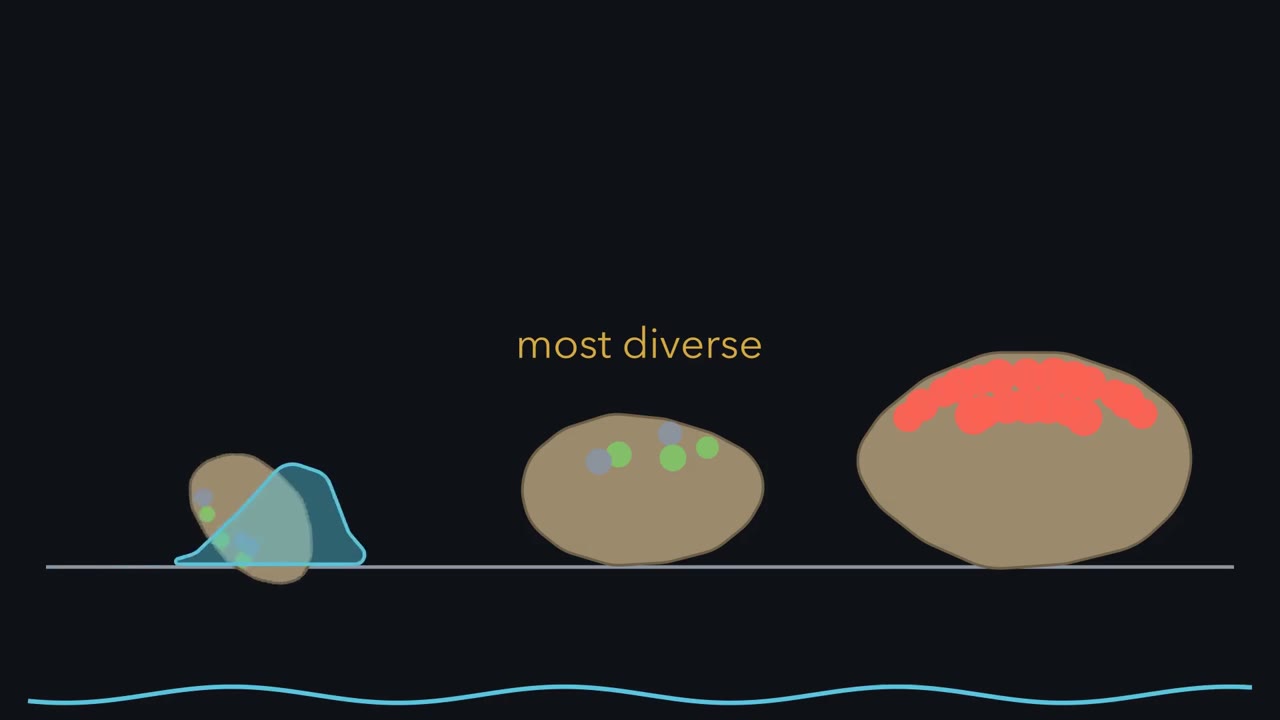
Two plots hold the same four species, a hundred individuals each. Can one be more diverse than the other? Count the species, and they tie. Look at the dots, and they do not look alike. Richness is the number of species present. Both plots have four, so richness calls it a tie. But richness counts every species once, however rare it is. It ignores abundance entirely. Diversity also asks how evenly the individuals are shared. In plot A, every species holds the same share. In plot B, two species hold most of the individuals, and two are rare. Here is a way to put richness and evenness on one scale.
Imagine a community in which every species is equally common. How many such species would score the same as plot B? That count is the effective number of species. For plot A, the answer is four, the same as its richness. For plot B, it is fewer than four, because two species hold most of the individuals. The measure has a dial, called the order. At order zero, every species counts once, however rare. As the order rises, common species count for more, and rare ones for less. Turn the dial for plot B. Its row of equal species shrinks, step by step, as its two rare species count for less. Plot A does not move, because nothing in it is rare. So the order you choose changes the number.
At order zero, the effective number is just the richness, so plot B ties plot A. Above order zero, it equals the richness only when every species is equally common. Always say which order you used. Now swap plot B's colours, so the rare species become the common ones. Nothing changes. These indices use only counts, never names, so none of them sees which species are present. One last test. A storm sweeps through plot B and kills the same share of every species. Most individuals die. What happens to its effective number?
Nothing happens to it. The counts drop, but every species keeps the same share. So the effective number stays exactly where it was. So a disturbance can change diversity in only two ways. It can change which species are present. Or it can change how evenly the individuals are shared, as the survivors regrow. Whether that raises or lowers diversity is a question for experiments.
Two plots hold the same four species. Can one be more diverse than the other?
Continue in the lesson: Diversity, Disturbance and Succession →
3:11 · Free, with captions and a transcript. The lesson has the full text, the questions and the sources.
More films from this lesson
How this film was made. Narration: written from this lesson's text and read by an AI narrator voice (Kokoro, af_heart). Animation: AI-generated in code (Manim) by Claude, a schematic with no drawn molecular structures. Captions come from the narration script. See something wrong? Report it.