How DNA Became Readable
Read the transcript of “How DNA Became Readable”
Film transcript: How DNA Became Readable
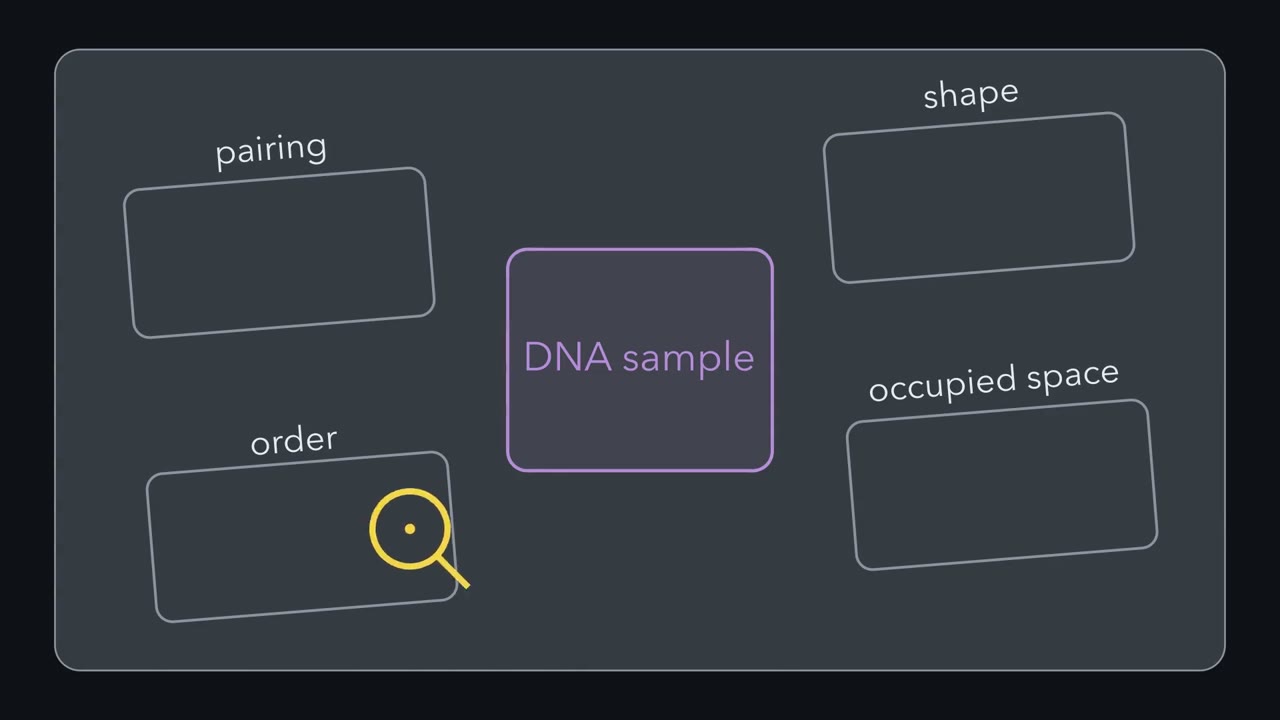
The double helix revealed the shape of DNA. But how can scientists read base order when shape does not show it? Move the yellow lens to order. Start with one template strand. A copying enzyme moves along it, adding matching base blocks. Ordinary blocks let the copy keep growing. The letters are still hidden in the process. Sanger's original method ran a separate reaction for each kind of base. Each reaction mixed ordinary blocks with a small amount of one kind of stop block. When a stop block joins a copy, that copy cannot grow farther. Many copies grow at once, so copies stop at many different matching positions.
Later versions give each kind of stop block its own color and use one reaction. Each tray now holds a mixture, not one planned staircase. Each copy ends with the base that stopped it. Sorting lanes can turn those lengths into readable order. Predict before the lane runs. Which copy reaches the bottom first: a shorter copy or a longer copy? Hold the picture and choose.
All the copies start moving together, but shorter copies move faster. The shortest reaches the bottom first, then longer copies follow. Reading each stop base in that order reveals the complementary sequence, one position after another. Sequencing changes the useful model. A coiled shape becomes a letter string. That string shows identity and order clearly, while hiding shape, size, and the partner strand. A genome is all the DNA in one chromosome set. A reference sequence acts like a ruler. New sequence strips align against it, making differences easier to find. The Human Genome Project used improved Sanger sequencing to build a human reference.
It joined work from several donors and still left gaps. Later projects filled more gaps and added variation. Reading also became far less costly. Plot the lesson's production-cost estimates on a logarithmic scale. The computed curve plunges, then flattens. The curve needs limits. These are production estimates, not prices paid by a person.
Later estimates use an existing reference. Earlier estimates priced building without one. Interpretation costs are excluded. Lower cost means a fixed budget can read more genomes. Biologists can compare many people and species instead of relying on one reference. The reference remains a model with limits. Shape required a structure model.
Order required a sequence model. Comparison required a reference. Choose DNA models by the question; every model leaves features out.
Four pictures can all represent the same DNA. Which one should you trust?
Continue in the lesson: How the DNA Model Was Built →
3:29 · Free, with captions and a transcript. The lesson has the full text, the questions and the sources.
More films from this lesson
How this film was made. Narration: an AI narrator voice (Kokoro, af_heart) reading narration written from this lesson's text. Animation: AI-generated in code (Manim) by Claude, a schematic with no drawn molecular structures. Captions come from the narration script. See something wrong? Report it.