Which Picture of DNA Should You Trust?
Read the transcript of “Which Picture of DNA Should You Trust?”
Film transcript: Which Picture of DNA Should You Trust?
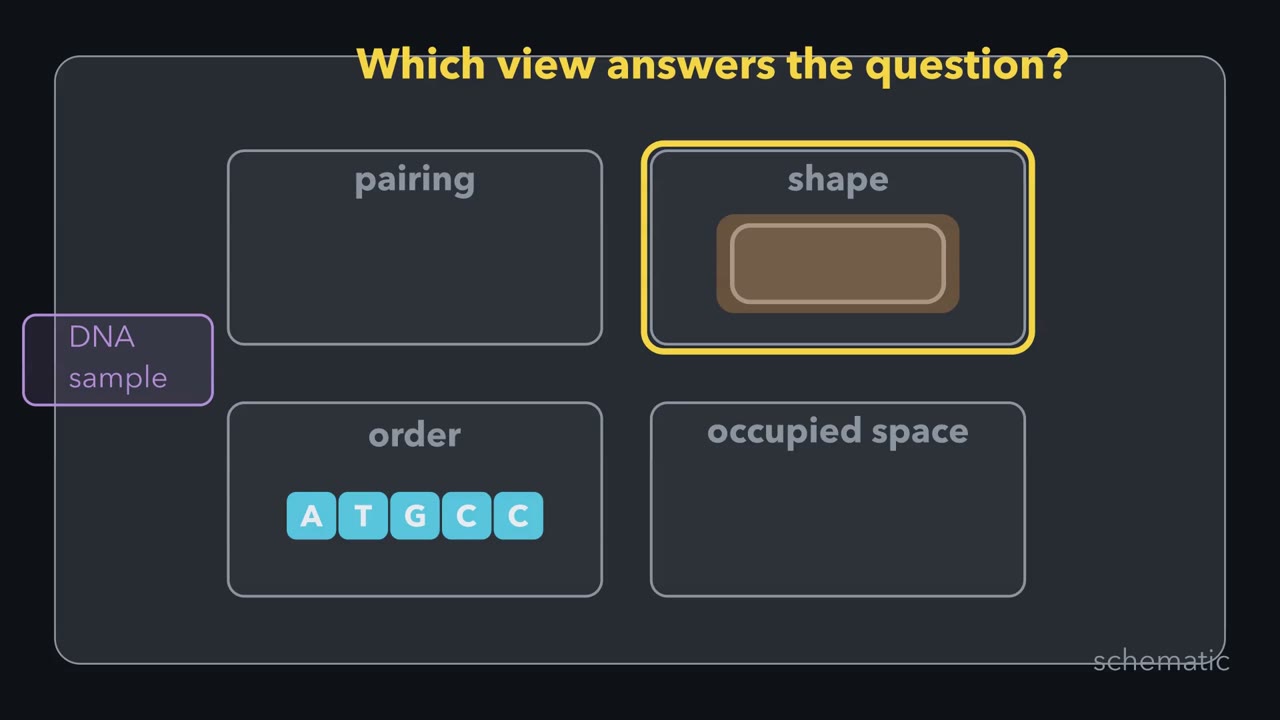
Several pictures can all represent DNA. Which one should you trust? The answer changes with your question. Keep one short sample in view while its pictures change. A scientific model is a simplified representation. It helps explain or predict something real. It is a tool, not a perfect copy. Every tool has a job and a limit. Ask which bases face each other. A flat ladder helps. Labelled base blocks form rungs between plain backbone bars. Pairing is clear, but the twist and atoms are gone. Ask for base order instead. The ladder folds into a straight letter strip. Comparing positions becomes easy.
Shape, size, and the partner strand disappear from this view. A ribbon model answers a shape question by showing coiling strands. A space-filling model shows occupied space. Neither is best for reading the exact order. Now predict. You need to show which bases face each other across the strands. Which model should move under the question lens? Hold your answer.
The ladder moves forward because its rungs expose pairing. The other models slide back, still useful for other questions. Choose DNA models by the question; every model leaves features out. Usefulness is not enough. Evidence can reject a model. Measured base amounts were close in pairs: adenine with thymine, and guanine with cytosine. A structure model had to explain that pattern, or be ruled out. X-ray diffraction added distances, width, and shape clues. It came from spots made by lined-up fibers. The pattern was indirect evidence, not a photograph of bases. Chemistry supplied another filter. Watson and Crick built a model fitting all the constraints.
Backbones stayed outside, bases paired inside, and the strands ran in opposite directions. Pairing also suggested a copying idea. Separate the strands, and each row fixes the matching row beside it. That was a prediction the model made, not proof by itself. The result was the double helix model. Watson and Crick still called it unproved. Franklin and Gosling called a helix highly probable. Later tests supported its main features. Return to the original sample. Pairing, shape, order, and occupied space still need different views. Start with the question, then inspect what your chosen view hides.
Four pictures can all represent the same DNA. Which one should you trust?
Continue in the lesson: How the DNA Model Was Built →
3:14 · Free, with captions and a transcript. The lesson has the full text, the questions and the sources.
More films from this lesson
How this film was made. Narration: written from this lesson's text and read by an AI narrator voice (Kokoro, af_heart). Animation: AI-generated in code (Manim) by Claude, a schematic with no drawn molecular structures. Captions come from the narration script. See something wrong? Report it.