Survive, Then Give Birth
Read the transcript of “Survive, Then Give Birth”
Film transcript: Survive, Then Give Birth
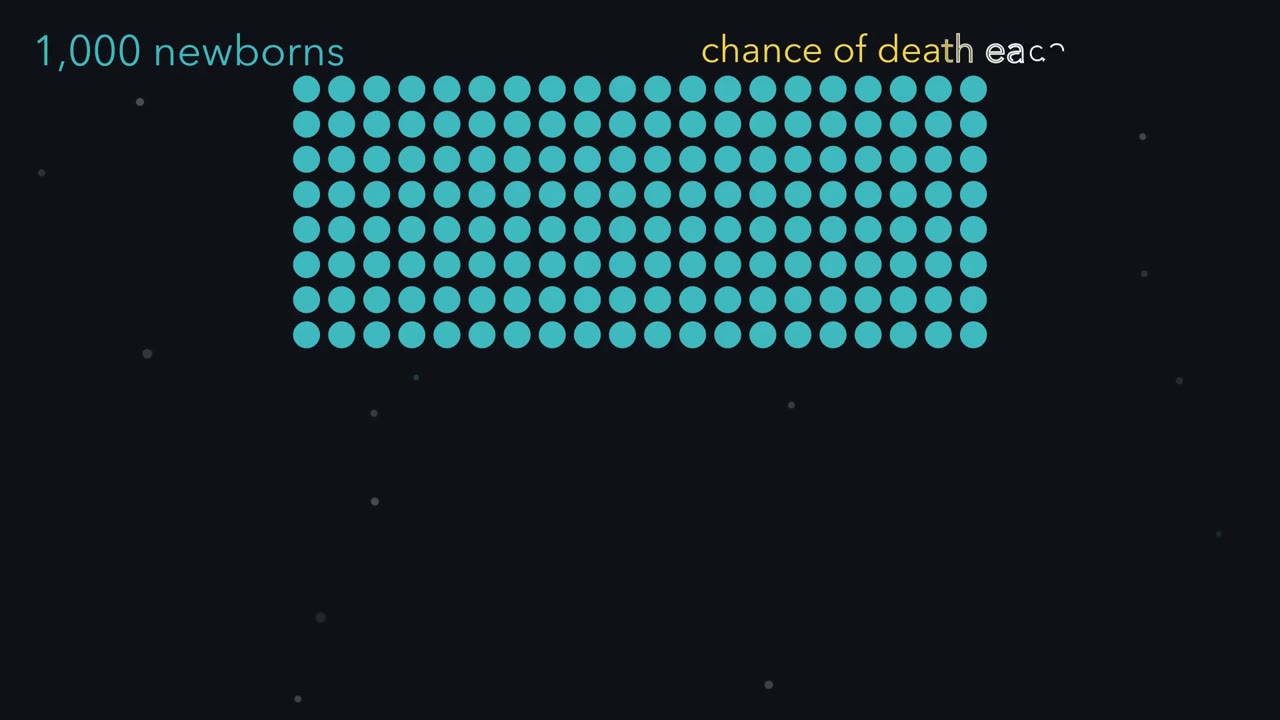
Here are a hundred newborn females, all born in the same season. Only ten of them will live to age three. Can this group still more than replace itself? A group born together is called a cohort. Follow it year by year, and at each age count how many are still alive. Those that die fade to grey. Divide each count by the starting hundred. That fraction is l_x, the share of the cohort still alive at age x. Here it falls from 1 to 0.1. Survivors also give birth.
Life tables like this usually count females only, so the births we count are daughters. At each age, m_x is the average number of daughters born per living female. Here the averages are 0 in the first year, then 1, 2, and 1. Now the key step. A newborn female may not live to a given age. So her daughters there count only as far as survival allows. Multiply the share still alive by the daughters each one has. That is what an average newborn female can expect at that age. Add those pieces across her whole life. The total is R0, the daughters left by an average newborn female. Here it comes to 1.7. The dashed line marks one. At one, each female just replaces herself.
Above it, each generation is larger than the last. Below it, each is smaller. So yes, this cohort more than replaces itself. Now give the cohort a hard first winter. Only half as many females reach age one. What happens to R0?
Keep every later survival chance and birth rate the same. Every female alive at two or three first had to survive that winter. So the share alive halves at every later age, not just at age one. Every piece of R0 halves, so R0 halves too, to below the line. Survival to any age is the product of every year before it. So a loss early in life cuts every later birth. Two cautions. R0 is counted per generation, not per year. A yearly rate also needs the length of a generation. And R0 predicts long-run growth only if the rates stay fixed, and nobody arrives or leaves.
Only 10 of 100 newborn females live to age 3. Can the cohort still more than replace itself?
Continue in the lesson: Demography and Survivorship →
2:55 · Free, with captions and a transcript. The lesson has the full text, the questions and the sources.
More films from this lesson
How this film was made. Narration: written from this lesson's text and read by an AI narrator voice (Kokoro, af_heart). Animation: AI-generated in code (Manim) by Claude, a schematic with no drawn molecular structures. Captions come from the narration script. See something wrong? Report it.