Films · Genetics and Molecular Biology
From a Programmed Cut to a Tested Knockout
Read the transcript of “From a Programmed Cut to a Tested Knockout”
Film transcript: From a Programmed Cut to a Tested Knockout
The first film showed that what you choose first sets what genetics can find. If Cas9 cuts the chosen gene, have you made a knockout? A blue guide carries gold Cas9 to a matching purple gene region. A nearby orange PAM licenses binding and cleavage. Without a PAM beside it, a fully matching site is effectively ignored. With it, the complex makes a double-strand break at the chosen site. The cut is only a handoff. One repair route rejoins ends without a supplied template. It may restore the sequence or leave an insertion or deletion. Another route copies a supplied template. One programmed site can therefore produce several repaired alleles. Their frequencies depend on local sequence and cell context.
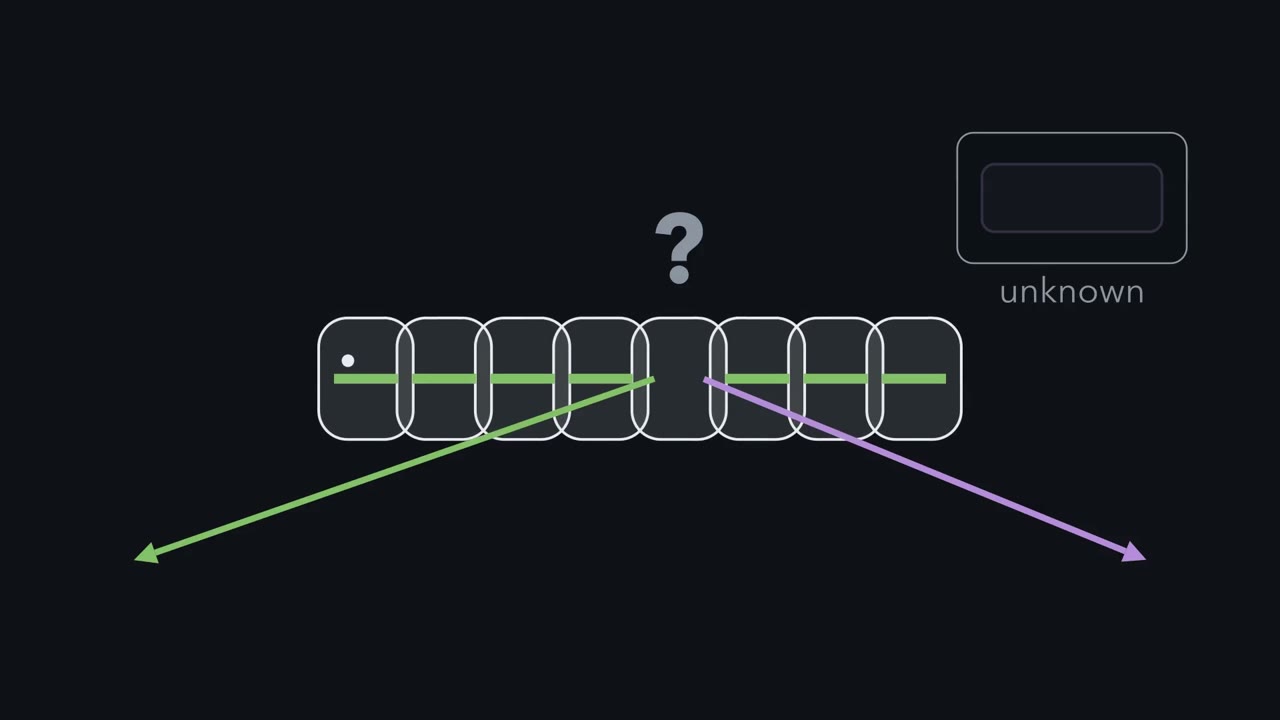
Follow an allele card through each checkpoint. Targeting means Cas9 reached the intended site. A cut means DNA broke. An edited allele carries a sequence change after repair. A functional knockout has lost gene function. These states require different evidence. Now the dish contains several repaired allele cards. Some are unchanged, some shortened, and some lengthened. Must every cell in this dish have lost gene function? Look closely before you decide.
No. Cells can carry different pairs of alleles, because a diploid cell carries a pair. Some pairs contain an unchanged or in-frame allele. Others carry frameshifts in both copies. The dish is a mixed population, and an allele count is not a cell count.
Even frameshifts in both copies are still sequence predictions. A frameshift always shifts the reading frame downstream of the indel. Whether the protein's function is gone needs its own measurement. An in-frame change can retain partial function. Genotype narrows the claim; it does not finish it. Derive single-cell clones and identify both alleles separately. Look beyond a short amplicon when large changes could be missed. Measure the gene product or activity. Then ask whether the phenotype follows the genotype. Each step moves the claim forward. Use independent guides that alter the same gene at different sites. If they reproduce the phenotype, a guide-specific effect becomes less likely.
Restore the gene in a way that resists the perturbation. If the phenotype reverses, the causal link becomes stronger. Still, no single control proves everything. Return to the pipeline. Cas9 can program a cut, but repair determines the allele. Sequencing can identify that allele, but function needs a phenotype or molecular readout. When genotype and phenotype agree across independent tests, the claim earns support.
How do you find what a gene does: start from a trait and hunt for the gene, or start from a gene you name and see whether the cell cares?
Continue in the lesson: Forward and Reverse Genetics: Screens, RNAi and CRISPR →
3:36 · Free, with captions and a transcript. The lesson has the full text, the questions and the sources.
More films from this lesson
How this film was made. Narration: an AI narrator voice (Kokoro, af_heart) reading narration written from this lesson's text. Animation: AI-generated in code (Manim) by Claude, a schematic with no drawn molecular structures. Captions come from the narration script. See something wrong? Report it.