Films · Genetics and Molecular Biology
Heritability Is About Variation
Read the transcript of “Heritability Is About Variation”
Film transcript: Heritability Is About Variation
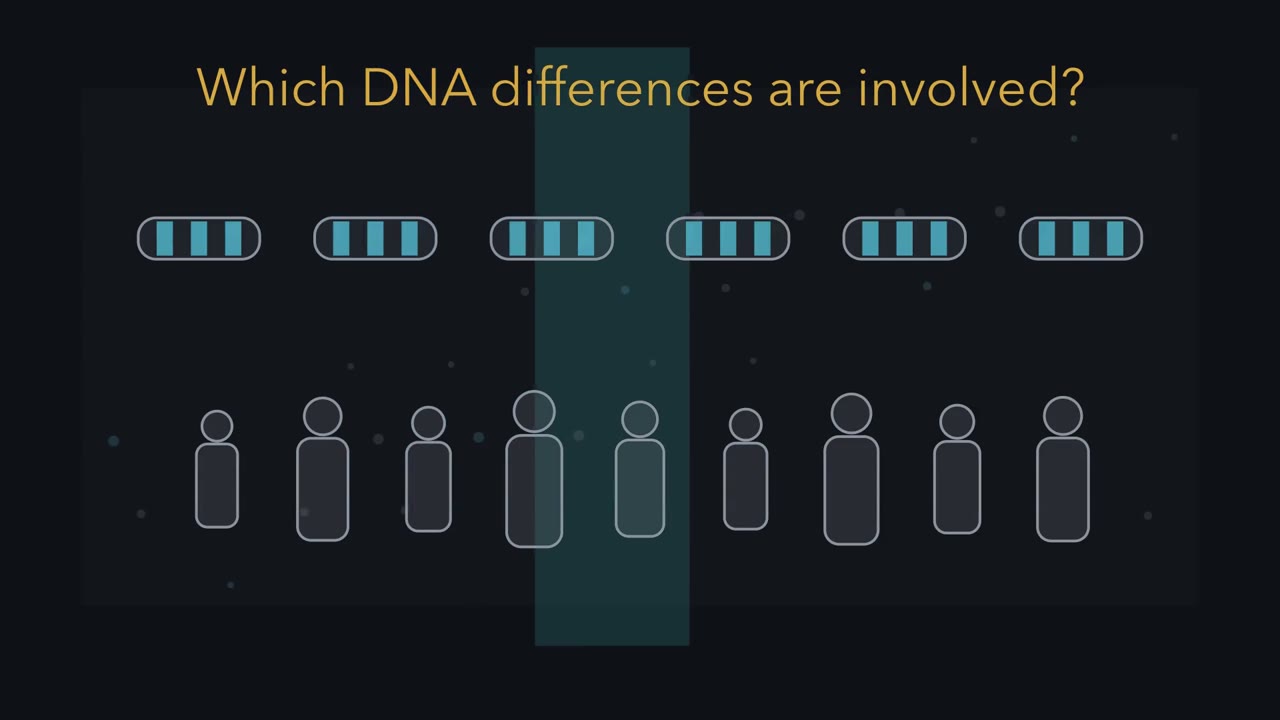
If height is highly heritable, does that tell you how much of your own height came from genes? No. Heritability describes differences across a population, so our picture begins with many people. Each person inherits many alleles by Mendel's rules. Give each small-effect allele a blue tile, then stack the tiles beneath each person. Few people collect only low or high stacks. Most gather combinations near the middle. With more loci, the classes multiply and sit closer together, although every allele remains discrete. Now let environmental differences nudge each person left or right. The separate allele-count columns blur into a continuous, bell-shaped distribution.
This curve is computed from many small additive effects, then widened by simulated environmental variation. The picture is a model, not a claim that every effect is equal. Variance measures spread around the population mean. We can partition that spread into additive, dominance, interaction, and environmental components. The additive part comes from average allele effects and helps predict resemblance between parents and offspring. The components add cleanly only under the model's stated assumptions. Narrow-sense heritability divides additive variance by total phenotypic variance.
Broad-sense heritability divides all genetic variance by the same total. These ratios have no units, and both belong to the population being measured. Changing the environment can alter the denominator even when allele frequencies stay the same. Keep every genetic tile exactly where it is. Now make the environmental nudges more varied. Will heritability rise, fall, or stay the same?
The total spread grows while the genetic variance stays the same, so heritability falls. Reverse the change, and heritability rises without any DNA changing. A ratio changes when one part changes and the other does not. That is why heritability cannot divide one person's height into genetic and environmental percentages. One person has a phenotype, but no population variance. High heritability also does not mean the trait cannot change. The same limit applies between groups. A large genetic share within each group does not explain a difference between their averages. Different environments can shift whole distributions while genetic differences still explain variation within each one.
Twin studies estimate variance components by comparing pair similarities. Under their assumptions, the extra similarity of identical twins over fraternal twins reflects half the additive share. Doubling that gap estimates the additive share. The estimate still describes that sampled population and environment. Many small Mendelian effects can create smooth variation, but heritability asks only how that variation is partitioned. Keep the scope attached to every estimate.
If height is 80 percent heritable, does that mean 80 percent of your height came from your genes?
Continue in the lesson: Complex Traits, Heritability and GWAS →
3:48 · Free, with captions and a transcript. The lesson has the full text, the questions and the sources.
More films from this lesson
How this film was made. Narration: written from this lesson's text and read by an AI narrator voice (Kokoro, af_heart). Animation: AI-generated in code (Manim) by Claude, a schematic with no drawn molecular structures. Captions come from the narration script. See something wrong? Report it.