What Did the Light Change?
Read the transcript of “What Did the Light Change?”
Film transcript: What Did the Light Change?
A mouse has no opsin, yet light changes its firing and turning. What did the light change? In wild-type mice, continuous striatal light suppressed firing and biased turning. Illumination had changed tissue without a light-sensitive construct. A light-on comparison therefore changes at least two things: the intended neural activity and the light itself. A recording can show that activity and behaviour vary together. A manipulation asks a different question.
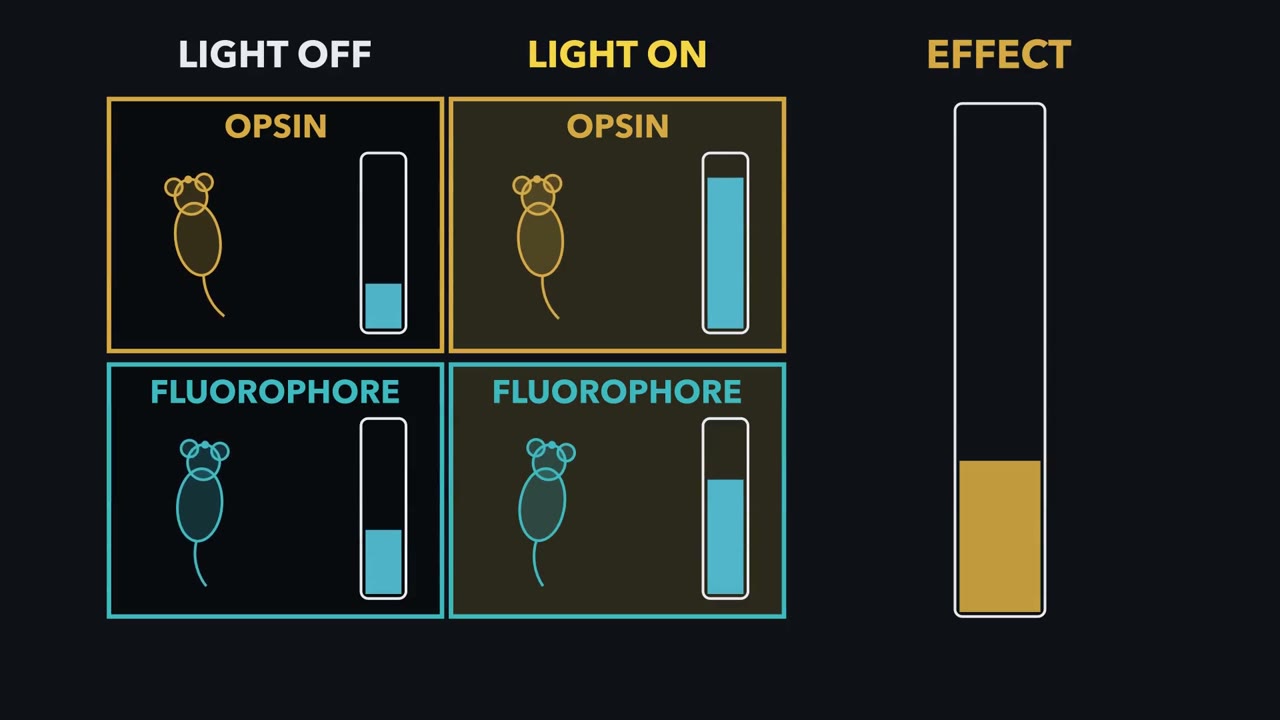
Driving chosen cells tests whether their activity is sufficient for the measured change. Suppressing them tests whether it is necessary. Each answer belongs only to the tested conditions. To separate the two causes, cross construct with light. Put opsin and fluorophore-only animals in two rows. Put light off and light on in two columns. Now every effect of illumination has a matched place to appear. You have compared light on with light off only in opsin animals. Which missing comparison would reveal whether light itself moved the behaviour?
Give fluorophore-only animals the same light. First measure the light effect in each row. Then compare those two effects. The shared light effect cancels. The remainder is the extra light-linked effect associated with carrying the opsin. Read the board as two differences, not four separate boxes.
Measure the light effect in opsin animals. Measure it again in fluorophore animals. Subtract the second effect from the first. This difference of differences identifies the opsin-linked remainder. That remainder is not a license to say the circuit controls the behaviour. Name the cells, the projection, the time window and the assay.
Activation tests sufficiency. Silencing tests necessity. Neither says these cells are the only route. A light spot does not name a pathway by itself. Terminal illumination can also excite labelled axons that only pass through the field. It can drive activity back toward the parent cell bodies. A local receptor block tests whether transmitter action there is required for the measured behavioural effect. Finally, verify what the manipulation actually did.
Record during and after the light. Confirm expression and fibre placement. Randomize allocation and blind the scoring. Only when the manipulation and its controls work can the matched contrast identify the effect. A claim can be no broader than that contrast.
Light alone changed firing and turning behaviour in mice with no opsin at all. What does your light-on versus light-off comparison actually show?
Continue in the lesson: Designing a Causal Circuit Experiment →
3:18 · Free, with captions and a transcript. The lesson has the full text, the questions and the sources.
More films from this lesson
How this film was made. Narration: written from this lesson's text and read by an AI narrator voice (Kokoro, af_heart). Animation: AI-generated in code (Manim) by Claude, a schematic with no drawn molecular structures. Captions come from the narration script. See something wrong? Report it.