The Size Test
Read the transcript of “The Size Test”
Film transcript: The Size Test
This drop of pond water looks empty. Is it? And if tiny living things swim in it, why can't your eyes see them? To answer, we need one test of size. Start with a metric ruler. Its smallest marks are one millimetre apart. Now split one millimetre into a thousand equal parts. Each tiny part is one micrometre (µm). Your eyes have a limit. Most people cannot make out anything smaller than about 100 µm, a tenth of a millimetre. We will draw that limit as a blue line, the eye line. Now build a size ladder. Each rung is ten times bigger than the rung below it. We place real cells on the ladder at their real sizes. A frog egg is one cell, often about a millimetre across.
It sits above the eye line, so you can see it. A human egg, about one hundred micrometres, sits right on the line. A green alga, a red blood cell and a bacterium all sit below it. Most cells are somewhere between about one and one hundred micrometres. That puts most of them below the eye line, too small to see without help. A microscope uses lenses to make small things look larger. Magnification is how many times larger the picture looks than the real thing. So the picture looks as big as the real size times the magnification. Turn the dial up, and every picture slides up the ladder together. The cells do not change. Only their pictures grow.
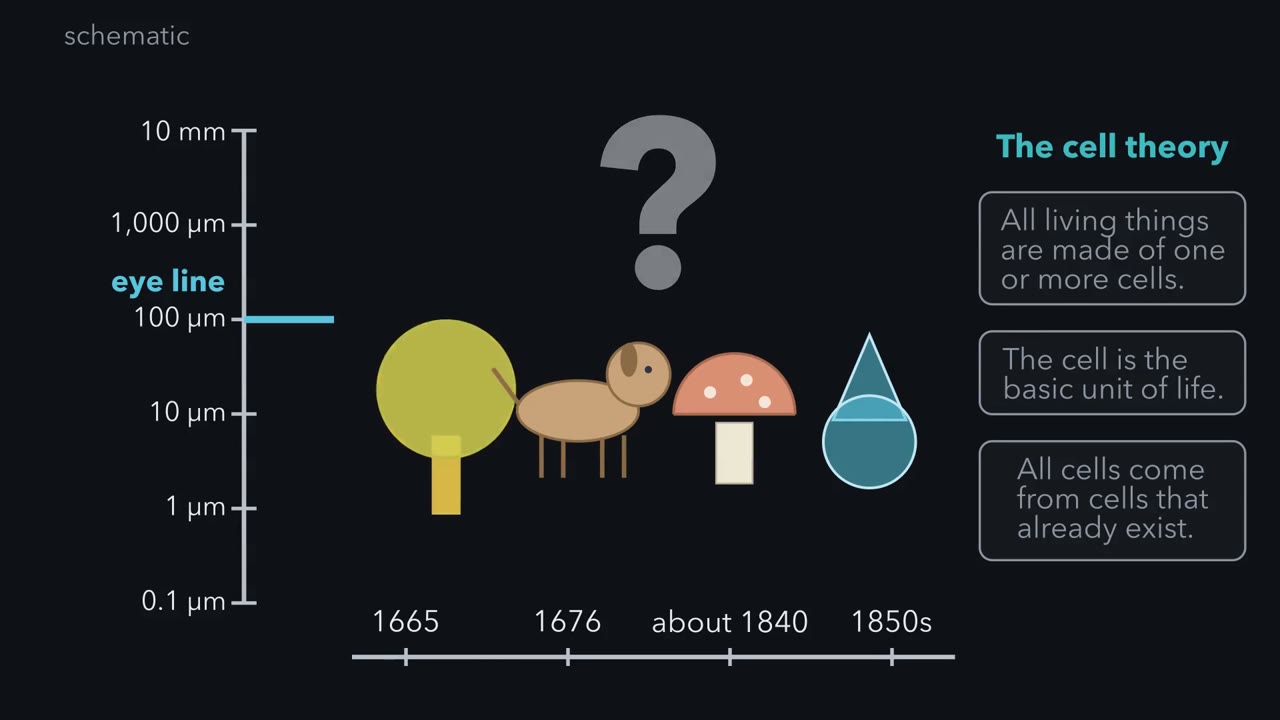
Watch the red blood cell. At 40x, its picture is already over 300 µm. It has crossed the eye line. Now the green alga, about 20 µm wide. Set the dial to just 10x. Will its picture cross the eye line? Yes. Its picture is 200 µm, twice the eye line. The red blood cell, at the same 10x, still sits below the line. A school microscope magnifies 40, 100 or 400 times. At 400x, most cells pass the eye line. Then you can see their shapes, if the lens shows them clearly and they stand out. So a clear drop is not always empty. Most living things in pond water sit below the eye line, where our eyes cannot reach. That is why most cells stayed hidden until microscopes were made.
How can a drop of pond water look empty to your eyes and still be full of living things, all made of cells?
Continue in the lesson: Cells Are Everywhere →
3:03 · Free, with captions and a transcript. The lesson has the full text, the questions and the sources.
More films from this lesson
How this film was made. Narration: written from this lesson's text and read by an AI narrator voice (Kokoro, af_heart). Animation: AI-generated in code (Manim) by Claude, a schematic with no drawn molecular structures. Captions come from the narration script. See something wrong? Report it.