Where Do New Cells Come From?
Read the transcript of “Where Do New Cells Come From?”
Film transcript: Where Do New Cells Come From?
Idea three says every cell comes from a cell. The first scientists to argue for cells everywhere did not think so. So where did they think new cells came from? By the 1830s, improved microscopes were in use. The argument was not only about seeing. In 1838, Matthias Schleiden described plant tissues as made of cells. In 1839, Theodor Schwann compared plant and animal tissues, such as tadpole cartilage. He found the same cellular plan. Comparison was the key step. Many kinds of tissue, plant and animal, showed one shared plan. That was evidence that plants and animals alike are built of cells. But Schleiden and Schwann also thought new cells could form inside a structureless fluid. Picture a crystal growing in a solution.
No cell divides to make it. Schleiden proposed this for plants. Schwann extended it to animals. So there were two models. In the fluid model, a new cell forms inside a structureless fluid, and no cell divides. In the division model, one existing cell splits into two. Suppose you could watch a growing tissue for a while. What would each model lead you to expect to find?
The fluid model predicts new cells taking shape out of fluid, with no cell dividing. The division model predicts a series of stages. One cell pinches in two, then its daughters split again. Watching over time can tell the two models apart. In 1852, Robert Remak published evidence that new cells form when existing cells divide. In 1855, Rudolf Virchow spread the idea widely in a short article. Every cell comes from a cell. Remak's evidence came first; Virchow made it widely known. The fluid idea was wrong, so it was dropped. The core stayed: plants and animals are made of cells. A corrected idea took the fluid idea's place: cells come from existing cells.
That is how a scientific theory works. It is a well-tested explanation, tied to many lines of evidence. When strong new evidence appears, it can be revised. Being revised does not make it a guess. One limit on the rule. Every cell comes from a cell is about cells living today. How the very first cells arose is a separate question that scientists still study.
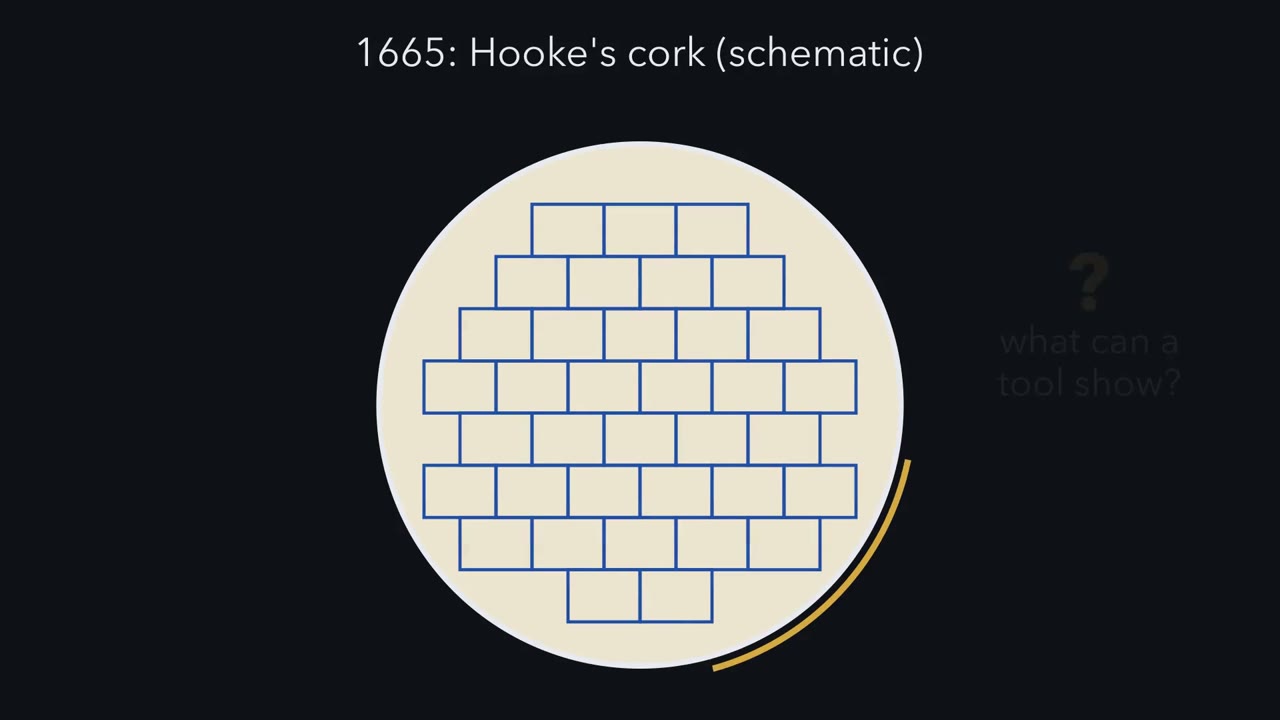
Robert Hooke saw tiny boxes in a slice of cork in 1665, so why did it take about 175 more years to claim that plants and animals alike are made of cells?
Continue in the lesson: The Cell Theory and Its Evidence →
3:05 · Free, with captions and a transcript. The lesson has the full text, the questions and the sources.
More films from this lesson
How this film was made. Narration: an AI narrator voice (Kokoro, af_heart) reading narration written from this lesson's text. Animation: AI-generated in code (Manim) by Claude, a schematic with no drawn molecular structures. Captions come from the narration script. See something wrong? Report it.