A Field Is a Sum
Read the transcript of “A Field Is a Sum”
Film transcript: A Field Is a Sum
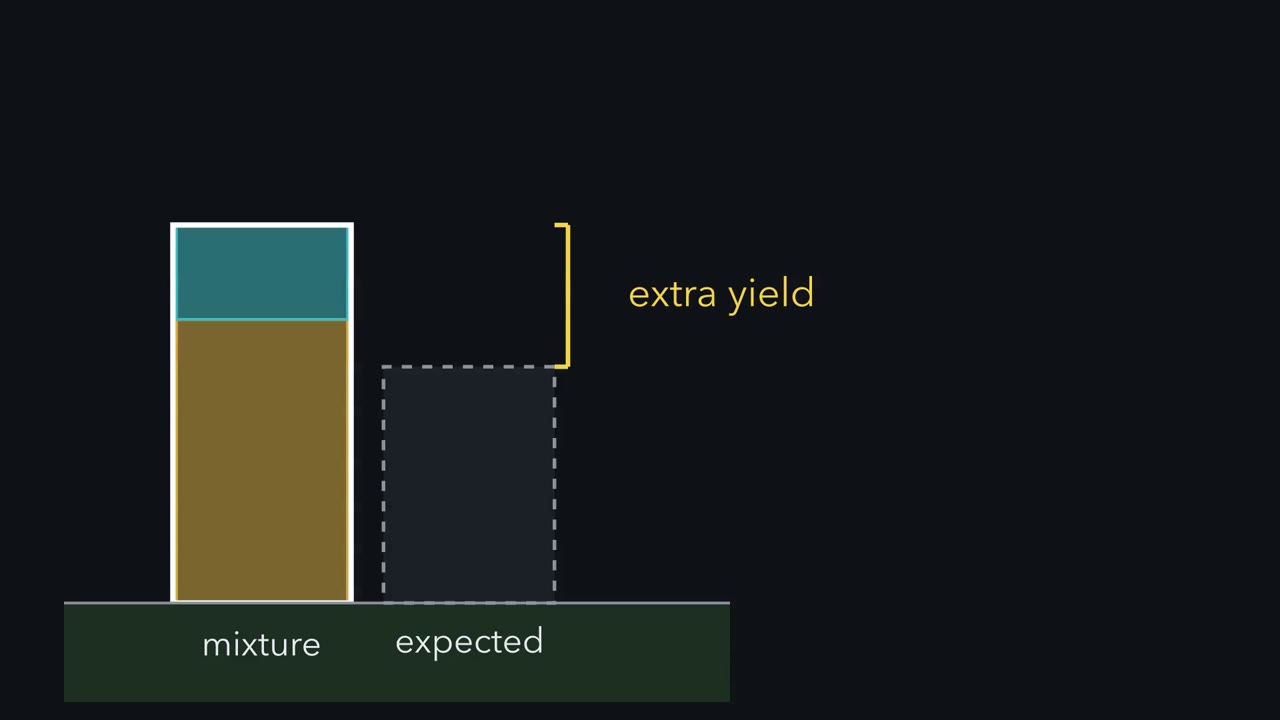
Sow sixteen plant species in a field instead of one. Why would that field grow more? And why would its total change less from year to year? Start with one plain fact. A plot's production is the sum of what each of its species produces. Every year, ecologists clip the plants, dry them and weigh them. Grow species A alone, shown in gold. It makes a tall pile of biomass. Grow species B alone, in teal. It makes a short pile. Now sow them half and half. If mixing neither helped nor hurt, each species would make half of its yield alone. That gives the dashed bar, the expected yield. But the real mixture grows taller than the dashed bar. That gap is the extra yield.
With an even sowing, the benchmark is the average monoculture, not the best one. Here the mixture only matches species A grown alone. Where could the extra come from? Perhaps the species use soil and light differently, or help each other. That is complementarity. Or a richer draw is more likely to include a species that yields highly alone. If such high-yielding species also gain the most relative to their yield alone, that is selection. Both can act at once. In a surveyed meadow, a wet patch can raise both species number and biomass. To separate richness from soil cleanly, ecologists sow richness at random. Now let the years pass. Grown alone, one species bounces up and down from year to year.
For its size, its total swings a lot. Stack four species, each swinging by that same amount, independently of the others. Their swings do not depend on each other. The dark outline traces their total. Here is the question. Each species swings by the same amount. Will the total swing four times as much as a single species does?
No. The total swings only about twice as much, while its mean is four times larger. Good and bad years partly cancel in the sum. This is statistical averaging. But cancelling needs the species to swing out of step. If all four rose and fell together, nothing would cancel. The total would be no steadier than one species. So a field is a sum. Its extra is judged against what its monocultures predict. When species swing out of step, their swings partly cancel, and that can steady the sum.
Grassland plots sown with sixteen species generally out-grew plots with one, yet the species inside them were, on average, less steady from year to year. How can the total be steadier than its parts?
Continue in the lesson: Biodiversity and Ecosystem Function →
3:09 · Free, with captions and a transcript. The lesson has the full text, the questions and the sources.
More films from this lesson
How this film was made. Narration: written from this lesson's text and read by an AI narrator voice (Kokoro, af_heart). Animation: AI-generated in code (Manim) by Claude, a schematic with no drawn molecular structures. Captions come from the narration script. See something wrong? Report it.