Antibody Outside, Zeta Tail Inside
Read the transcript of “Antibody Outside, Zeta Tail Inside”
Film transcript: Antibody Outside, Zeta Tail Inside
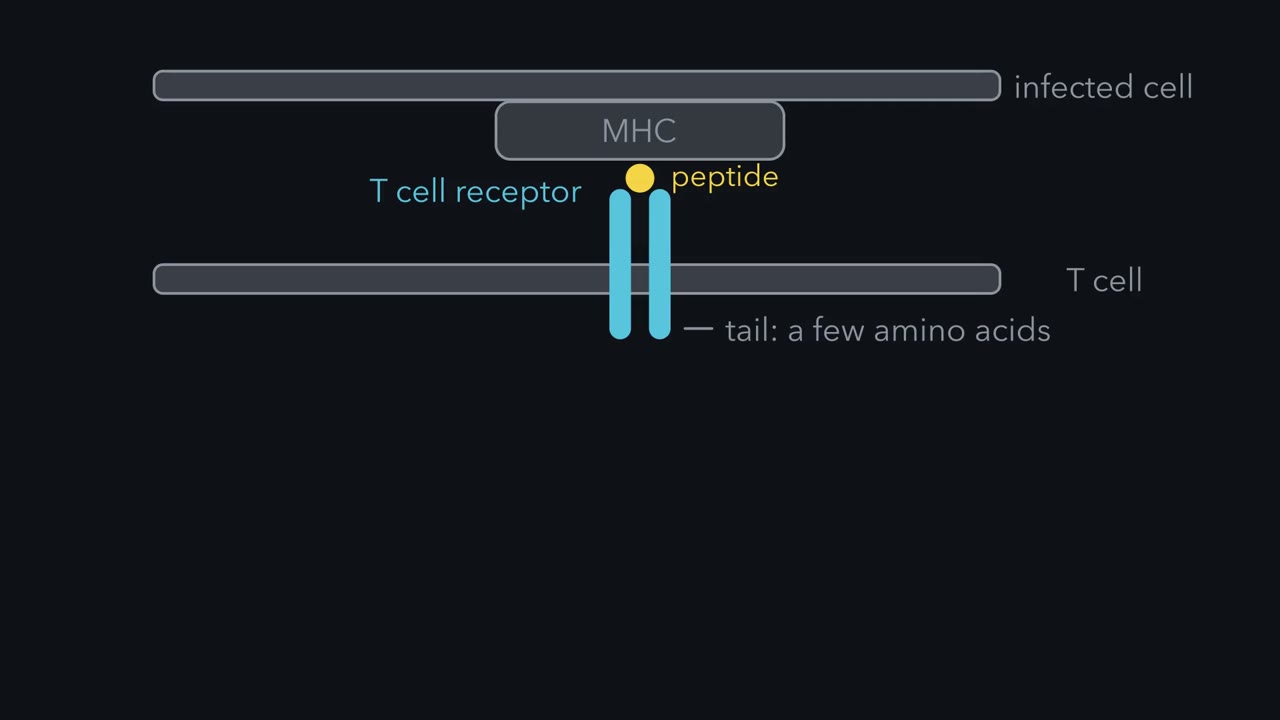
The T cell receptor reads a short peptide held in the groove of an MHC protein. Blocking a brake helps only if the patient already has T cells that recognise the tumour. The other approach gives T cells a new receptor. Can you build one from parts? In 1989, Gideon Gross, Tova Waks and Zelig Eshhar joined the variable regions of an antibody to the constant regions of T cell receptor chains. T cells carrying the hybrid responded to the antibody's target. Yoshihisa Kuwana and colleagues had published the same kind of construct in 1987. The receptor's own tips read a peptide held on an MHC protein. An antibody is different. It grips a whole folded protein directly.
So such a receptor needs no peptide and no MHC protein. Later designs, from Eshhar's laboratory and others, were single chains. They put an antibody fragment outside the cell and the zeta tail inside. This is a chimeric antigen receptor, or CAR. Remember the plan: antibody outside, zeta tail inside.
The T-cell receptor has no enzyme and almost no tail. How does it tell the cell to kill?
Continue in the lesson: Antigen Receptors and Checkpoints →
1:30 · Free, with captions and a transcript. The lesson has the full text, the questions and the sources.
More films from this lesson
How this film was made. Narration: an AI narrator voice (ElevenLabs, Sarah) reading narration written from this lesson's text. Animation: AI-generated in code (Manim) by Claude, a schematic with no drawn molecular structures. Captions come from the narration script. See something wrong? Report it.