A Loop That Keeps Time
Read the transcript of “A Loop That Keeps Time”
Film transcript: A Loop That Keeps Time
A man's testes keep making sperm through adult life. A woman's ovaries usually release one egg per cycle. What keeps the gonads on schedule? The control sits at three levels, stacked top to bottom. The hypothalamus is at the base of the brain. The pituitary gland hangs just below it. Then come the gonads, the testes or ovaries. Neurons in the hypothalamus release a hormone called GnRH, gonadotropin-releasing hormone. Portal vessels carry it down to the pituitary. And it arrives in pulses, not a steady stream. The pituitary answers with two hormones of its own, LH and FSH. They travel in the blood to the gonads. Because they act on gonads, they are called gonadotropins.
Follow them into a testis. LH reaches Leydig cells, which sit between the sperm-making tubules. They make testosterone. FSH reaches Sertoli cells, which line the tubules and support the developing sperm. Now the loop closes. Testosterone travels back up and lowers the output of the hypothalamus and the pituitary. When a product turns down its own pathway, that is negative feedback. Think of it as a brake. With the brake on, LH and FSH fall. When testosterone drops, the brake eases, and LH and FSH climb back up. So here is a test of the loop.
Remove the testes. What happens to LH and FSH in the blood? Do they go up, or down? Both go up. With the testes gone, their testosterone is gone, so the main brake is off. The pituitary keeps driving, and LH and FSH climb. FSH has a second brake of its own. Sertoli cells release a hormone called inhibin B, which lowers FSH. Remove the testes, and that brake goes too. The ovary runs on the same loop. There the brake comes from the follicle, the sac of cells around a growing egg. Its hormone, estradiol, brakes the loop through most of the cycle's first half. But when estradiol stays high for long enough, the brake becomes an accelerator. After ovulation, progesterone brakes instead.
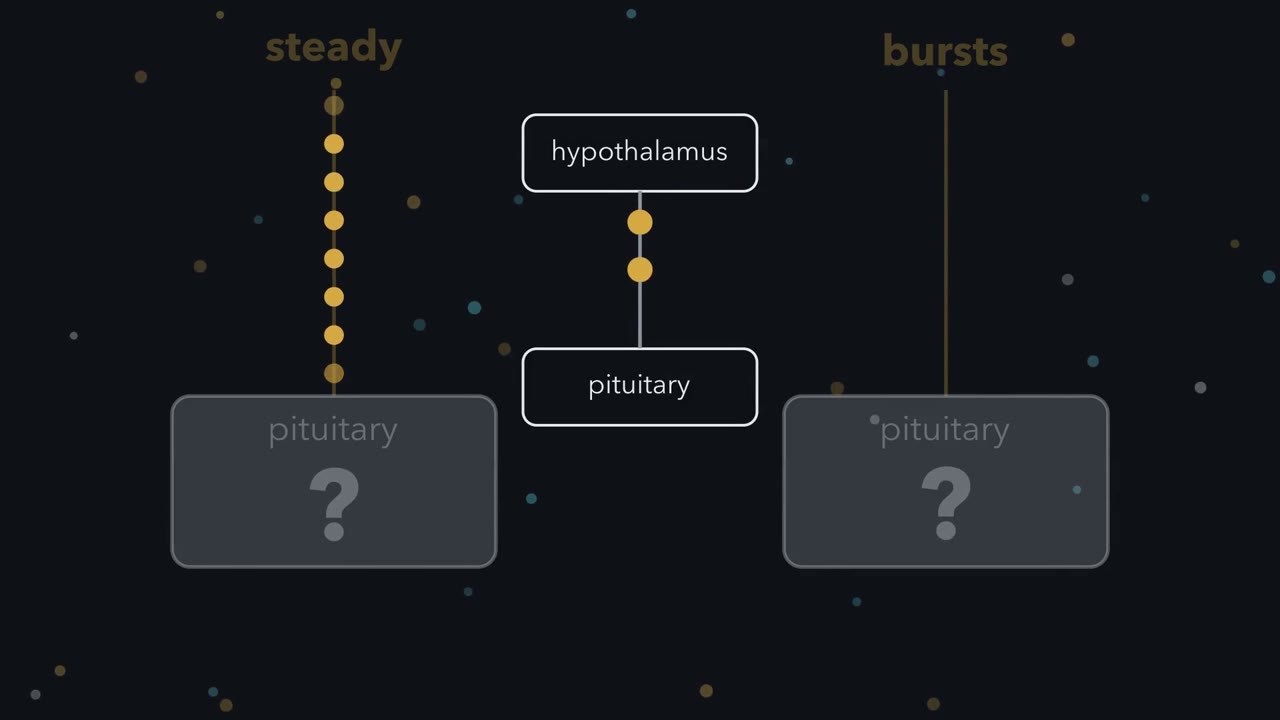
The lesson shows how. One thing is still odd. GnRH reaches the pituitary in bursts, not a stream. Is the burst just how it travels, or is it the message? So the brain drives the gonads in pulses, through the pituitary. And the gonads' hormones come back up as a brake, almost all the time.
A monkey's pituitary, cut off from the brain's drive, was given its missing hormone either as a steady drip or once an hour, the drip giving at least as much. Only one schedule kept it working. Why would timing matter?
Continue in the lesson: Animal Reproduction →
3:21 · Free, with captions and a transcript. The lesson has the full text, the questions and the sources.
More films from this lesson
How this film was made. Narration: written from this lesson's text and read by an AI narrator voice (Kokoro, af_heart). Animation: AI-generated in code (Manim) by Claude, a schematic with no drawn molecular structures. Captions come from the narration script. See something wrong? Report it.