How a Scaffold Keeps Signals on Route
Read the transcript of “How a Scaffold Keeps Signals on Route”
Film transcript: How a Scaffold Keeps Signals on Route
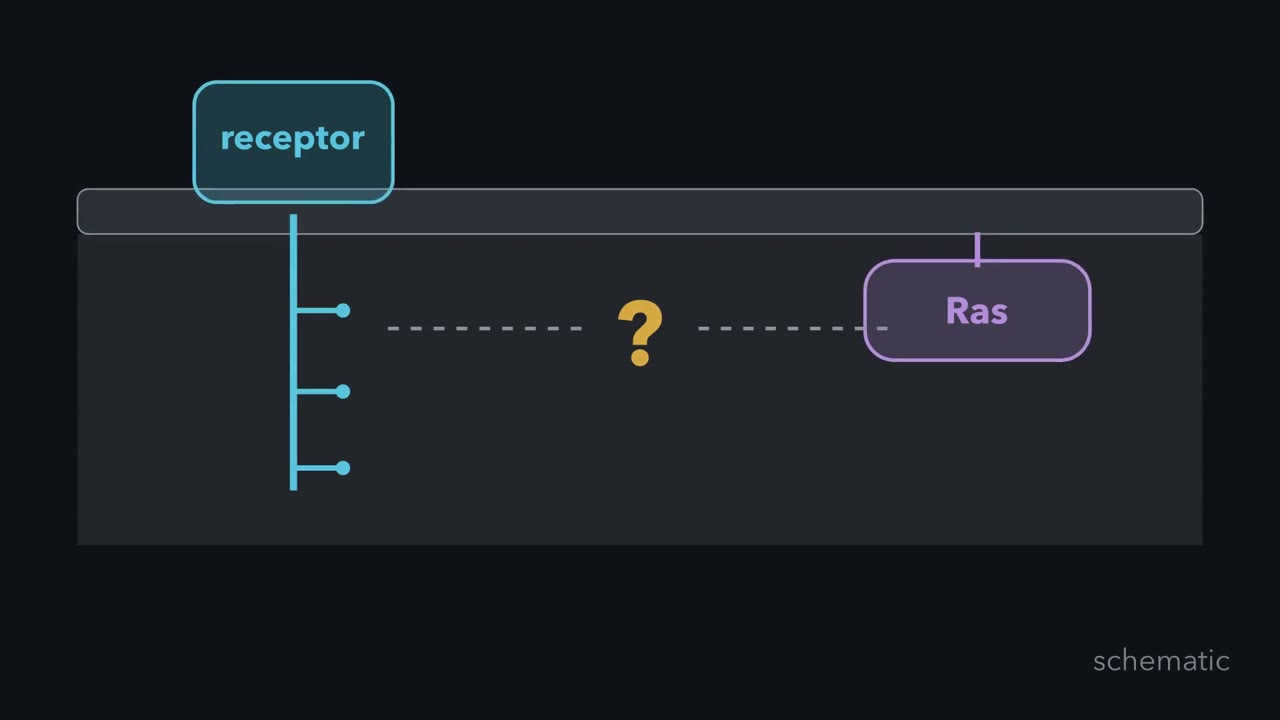
The first film used Grb2 to route a receptor signal toward Ras. But what if two pathways share the same kinase? Follow the same colors as one orange kinase faces two possible purple outputs. Yeast mating uses a kinase route ending in Fus3. Some upstream kinases also serve other responses. A pheromone input must reach the mating output without making the cell follow every route that shares a part. A shared kinase does not carry a label saying which response should follow. Its meaning depends on the partners around it. The cell therefore needs an organizer that assembles the mating route under the mating input. Ste5 is a green scaffold with no enzyme activity.
Different regions bind Ste11, Ste7 and Fus3, so one Ste5 can hold all three. This assembly can make productive encounters more likely. Within the assembled route, Ste11 activates Ste7, and Ste7 activates Fus3. Fus3 helps prepare the cell for mating. The scaffold does not perform those kinase reactions. It organizes the proteins that do. Proximity is only the first model. Ste5 responds to pheromone-linked recruitment at the membrane. Its shape opens there. A Ste5 domain also helps Ste7 activate Fus3, which is otherwise a poor substrate. The scaffold therefore helps select an output. It controls partners, place and activation, rather than locking every shared kinase away. The same shared parts can behave differently inside a different organized context.
The filament-growth route uses Ste11 and Ste7 but ends at Kss1. One salt-stress branch uses Ste11, then a different middle kinase, and ends at Hog1. Only the mating route has Ste5, so only the mating route switches on Fus3. Suppose the cell keeps adding empty Ste5 scaffolds. Must the number of complete kinase assemblies keep rising? Watch where each kinase might land, then make your prediction.
No. In the simplest model, all three kinases must share one scaffold to signal. With scaffold in excess, they spread across different scaffold molecules. Fewer scaffolds are complete, so predicted output falls. This model effect is called combinatorial inhibition. Experiments support both layers. Ste5 binds the mating kinases on different regions. Later work showed that a Ste5 domain makes Fus3 easier for Ste7 to activate. Assembly and selective activation work together. Return to the fork. A shared kinase does not choose an output alone. The organizer around it changes which partners meet, where the complex forms and whether the last step can proceed.
A receptor activates Ras without ever touching it. How does the message cross the gap?
Continue in the lesson: Adaptors, Docking Proteins and Scaffolds →
3:37 · Free, with captions and a transcript. The lesson has the full text, the questions and the sources.
More films from this lesson
How this film was made. Narration: an AI narrator voice (Kokoro, af_heart) reading narration written from this lesson's text. Animation: AI-generated in code (Manim) by Claude, a schematic with no drawn molecular structures. Captions come from the narration script. See something wrong? Report it.