Press play to start at .
The Loop and the Brake
From the film
- A bile acid pool of about 3.5 g goes round about five times a day, delivering about 17.5 g a day to the gut.
- Only 200 to 400 mg a day is lost in stool, and at steady state the liver makes only that much.
- ASBT takes bile acids back in the terminal ileum, NTCP carries most uptake into liver cells and BSEP pumps them into bile.
- Ileal uptake switches on FXR, which induces FGF19, and FGF19 lowers CYP7A1 in the liver.
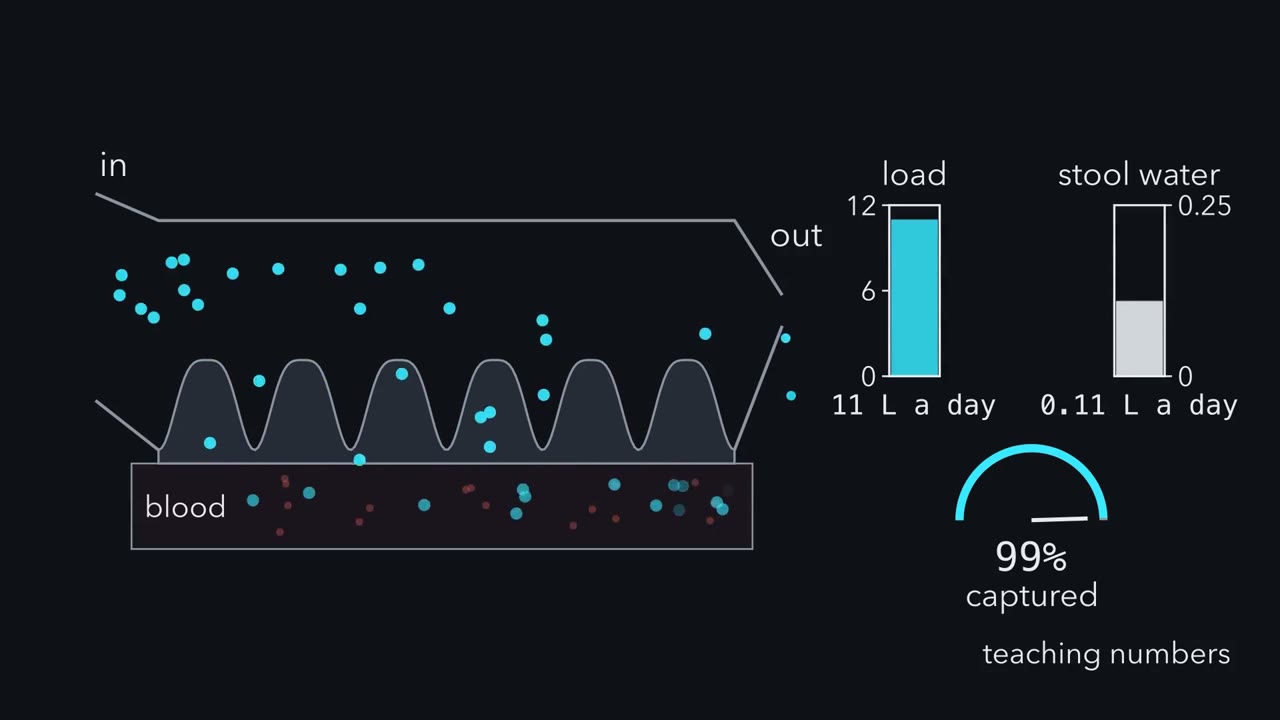
- If capture fell to 90 percent, loss would be about 1.75 g a day, about six times a mid-range loss, and synthesis would have to rise to match.
Read the transcript of “The Loop and the Brake”
Film transcript: The Loop and the Brake
Tap a sentence to play from there.
- 0:00 A few grams of bile acid help absorb the fat in every meal.
- 0:06 How can so little go so far?
- 0:08 For water, what left the gut was whatever was not taken back.
- 0:13 Bile acids follow the same rule, round a loop.
- 0:19 The liver makes them from cholesterol.
- 0:23 Between meals they wait in the gallbladder.
- 0:26 After a meal they pour into the gut and form micelles, tiny carriers for fat.
- 0:32 From the end of the small intestine, portal blood carries them back to the liver.
- 0:37 Four names mark the stations.
- 0:41 CYP7A1 sets the pace of the classic pathway that makes them.
- 0:46 ASBT takes them back in the terminal ileum.
- 0:51 NTCP carries most uptake into liver cells.
- 0:55 BSEP is the main pump back into bile.
- 0:59 The pool is about 3.5 grams, sent round about 5 times a day.
- 1:05 That delivers about 17.5 grams to the gut each day.
- 1:10 Only 200 to 400 milligrams a day escape in stool.
- 1:14 At steady state, the liver makes only what escapes, a few hundred milligrams a day.
- 1:21 The rest of each day's delivery is recycled, not made.
- 1:25 Here is the one idea.
- 1:28 A recycling loop needs new supply only for its residue.
- 1:33 Capture, mostly in the ileum, sets that residue, and so sets how much the liver must make.
- 1:39 Now let capture slip to 90 percent a cycle.
- 1:44 Delivery stays 17.5 grams a day.
- 1:47 How much must the liver now make to keep up?
- 1:55 Ten percent of 17.5 grams is 1.75 grams a day.
- 2:01 That is about six times a mid-range loss.
- 2:05 A modest slip in capture, once again, multiplies the residue.
- 2:10 How does the liver know?
- 2:13 Bile acids taken up in the ileum switch on a nuclear receptor, FXR.
- 2:19 It induces a signal, FGF19, which reaches the liver and lowers CYP7A1.
- 2:26 So when ileal recovery falls, less FGF19 arrives, the brake lifts, and synthesis rises. If it rises enough, the pool holds.
- 2:37 If not, the pool settles smaller, where loss equals synthesis.
- 2:42 So the liver is not the store.
- 2:45 It only tops up what slips past the gut.
- 2:48 The gut's own uptake sets the brake on that synthesis.
Bile acid recycling: the same idea, other levels
A level is a place to start, not a rank. If this loses you, the rung below teaches the same idea, told more simply.
College, upper level · the level you chose
Absorption, the Liver and Enterohepatic Circulation · this lesson
A 3.5 g bile acid pool cycles five times a day, losing little.
Physiology · about 28 min · 4 practice questions
Next door
- Cholesterol: The cholesterol gauge · 3:15 Bile acids are made from cholesterol, so recycling them or losing them changes how much cholesterol the liver must make.
- Lipids and fatty acids: Shape is destiny · 2:27 Bile acids break fat into tiny droplets, so the gut enzymes can reach it and absorb it.
- Digestion and absorption: The master switch of digestion · 2:48 Bile acids are one tool the gut uses to cut food into pieces small enough to absorb.
More films from this lesson
Continue in the lesson: Absorption, the Liver and Enterohepatic Circulation →
Free, with captions and a transcript. The lesson has the full text, the questions and the sources.
How this film was made. Narration: an AI narrator voice (Kokoro, af_heart) reading narration written from this lesson's text. Animation: AI-generated in code (Manim) by Claude, a schematic with no drawn molecular structures. Captions come from the narration script. See something wrong? Report it.