Biology Together · Unit 4: Flowers, seeds and life cycles
Seeds on the Move
Rewritten on : new text and film. Your notes and highlights stay, but the text around them may have moved.
How does a plant that can’t walk get its seeds to new places? A sock walk catches some in the act.
Three real-life stories behind this activity, about 2 minutes aloud, or read them below.
The film, 3 minutes, and the safety notes, for the grown-up to look at before the activity.
The hands-on part, done with a child: about 35 minutes, then a few quick looks later.
Pause when the reading reaches a film, and offer to play it. Saved on this device.
Watch the film now, or keep listening
That is the end of the reading
This idea at other levels
An activity for ages 5 to 10 about seed dispersal. Next, for an older child: Adaptations for Survival (grade 7).
See every levelHide the levels
Seed dispersal
Plants cannot walk, so their seeds travel away from the parent by wind, water and animals.
Two levels here: ages 5 to 10 and grade 7. The lesson at grade 7 was picked by hand for this lesson.
Grade 7 · the level you chose
Adaptations for Survival · also at this level, picked for this lesson
Life Science · about 40 min · Virginia LS.7 b
Ages 5 to 10 · the level you chose
Seeds on the Move · this lesson
A sock walk catches hitchhiking seeds; then sort them and time maple keys.
Biology Together · about 35 min · film 2:59 · Virginia 2.4 b
Next door to seed dispersal
- AdaptationsA seed's wing, hook or fleshy fruit is an adaptation that gets it to new ground.Nearest lesson: Fur, Feathers and Scales (ages 5 to 10)
- Competition between speciesSeeds that land under the parent compete with it for light, water and soil, which is why travel helps.Nearest lesson: Competition and Cooperation (grade 7)
Short versions inside this lesson
The grade 7 version · about 1 minute to read
In grade 7 Life Science, children learn that a feature like a seed’s wing or hook is an adaptation, a trait that helps living things survive and reproduce where they live. A single plant cannot grow better wings because it needs them. Over many generations, plants whose seeds spread a little farther left more young, so the trait became common in the population.
The plainest version · about 1 minute to read
Plants can’t walk, but their seeds can travel. Some have wings or fluff, and the wind carries them. Some have tiny hooks that grab fur or socks. Some are inside berries that birds eat, and the seeds come out somewhere else. Some float on water. A seed that lands far from its parent often has more room and light to grow.
Find an idea: every idea, searchable
Which lessons teach an idea, and the notes on each level, were written by AI models from the lessons and checked by a second model. A person has not yet read every one. How we use AI
About this activity what is in it
Builds on:Take a Flower Apart (read)Why these?
Rewritten on : new text and film. Notes and highlights stay, but the text around them may have moved.
Before you start
- Hands-on time
- About 35 minutes, plus an optional few weeks of watering the sock to see what sprouts
- Where
- Indoors or outdoors
- Ages
- 5 to 10, with an easier and a harder version below
- Grown-up
- Stay within arm’s reach outdoors and choose the patch to walk through. You set up and run any fan.
What you need
- An old fuzzy or wool sock, big enough to pull over a shoe
- Long pants and closed shoes
- A paper bag or egg carton for collecting
- A zip-top plastic bag for the sock
- For growing the sock (optional): a shallow tray, potting soil and a clear plastic bag that closes over the tray
- A hand lens or magnifying glass
- Tweezers
- A clear bowl of water
- 5 to 10 maple keys (the winged seeds), if you can find them
- Paper, scissors, tape and a paper clip
- A phone or watch with a stopwatch
- A small fan with a guard over the blades (optional, for the harder version)
Virginia science standards SOL 2.4 b
In this activity. You and your child walk through a weedy patch with an old fuzzy sock over one shoe, then look at what stuck to it.
The film
 ▶ Watch Seeds on the Move: Parent Guide · 2:59
Read the transcript of “Seeds on the Move: Parent Guide”
Film transcript: Seeds on the Move: Parent Guide
A plant can't walk. So how do its seeds get to new places? An old fuzzy sock pulled over your shoe can catch some in the act. In about thirty-five minutes, your child practices looking closely, sorting by a rule, and testing a guess. They notice how seed shapes help seeds travel by wind, water, and animals, including people. Ask, 'How do seeds get to new places?' Write down their ideas. Slip the sock over one shoe. Walk slowly along the weedy edge for three to five minutes. Collect only seeds you know are safe to handle, like maple keys. Stay outdoors to check the sock. Lay it on white paper. You pull off what stuck with tweezers, looking for ticks as you go.
Then seal the sock in a zip-top bag. Use a hand lens to see how hooks and spines caught on the sock. Then make four piles: flies, floats, sticks, gets eaten. Ask, 'Why does this one go in that pile?' Some seeds fit two piles, and that is fine. Stay with your child at a shallow bowl of water. Ask which seeds will float. Drop one of each kind into the water. Check again after ten minutes. Empty the bowl when you're done. Now a question for you. Stand on the floor and hold a whole maple key up high.
Snap the wing off another key. Hold both at the same height. Which do you predict will land first? The key without its wing hits the floor much sooner. The whole key spins as it falls, and the spinning wing slows its drop. A breeze then has more time to push it sideways.
Time three drops of each. Choose a patch where picking is allowed. Stay within arm's reach outdoors. Never taste any part of a wild plant. Keep acorns, small seeds, and burrs away from children under four. Call nine one one if choking. If anyone swallows berries or seeds from the activity, call Poison Help. Ticks live in tall grass. Wear closed shoes and tuck long pants into socks. Before going inside, check your child's skin, scalp, hair, and clothes for ticks. Wash hands with soap after handling seeds. Look back at your child's first ideas. Ask, 'How did the seeds on the sock get there?' Any seeds that stuck show how people can carry them. If the sock stayed empty, try again later.
Before you start
- Hands-on time
- About 35 minutes, plus an optional few weeks of watering the sock to see what sprouts
- Where
- Indoors or outdoors
- Ages
- 5 to 10, with an easier and a harder version below
- Grown-up
- Stay within arm’s reach outdoors and choose the patch to walk through. You set up and run any fan.
What you need
- An old fuzzy or wool sock, big enough to pull over a shoe
- Long pants and closed shoes
- A paper bag or egg carton for collecting
- A zip-top plastic bag for the sock
- For growing the sock (optional): a shallow tray, potting soil and a clear plastic bag that closes over the tray
- A hand lens or magnifying glass
- Tweezers
- A clear bowl of water
- 5 to 10 maple keys (the winged seeds), if you can find them
- Paper, scissors, tape and a paper clip
- A phone or watch with a stopwatch
- A small fan with a guard over the blades (optional, for the harder version)
Virginia science standards SOL 2.4 b
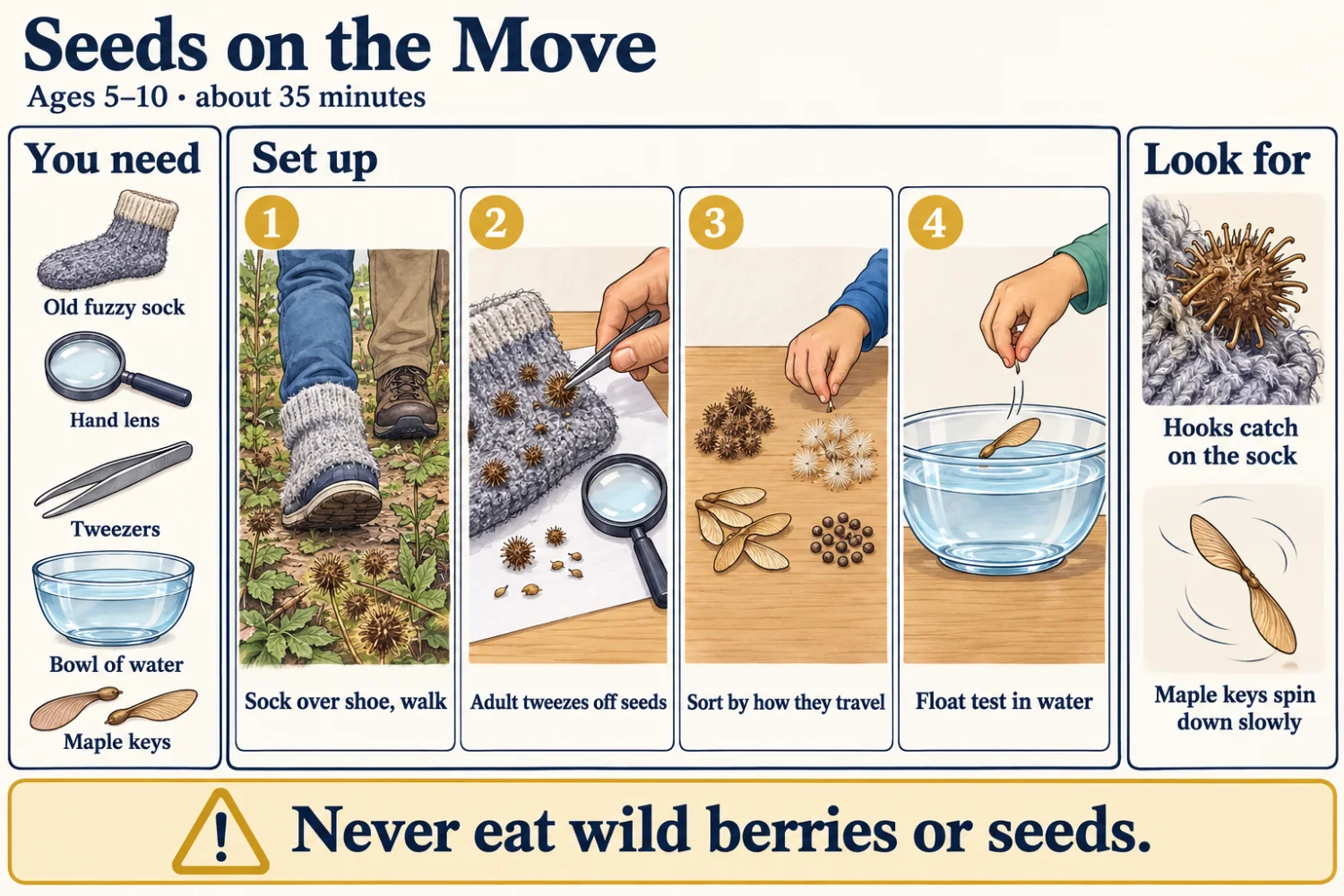
The big idea
A sock walk, a sorting game and a few timed drops give your child practice looking closely, sorting seeds by how they travel, and testing a guess. Your child finds out that seeds have shapes that carry them away from the parent plant, by wind, water and animals, including people.
Say it together (read aloud): “Plants can’t walk, but their seeds can travel. Some fly on the wind, some float, some stick to fur or socks, and some get eaten and dropped somewhere else.”
If you’ve pulled burrs off a dog or your socks after a walk, you’ve seen seeds travel.
A plant stays rooted in one place, but its seeds can move. Moving seeds away from the parent plant is called seed dispersal. Many seeds have shapes that suit one way of travelling. Winged and fluffy seeds ride the wind. Seeds with hooks catch on fur and clothes. Seeds inside juicy fruits are eaten by animals and dropped somewhere else. Some seeds float on water. Seeds that land away from the parent often have more room and light, and they can reach new places.
The best time is late summer and fall, when weeds are full of ripe seeds. Some maples drop their keys in spring instead.
For teachers (Virginia standards)
Virginia’s grade 2 standard says seeds are dispersed by wind, water and animals, including humans. The sock is your child’s proof that people carry seeds too.
What to do
- Predict. Before you go out, ask, “Plants can’t walk. How do you think their seeds get to new places?” Write down every idea. You will check them at the end.
- Sock walk. Pull the old sock over one shoe. Walk slowly back and forth along the edge of an unmowed, weedy patch for 3 to 5 minutes. Brush through the plants without trampling deep into them. Ask, “I wonder how many seeds will be stuck to the sock. What’s your guess?”
- Collect what you see. On the way back, look for other seeds without pulling up plants: maple keys, dandelion fluff, acorns, and the winged seeds that fall out of open pine cones. Leave acorns where they are if anyone taking part has a known acorn allergy. Put a few of the seeds you collect in the bag. Point out berries, but leave them on the plant. Say, “Berries are for looking at and drawing.”
- Check the sock. Stay outdoors, on a step or an outdoor table. Lay the sock on white paper and look with the hand lens. You use tweezers to pull off what stuck, and look for ticks as you go. Young ticks can be as small as a poppy seed. Stick any tick to tape, fold the tape over it, and throw it away. Count the seeds. Look at the hooks, spines or barbs that held on. Ask, “What do you think these little hooks are for?” Then seal the sock in the zip-top bag before you go inside.
- Sort by travel. Make four piles: flies, floats, sticks, gets eaten. Let your child decide where each seed goes and explain why: “Why does this one go in that pile?” Some seeds fit two piles, and that is fine.
- Float test. Ask your child to predict which seeds will float. Drop one of each kind into the bowl of water. Check again after 10 minutes.
- Helicopter drop. Ask, “What do you think will happen if we drop the key without its wing?” Stand on the floor and hold a whole maple key as high as you can reach. Drop it and time the fall. Snap the wing off another key and drop the seed part from the same height. Do three drops of each. If you have no maple keys, you cut a paper copy: a strip about 10 cm by 3 cm with a paper clip on one end as the seed.
- Grow the sock (optional). You set up the tray outdoors. Lay the sock on damp potting soil in a shallow tray. Slip the whole tray into a clear plastic bag and close it so nothing still on the sock can crawl out. Keep it in a bright spot out of hot direct sun. Over the next few weeks, some seeds may sprout. Many wild seeds picked in fall wait for a winter’s cold before they sprout, so a tray with nothing growing is a real result too. If mould grows, keep the bag closed and throw it away. You check the tray, nobody tastes the sprouts, and when you are done you seal the sock, sprouts and soil in a bag and put it in the trash, not the garden.
- Debrief. Look back at the ideas you wrote down in step 1, then ask two closing questions:
- “What did the sock walk show you about how people can move seeds?”
- “What did you see a seed’s shape help it do?” Read Say it together aloud again.
With a class, give each group of four one sock and walk together, then compare piles across groups.
Questions to ask while you do it
Ask your child to guess first, then check.
- “I wonder how many seeds will be stuck to the sock. What’s your guess?”
- “What do you think these little hooks are for?”
- “Which seeds do you think will float? Why?”
- “What do you think will happen if we drop the key without its wing?”
- “If every seed fell straight down under its tree, what would happen to all those seedlings?”
- “How do you think seeds got onto the sock that was on your shoe? Could people carry seeds too?”
What children often think
-
A child might say “Seeds come from the store.”
You could try Ask where the seeds on the sock came from, since nobody bought them. Look at the weeds you walked through. Every seed grew on a plant, and most plants make their own seeds without any help from people.
-
A child might say “Seeds just fall straight down under the tree.”
You could try Drop a maple key and a pebble side by side, or wave a hand fan at dandelion fluff. Many seeds do land close by, but wind, water and animals carry plenty of them much farther.
-
A child might say “A heavier seed flies farther.”
You could try Ask your child to predict, then compare the whole key and the wingless one. The whole key is a little heavier, yet it stays up longer and drifts more, because its spinning wing slows the fall. For wind seeds, what counts is how much wing or fluff a seed has for its weight. A light seed with a big wing or lots of fluff stays up longest.
-
A child might say “The plant throws its seeds far away because it wants babies everywhere.”
You could try Ask, "Can a plant think?" Plants do not plan. Over a very long time, plants whose seeds happened to spread farther had more young plants survive. That is how wings and hooks became common.
Why it works
Seedlings that sprout right under the parent compete with it for light, water and soil. Seeds that travel can reach open ground, and some land somewhere better.
Each shape works in a different way. A maple key spins as it falls, and the spinning wing slows its drop, so a breeze has more time to push it sideways. Dandelion fluff acts as a tiny parachute. Burdock and beggar’s ticks have hooks or barbs that cling to fur and cloth. The hooks on burdock burrs inspired the hook-and-loop fastener. Cherries and other fleshy fruits are eaten by birds, and the hard seeds often pass through unharmed. Squirrels bury acorns and forget some. Coconuts and the seeds of many streamside plants float.
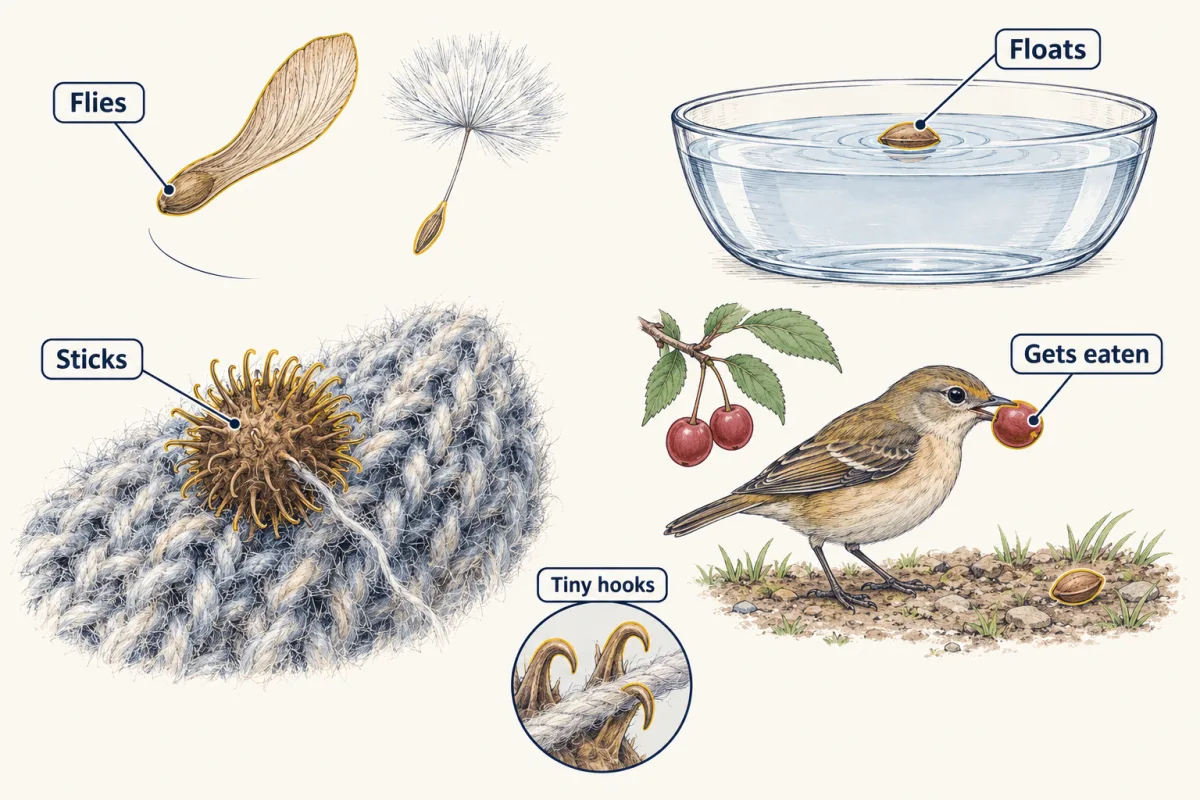
Some plants scatter their own seeds. Jewelweed pods, common in damp Virginia woods, burst open when touched. Scientists usually describe these shapes as adaptations, traits that became common over many generations because they helped plants spread.
Easier and harder
Ages 5 to 7
Skip the timing and float test. Do the sock walk, then sort into just two piles: “sticks to things” and “blows in the wind.” Your child can tape one of each onto the observation sheet and draw how it travels. Then drop a maple key and watch it spin, without timing.
Ages 8 to 10
Time three drops of each seed and work out the average. Then make a paper seed that falls as slowly as possible. Change one thing at a time, such as wing length or the number of paper clips. You do any cutting. For a wind test, you set a guarded fan on low on a table and keep fingers away from it. Your child drops each design 50 cm in front of the fan and measures in centimetres how far it lands.
If it doesn’t go as planned
A sock with nothing on it usually means the plants were mowed or the seeds are not ripe yet. Try a taller, weedier edge a few weeks later, or look along fences and path edges. If you find no maple keys, use the paper copy, or try dandelion fluff in spring and pine cones in fall.
Observation sheet
Here is what one filled-in row can look like:
| Draw the seed | Where I found it | How it travels: flies, floats, sticks or gets eaten |
|---|---|---|
| A round burr with tiny hooks | Stuck to the sock | Sticks |
Observation sheet
Seeds on the move
NameDate
Draw each seed. Circle how you think it travels.
| Draw the seed | Where I found it | How it travels: flies, floats, sticks or gets eaten |
|---|---|---|
Whole maple key fell in ___ seconds. Key with no wing fell in ___ seconds.
The seed that travels best is:
stemhop.com · Biology Together
The three stories, told aloud Side Hops: three stories that go with this lesson Side Hops
Three fun ways to talk about traveling seeds
1:37 · Narration: an AI narrator voice (Kokoro, af_heart).
Read the transcript
If you are about to head out on the sock walk, here are three easy lines you can tuck in your pocket for the trip.
First, while your child is putting on shoes, pull open a hook-and-loop sneaker strap or jacket tab together. Let them touch the stiff, scratchy hooks on one side and the fuzzy loops on the other. Back in nineteen forty-one, an engineer came home from a walk with burdock burrs clinging to his pants and his dog's fur. Looking closely at those tiny hooks gave him the idea for hook-and-loop tape, a kind of grip NASA has used to hold gear on spacecraft walls. Suddenly that fuzzy sock on your child's shoe is not just a silly costume. It is a seed-catching experiment.
Second, if your child wonders how heavy seeds like acorns move without wings, try saying, "Blue jays are acorn gardeners!" A single blue jay can carry five acorns at once, fly them more than a mile away, and bury up to five thousand in one autumn. Jays hide acorns to eat later, and the ones they never dig back up can sprout into new oak trees.
Finally, after the float test, tell your child that a whole coconut wears a built-in swim vest. Its thick husk and hollow center help it bob along on ocean waves. Scientists report coconuts that could still sprout after floating in seawater for up to one hundred ten days.
Pick whichever line fits your moment, and enjoy watching what hitches a ride home.
The idea underneath them. You and your child walk through a weedy patch with an old fuzzy sock over one shoe, then look at what stuck to it.
Your notes
Select any text in the lesson to highlight it or add a note to it. Your highlights and notes are saved in this browser and collected in your notebook.
This browser is not letting the site save anything (a private window or strict privacy settings), so highlights and notes will be lost when you leave the page.
Where this lesson fits
Before thisReview first
- Take a Flower ApartThis course · Lesson 11
There you saw where seeds begin inside a flower, so you know what is being carried away here.
After thisStudy next
- Fur, Feathers and ScalesThis course · Lesson 15
Your child can see another body shape that suits a job, as hooks on seeds suit sticking to fur.
- The Camouflage HuntThis course · Lesson 18
It builds on the idea that a trait helps a living thing survive, as seed shapes help seeds spread.
Elsewhere on the siteFilms, simulations and method films in other courses
- Why a White Coat Can Help—and HurtFilm · Life Science
A seed's wing, hook or float is an inherited feature that helps survival, as this film shows.
Suggested by an AI model from the lessons themselves, then checked. How we use AI
Those are the stories. The idea under them is the one the lesson builds.
That is the film. The rest of the activity is the fun part.
The rest of the activity is here when you want it.
Finish line
Test yourself
4 questions
Questions to talk over together.
Next · Lesson 14
Mealworms to Beetles
Is a mealworm a worm? Raising a few shows a child what it turns into.
Continue →Rewritten on : new text and film. Notes and highlights stay, but the text around them may have moved.