Biology Together · Unit 5: Animal bodies, homes and adaptations
Fur, Feathers and Scales
Rewritten on : new text and film. Your notes and highlights stay, but the text around them may have moved.
Why does a bird have feathers and a fish have scales? Feeling the real thing helps a child find out.
Three real-life stories behind this activity, about 2 minutes aloud, or read them below.
The film, 3 minutes, and the safety notes, for the grown-up to look at before the activity.
The hands-on part, done with a child: about 30 minutes.
Pause when the reading reaches a film, and offer to play it. Saved on this device.
Watch the film now, or keep listening
That is the end of the reading
This idea at other levels
An activity for ages 5 to 10 about adaptations. Next, for an older child: Sorting Living Things (grade 7).
See every levelHide the levels
Adaptations
An adaptation is a body part or behavior that helps a living thing survive where it lives.
Taught at two levels: ages 5 to 10 and grade 7.
Grade 7 · the level you chose
Body or behavior, always for one setting: the hare that stays white too long.
Life Science · about 40 min · film 3:22 · Virginia LS.7 b
Sorting Living Things · also at this level, picked for this lesson
Life Science · about 40 min · Virginia LS.3 c
Ages 5 to 10 · the level you chose
Fur, Feathers and Scales · this lesson
Feel feather, fur, scale and shell, then guess where each animal lives.
Biology Together · about 30 min · film 3:24 · Virginia 1.5 b, 1.5 c, 1.5 a
Kitchen tools as beaks: each shape is good at one food.
A grown-up runs this one; its safety notes are in the guide.
Biology Together · about 35 min · film 3:47 · Virginia 3.4 b, 1.5 b, 3.4 a
Line one mitten with shortening, dip both in ice water, see which chills.
A grown-up runs this one; its safety notes are in the guide.
Biology Together · about 30 min · Virginia 3.4 b
Damp or dry, dark or light: count where the worms choose to go.
A grown-up runs this one; its safety notes are in the guide.
Biology Together · about 35 min · film 3:51 · Virginia 3.6 a, 3.4 b, 1.5 a, 3.5 b
Next door to adaptations
- Natural selectionSelection is how a population comes to have its adaptations.Nearest lesson: The Camouflage Hunt (ages 5 to 10)
- Keeping warm and keeping coolFur, fat and feathers are adaptations for holding heat.Nearest lesson: The Blubber Glove (ages 5 to 10)
Short versions inside this lesson
The grade 7 version · about 1 minute to read
In grade 7 Life Science, children sort living things the way scientists do. They use a key, a set of yes-or-no questions about features like body covering, to name an organism. They learn the levels of classification, from kingdom down to species, and how to write a two-part scientific name. The features your child sorted by today become the questions in that key.
The plainest version · about 1 minute to read
Animals wear different coats. Birds wear feathers, which are light and help them fly and stay warm. Many animals on land wear fur. Most fish wear scales, which overlap like roof tiles and are coated in slime. Snails and turtles carry a hard shell. Each coat helps the animal live where it lives and move the way it moves.
Find an idea: every idea, searchable
Which lessons teach an idea, and the notes on each level, were written by AI models from the lessons and checked by a second model. A person has not yet read every one. How we use AI
About this activity what is in it
Rewritten on : new text and film. Notes and highlights stay, but the text around them may have moved.
Before you start
- Hands-on time
- About 30 minutes
- Where
- Indoors
- Ages
- 5 to 10, with an easier and a harder version below
- Grown-up
- Stay with your child the whole time. You handle any raw fish, scissors or glass magnifier, and you check shells for sharp edges first.
What you need
- A large tray or baking sheet
- 3 to 5 feathers from a craft store
- A scrap of fake fur, or a pet's brushed-out fur in a zip bag
- A small piece of raw fish with the skin and scales still on, on a plate (optional; ask the fish counter to leave the scales on)
- 2 or 3 clean, empty shells from a store or a beach
- A dropper or spoon and a small cup of water
- 12 to 16 animal pictures, printed or cut from magazines: include a snake, a turtle, a bat, a penguin, a frog, a fish, a duck, a dog, a squirrel, a snail and an insect
- A magnifying glass (optional)
- Paper and a pencil, or the printed observation sheet below
Virginia science standards SOL 1.5 bSOL 1.5 cSOL 1.5 a
The main idea. A touch-and-compare table of real animal coverings: craft feathers, fur, fish scales and shells.
The film
 ▶ Watch Fur, Feathers and Scales: Parent Guide · 3:24
Read the transcript of “Fur, Feathers and Scales: Parent Guide”
Film transcript: Fur, Feathers and Scales: Parent Guide
Why does a feather feel smooth one way and rough the other? Fish scales can feel that way, too. At the kitchen table, your child can compare animal coverings and use what they notice to sort pictures. This activity lets your child practice looking closely and describing what they actually feel. They make a guess, test it with water, and sort animal pictures by rules they explain. Formal group names like mammal or reptile can wait. Set out three to five craft-store feathers, fake fur, and two or three clean shells. Add a cup of water and a dropper. If you use raw fish, choose a piece with skin and scales still attached. Put it on a plate. Keep twelve to sixteen animal pictures face down nearby.
Stay with your child. Handle raw fish, scissors, and glass magnifiers yourself. Check shells for sharp edges. Use only craft-store feathers. Leave wild feathers where you find them. Keep small shells, small feathers, and loose dropper parts from children under four. Call nine one one if choking. Use photos if anyone is allergic to a material. Have your child describe the feather, fur, and shell in two words each. Open and smooth the feather's edge. If you're using raw fish and have no cuts or sores on your hands, stroke it both ways. Keep hands away from faces and mouths. Wash your hands with soap and water immediately after touching fish, before touching anything else.
Before the water test, ask, "Which one will stay driest if it gets wet?" Place three drops on the feather and three on the fur. Water often beads on feathers, while fur and craft feathers vary. Each coat fits where an animal lives. Flip the pictures over and match animals to their coverings. Look for legs, wings, fins, and tails. Ask, "Does it live on land or in water, and how does it move?" Sort by covering, then by leg count, then by movement. Let your child pick a fourth rule. Flip the pictures over and match animals to your coverings. Let your child pick a fourth rule. A bat flies, and a penguin has feathers. Imagine your child sorts those two pictures by body covering.
Before you turn the cards over, predict whether the bat and penguin will go in the same group. Turn the bat and penguin cards over. Ask, "Which one flies, and which one has feathers?" Bats have fur, and penguins have feathers. Put them in different groups when you sort by covering. The group depends on the feature you choose. Wrap and refrigerate the fish within two hours of taking it out. If the room is above ninety degrees Fahrenheit, you have one hour. If it has been out longer, throw it away. Wash hands with soap and water for twenty seconds. Wash the tray and table with soap and water.
Before you start
- Hands-on time
- About 30 minutes
- Where
- Indoors
- Ages
- 5 to 10, with an easier and a harder version below
- Grown-up
- Stay with your child the whole time. You handle any raw fish, scissors or glass magnifier, and you check shells for sharp edges first.
What you need
- A large tray or baking sheet
- 3 to 5 feathers from a craft store
- A scrap of fake fur, or a pet's brushed-out fur in a zip bag
- A small piece of raw fish with the skin and scales still on, on a plate (optional; ask the fish counter to leave the scales on)
- 2 or 3 clean, empty shells from a store or a beach
- A dropper or spoon and a small cup of water
- 12 to 16 animal pictures, printed or cut from magazines: include a snake, a turtle, a bat, a penguin, a frog, a fish, a duck, a dog, a squirrel, a snail and an insect
- A magnifying glass (optional)
- Paper and a pencil, or the printed observation sheet below
Virginia science standards SOL 1.5 bSOL 1.5 cSOL 1.5 a
The big idea
In 30 minutes at the table, your child feels real coverings, tests a guess with water and invents sorting rules. Run a finger along a feather: smooth one way, rough the other. Stroke a fish from head to tail, then backward, and the same thing happens. Your child’s hands notice these clues before any book does.
Say it together: “Animals wear different coats. Feathers, fur, scales and shells each do a job. An animal’s coat and body parts help it live where it lives and move the way it moves.”
Animals wear hair or fur, feathers, scales or shells. They also have appendages—parts that stick out, like legs, wings, fins and tails. Feathers are light and help birds fly and stay warm. Scales and fins suit life in water. Fur and legs suit many animals on land. Shells protect soft bodies: a snail’s shell covers its body, and a turtle’s shell is part of its skeleton.
What to do
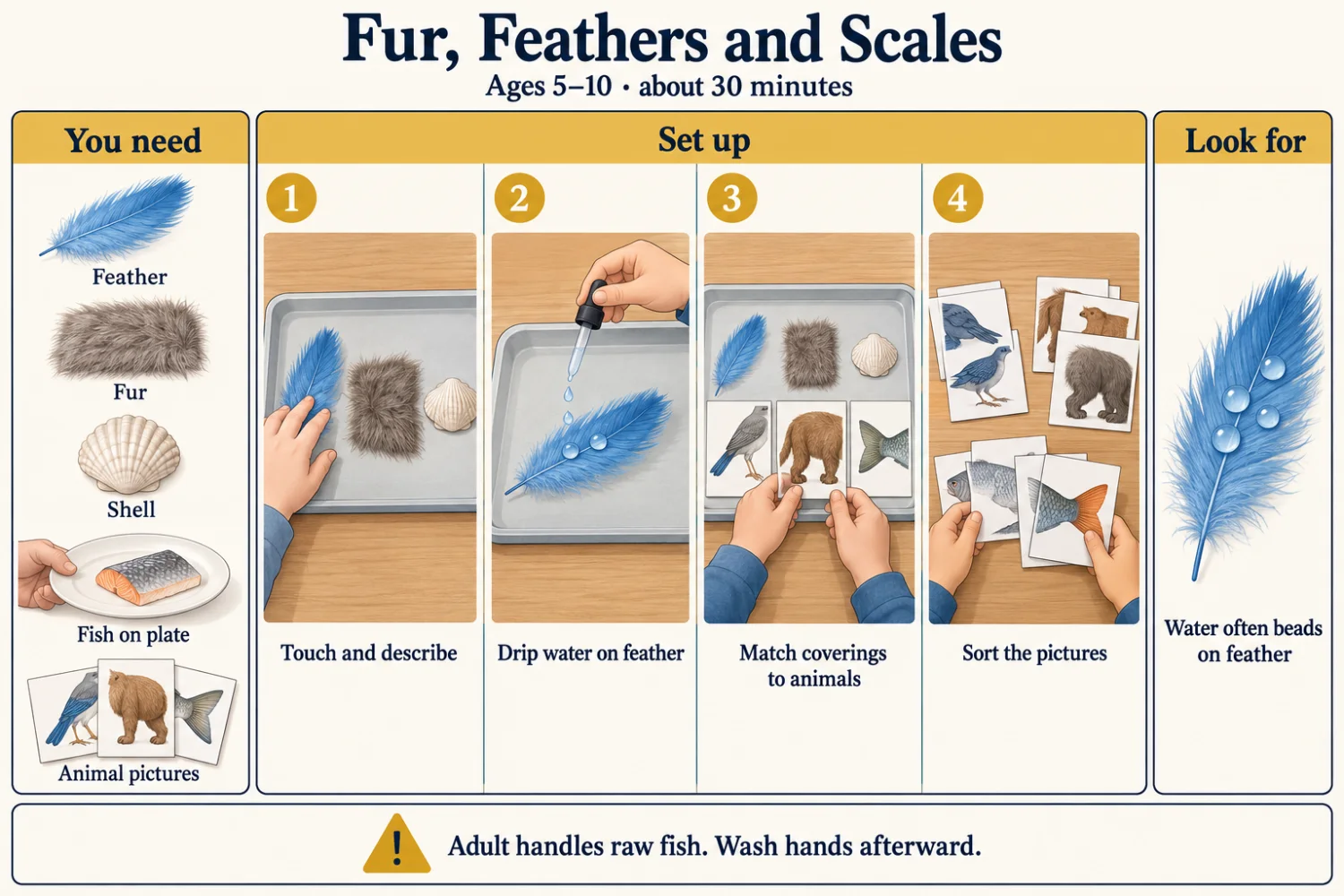
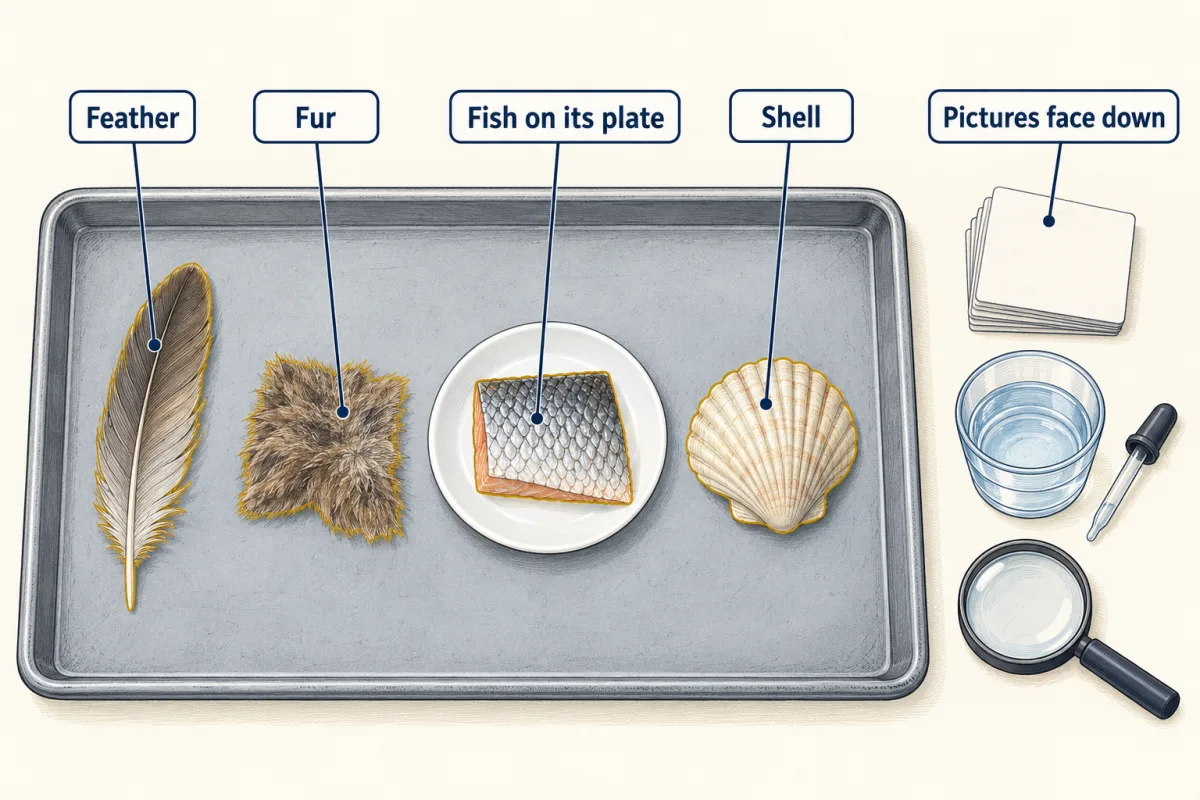
- Set the table. Set a feather, fur and a shell on the tray, a hand’s width apart. If you’re using fish, add it on its own plate. Keep the pictures face down beside the tray.
- Touch and describe. Hold the fish yourself; anyone who touches it washes hands right away. Say: “Touch each one and pick two words for how it feels—soft, hard, smooth, rough, slimy, light or bumpy.” Write their words down.
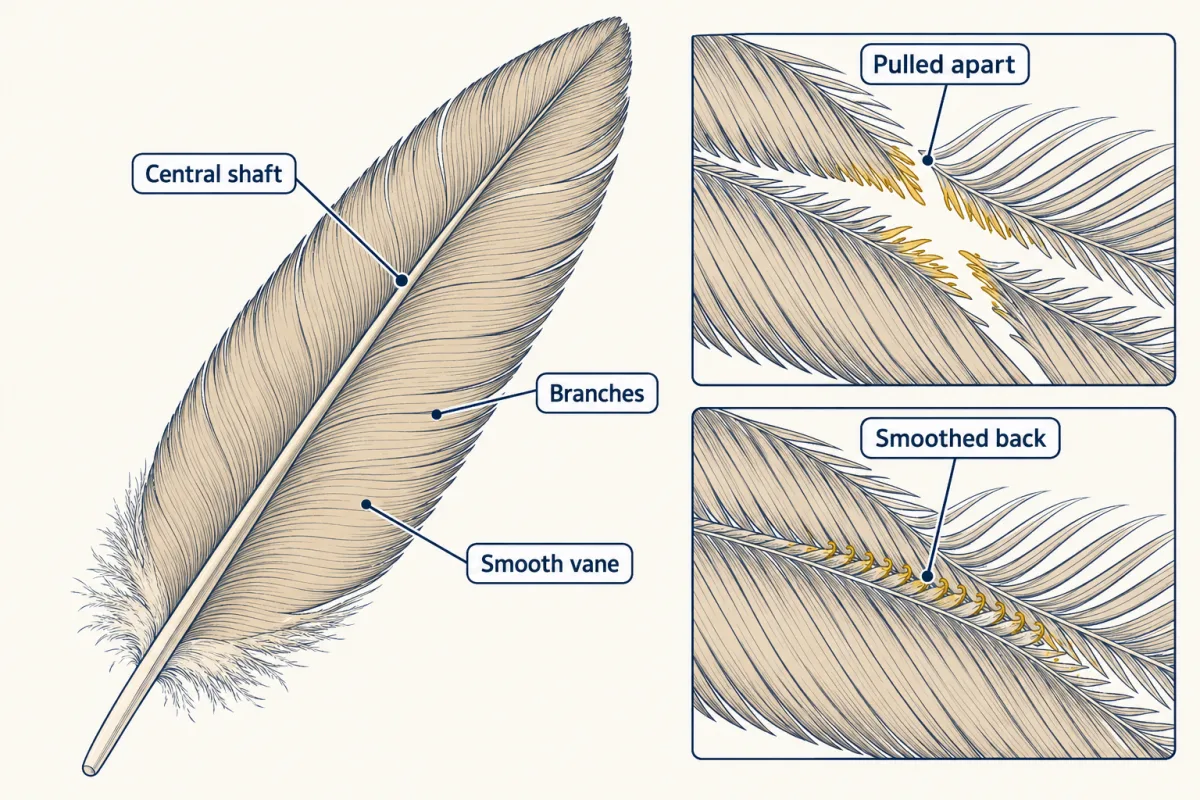
- Look closer (predict, then feel). Ask: “What will happen if we pull the feather’s edge apart and smooth it back?” Pull apart, then smooth: the parts hook back together. Hold the fish and ask: “Will it feel the same both ways?” Stroke head to tail, then backward (wash hands right away). Scale edges catch going backward; ask why they point toward the tail. Spot shell rings with a magnifier.
- Predict, then drip. Ask: “Which will stay driest if it gets wet—the feather or the fur?” Put 3 drops of water on each. Water often beads on a feather; fur and craft feathers vary (water may bead or soak in).
- Match to animals. Turn the pictures over. Ask: “Which animals wear this coat? Pick one. Does it live on land or in water? Does it walk, crawl, fly or swim?”
- Spot parts that stick out. Point to legs, wings, fins and tails. Ask: “What job does this part do?”
- Sort one rule at a time. Keep covering and movement separate by working one case first: “Let’s place the fish together—what covering does it wear?” Sort by covering, then by legs (0, 2, 4, 6 or 8), then by movement. Then say: “Make a fourth rule of your own.”
- Two-question debrief. Ask your child: “Pick one animal—how does its coat fit where it lives and moves?” and “Which animal was hardest to sort, and why?”
- Clean up. Wrap the fish yourself. Refrigerate it within 2 hours of taking it out, or within 1 hour if the room is above 90 °F. Throw it away if it has been out longer. Wash hands with soap and water for 20 seconds. Wash the tray and table with soap and water too.
Questions to ask while you do it
Ask your child to guess first, then check.
- “I wonder which covering would keep an animal warmest. Which would you want on a cold day?”
- “What do you think is under the slime on a fish?”
- “This animal has fins. Do you think it lives on land or in water? Why?”
- “The bat flies. Does it have feathers? What does it have?”
- “What do you think would happen if a turtle tried to take off its shell?”
- “Which animal was hardest to sort? Why?”
What children often think
-
A child might say “Only dogs and cats have fur.”
You could try Ask your child to find every furry animal in the pictures. Squirrels, bats, deer, rabbits and people all have hair or fur. Many land animals have it, in many shapes and sizes.
-
A child might say “Fish are slimy, so they don’t have scales.”
You could try Stroke the fish from tail to head and feel the edges catch, then wash your hands. Most fish have scales, with a layer of slime on top that helps protect them. Some fish, like most catfish, really have no scales.
-
A child might say “Only birds fly, and everything with feathers can fly.”
You could try Put the bat and the penguin side by side. Ask, "Which one flies? Which one has feathers?" Bats fly on wings of skin and have fur. Penguins have feathers and swim instead of fly. Many insects fly too.
-
A child might say “A turtle can climb out of its shell.”
You could try Ask your child to feel their own ribs and backbone. A turtle’s shell is joined to its ribs and backbone, so it cannot come out, just as you cannot take off your ribs. Many turtles can pull their head and legs in, but sea turtles cannot.
Why it works
Each covering is built for a job. A flat outer feather has a central shaft with rows of branches. Tiny hooks hold those branches together into one smooth, flat surface. That makes a light, strong surface for flying. Fluffy down feathers underneath trap warm air. Fur also traps air near the skin. Most fish have thin, overlapping scales coated in mucus, which protects against infection and helps the fish slip through water. A turtle’s shell is part of its skeleton: the top half joins its ribs and backbone, and the bottom half is made of other flat bones.
Feeling the real coverings helps your child find features to sort by, as the grade 1 standard asks. Some animals are puzzles on purpose. A frog has bare, damp skin, with no fur, feathers, scales or shell. A snake has scales and no legs. Those puzzles show that grouping animals depends on which feature you pick.
Easier and harder
Ages 5 to 7
Use three coverings (feather, fur, shell) and eight pictures. Sort only by covering, then only by land or water. Let your child point and say instead of writing. Save the fish for the end, or use a photo of fish scales instead.
Ages 8 to 10
Add a fourth sort by appendages: wings, fins, legs or none. Your child makes a table showing each animal’s covering, legs, home and way of moving. Then they write two yes-or-no questions that split the pictures into groups, such as “Does it have feathers?” That is the first step toward a key.
For teachers
Virginia SOL 1.5 a–c (Grade 1): Children describe animal body coverings and appendages, use those features to guess where an animal lives and how it moves, and group animals by features they choose. The framework notes that grade 1 children do not need to sort animals into formal groups like reptiles, birds or mammals. Let your child set the sorting rules.
If it doesn’t go as planned
Some grocery fish already have their scales scraped off. Ask at the counter for a piece with scales left on, or look for skin-on salmon, which sometimes keeps its small scales (run a finger along the skin to check). A clear close-up photo works too. If water soaks right into your craft feather, say so—dyed feathers sometimes behave differently from a bird’s own feathers.
Observation sheet
Worked example (one row filled in): Scales | Slimy, smooth one way | Fish | Water | Swims
Observation sheet
Fur, feathers and scales
NameDate
Touch each covering. Write or draw what you find.
| Covering | How it feels | One animal that has it | Land or water? | How does it move? |
|---|---|---|---|---|
| Feathers | ||||
| Fur | ||||
| Scales | ||||
| Shell |
I sorted my animals by:
stemhop.com · Biology Together
The three stories, told aloud Side Hops: three stories that go with this lesson Side Hops
Three ways to talk about animal coats
1:39 · Narration: an AI narrator voice (Kokoro, af_heart).
Read the transcript
Hi there! If you are setting up the fur, feathers and scales tray, here are three easy ways to talk about animal coats with your child, no textbook voice needed.
First, when your child is holding the craft feather or looking at the turtle card, try this line: "Tap your fingernail. Feel how hard it is? A bird's feathers and the hard plates on most turtle shells are made of tough stuff like that, too!" Kids love finding out that something on the tips of their own fingers connects a soft, light feather to a hard turtle shell. Let them tap away.
Next, save a question for the frog card. Ask, "A frog doesn't sip with its mouth. How do you think it drinks?" You may hear wonderful answers, like licking puddles or gulping raindrops. Enjoy every guess. Then share the real trick: a frog soaks up water through a bare patch of skin on its belly and the undersides of its thighs. No cup, no straw, just skin.
Finally, once the sorting is done, here is a fun one to end on. You have probably seen a cut tree stump with rings, one ring for each year the tree grew. Some fish keep a record a lot like that on their scales. New ridges on a scale form closer together in winter, and scientists count those winter bands to guess how old the fish is. So a tiny scale can hold a birthday count.
Have fun at the tray together, and see which coat surprises your child the most!
The idea underneath them. A touch-and-compare table of real animal coverings: craft feathers, fur, fish scales and shells.
Your notes
Select any text in the lesson to highlight it or add a note to it. Your highlights and notes are saved in this browser and collected in your notebook.
This browser is not letting the site save anything (a private window or strict privacy settings), so highlights and notes will be lost when you leave the page.
Where this lesson fits
After thisStudy next
- The Camouflage HuntThis course · Lesson 18
Animal coverings like fur and feathers come in colours that help an animal hide, which this game tests.
- The Blubber GloveThis course · Lesson 17
It looks at another body covering, a fat layer, and how it keeps an animal warm in cold water.
Suggested by an AI model from the lessons themselves, then checked. How we use AI
Those are the stories. The idea under them is the one the lesson builds.
That is the film. The rest of the activity is the fun part.
The rest of the activity is here when you want it.
Finish line
Test yourself
4 questions
Questions to talk over together.
Next · Lesson 16
Beak Buffet
Why don't all birds have the same beak? A timed kitchen-tool buffet lets a child find out.
Continue →Rewritten on : new text and film. Notes and highlights stay, but the text around them may have moved.