Biology Together · Unit 6: Food chains, soil and decomposers
Rot Detectives
Rewritten on : new text and film. Your notes and highlights stay, but the text around them may have moved.
Where does a rotten apple go? Sealed jars let a child watch decomposers at work without opening a lid.
Three real-life stories behind this activity, about 2 minutes aloud, or read them below.
The film, 3 minutes, and the safety notes, for the grown-up to look at before the activity.
The hands-on part, done with a child: about 25 minutes, then a few quick looks later.
Pause when the reading reaches a film, and offer to play it. Saved on this device.
Watch the film now, or keep listening
That is the end of the reading
This idea at other levels
An activity for ages 5 to 10 about decomposers and decay. Next, for an older child: Producers, Consumers and Decomposers (grade 7).
See every levelHide the levels
Decomposers and decay
Fungi, bacteria and small animals break down dead things and return their nutrients to the soil.
Taught at three levels: ages 5 to 10, grade 7 and high school.
High school · the level you chose
Microbes in Bodies and Ecosystems
Decomposers digest outside themselves; on Ohio stream leaves, fungi outweighed bacteria.
Biology · about 40 min · Virginia BIO.4d
Grade 7 · the level you chose
Producers, Consumers and Decomposers
Why the forest's leaf pile stops growing: weigh a bag of leaves.
Life Science · about 40 min · film 3:24 · Virginia LS.5 c
Ages 5 to 10 · the level you chose
Rot Detectives · this lesson
Seal an apple slice in a jar and watch decomposers work.
Biology Together · about 25 min · film 3:21 · Virginia 3.5 b, 4.3 b, K.10 c, K.10 d
Next door to decomposers and decay
- Food webs and energy flowDecomposers are the part of the web that eats what is left.Nearest lesson: Who Eats Whom? (ages 5 to 10)
- The carbon cycleRotting sends carbon back to the air as carbon dioxide.Nearest lesson: The Carbon and Water Cycles (grade 7)
Short versions inside this lesson
The grade 7 version · about 1 minute to read
In grade 7 Life Science, children run a model forest floor with and without decomposers. They read real data from bags of fallen leaves left in a forest for two years and watch the leaf mass shrink. They learn how producers, consumers and decomposers depend on each other, and they back a claim with numbers.
The plainest version · about 1 minute to read
When a plant or animal dies, tiny living things eat it. Some are too small to see. Others, like mold, grow fuzzy spots we can see. They break dead things into tiny bits that go back into the soil, and new plants use those bits to grow. That is why old leaves do not pile up forever. Plastic does not rot this way.
Find an idea: every idea, searchable
Which lessons teach an idea, and the notes on each level, were written by AI models from the lessons and checked by a second model. A person has not yet read every one. How we use AI
About this activity what is in it
Builds on:Alive or Not? (read)Who Eats Whom? (read)Why these?
Rewritten on : new text and film. Notes and highlights stay, but the text around them may have moved.
Before you start
- Hands-on time
- About 25 minutes, plus a 5-minute look twice a week for 3 to 4 weeks
- Where
- Indoors
- Ages
- 5 to 10, with an easier and a harder version below
- Grown-up
- You set up and seal every container, and you throw them away at the end. Children look and draw but never open the containers.
What you need
- 5 clear plastic containers with tight lids, such as clean deli or takeout tubs, or 5 zip-top sandwich bags
- Wide clear packing tape
- About 1 cup of damp soil from a garden bed or a bag of potting soil
- 1 apple slice, cut in half
- 1 dry fallen leaf
- 1 small piece of bread
- 1 plastic bottle cap or a small ball of foil
- A spoon and a permanent marker
- A magnifying glass (optional) and a ruler (for ages 8 to 10)
- Paper and a pencil, or the printed observation sheet below
Virginia science standards SOL 3.5 bSOL 4.3 bSOL K.10 cSOL K.10 d
In this activity. You seal an apple slice, a leaf, a piece of bread and a bottle cap in clear containers with a little damp soil, then your child checks them twice a week for three to four weeks.
The film
 ▶ Watch Rot Detectives: Parent Guide · 3:21
Read the transcript of “Rot Detectives: Parent Guide”
Film transcript: Rot Detectives: Parent Guide
Every autumn, trees drop huge piles of leaves. A year later, many of them seem to be gone. Where did they go? Five sealed containers on a shelf will show your child. Set aside about twenty-five minutes. Then check the containers twice a week for three to four weeks. Your child practices looking closely, recording changes, and checking their guesses. Number five clear plastic tubs with tight lids. Put two or three spoonfuls of damp soil into each of the first four. Use one item per tub. Add half an apple slice, a dry leaf, bread, and a bottle cap, in that order. The fifth container gets the other half of the apple and no soil. Tape every lid shut, all the way around.
Tell your child, 'These lids stay shut. We are detectives, so we look through the sides.' Before the first check, ask, 'Which one do you think will change first?' Write down the guess together. Have your child draw what each container looks like on day one. Now a question for you. After two weeks on a shelf, which containers do you predict will look different? And which one will look exactly the same?
Bread often grows fuzzy mold within one to two weeks. Both apples usually rot, even the one with no soil. Mold spores are in the air and on the fruit. The leaf may barely change in a month. The bottle cap can look the same at the end. Most decomposers cannot use plastic as food. Decomposers break down dead things. Here, the main ones are tiny living things like bacteria and mold. Each time you look, ask, 'What is different since last time?' Compare the apple in soil with the apple on its own. At the end, line up the drawings. Use them to check the starting guess and sort fast, slow, and unchanged results. You set up and seal every tub. Keep the tubs on a shelf out of direct sun.
Stay with your child and look through the sides. Nobody opens, sniffs, or shakes a tub. Mold spores can set off allergies and asthma. Anyone with asthma, a mold allergy, or a weakened immune system should leave the containers alone. Wash hands after each check. A bottle cap, foil ball, or other small piece is a choking risk for children under four. Keep small pieces out of reach. Call nine one one if a child is choking. Never taste the leaf or any food used here. At the end, bag the sealed tubs and put them in the outdoor trash. So where did all those autumn leaves go?
Tiny living things ate them, slowly, and returned the bits to the soil. New plants use those bits to grow.
Before you start
- Hands-on time
- About 25 minutes, plus a 5-minute look twice a week for 3 to 4 weeks
- Where
- Indoors
- Ages
- 5 to 10, with an easier and a harder version below
- Grown-up
- You set up and seal every container, and you throw them away at the end. Children look and draw but never open the containers.
What you need
- 5 clear plastic containers with tight lids, such as clean deli or takeout tubs, or 5 zip-top sandwich bags
- Wide clear packing tape
- About 1 cup of damp soil from a garden bed or a bag of potting soil
- 1 apple slice, cut in half
- 1 dry fallen leaf
- 1 small piece of bread
- 1 plastic bottle cap or a small ball of foil
- A spoon and a permanent marker
- A magnifying glass (optional) and a ruler (for ages 8 to 10)
- Paper and a pencil, or the printed observation sheet below
Virginia science standards SOL 3.5 bSOL 4.3 bSOL K.10 cSOL K.10 d
The big idea
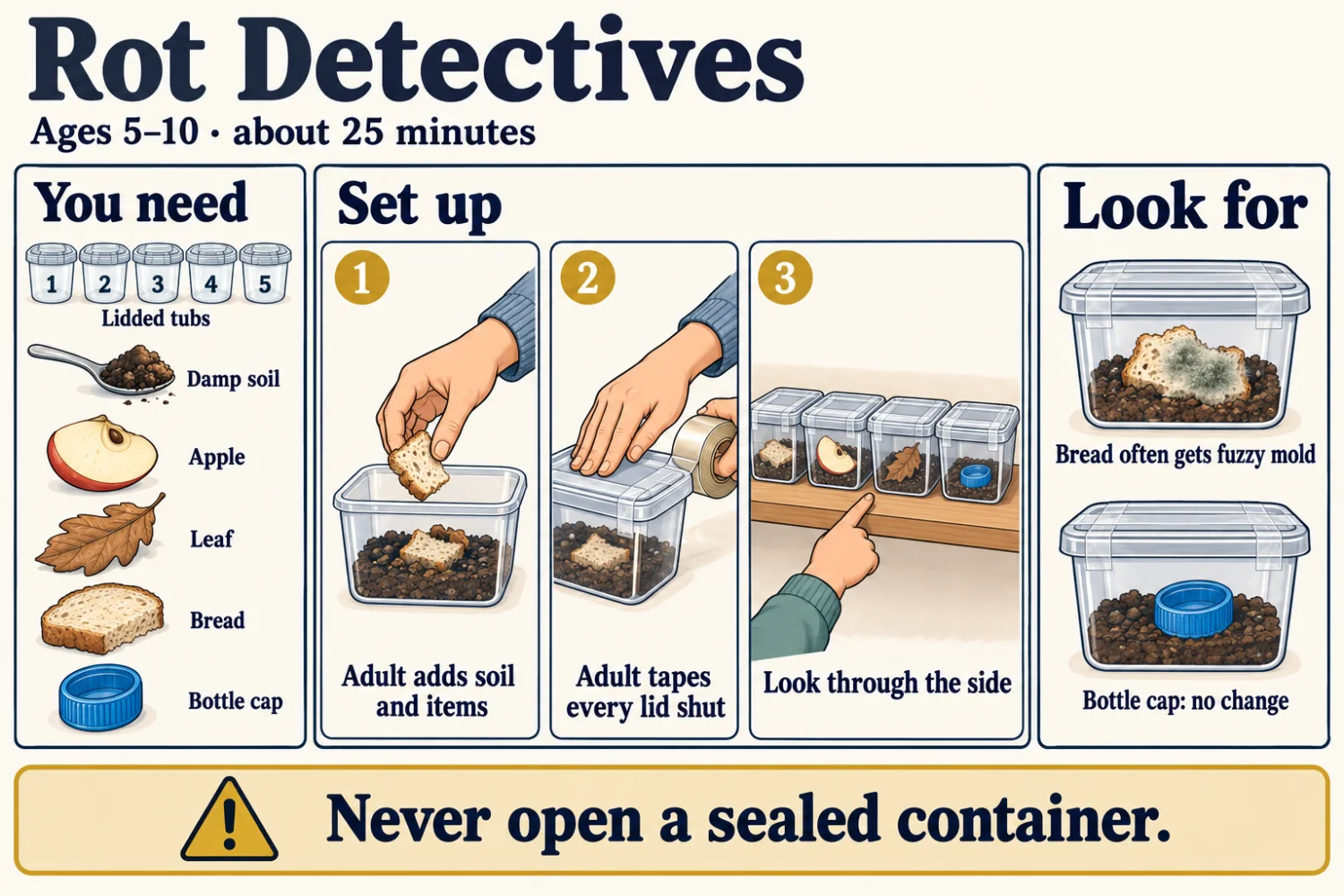
Your child watches what happens inside five sealed containers. They practice looking closely, recording changes, and checking their guesses. Tiny living things make some things rot quickly. Other things rot slowly or stay the same during the activity.
Say it together (read aloud): “Tiny living things eat dead plants and food. That is called rotting. Some things rot fast and some rot slowly. The plastic cap stays the same during our checks.”
Every autumn, trees drop huge piles of leaves. A year later, many of them seem to be gone. Where did they go?
Living things called decomposers break down dead plants and animals. Most are far too small to see, like bacteria. Some, like mold, a kind of fungus, grow fuzzy patches you can see. Small animals such as earthworms and pill bugs help too, by eating dead leaves. As decomposers break things down, they return nutrients to the soil, and plants use them again.
In this activity, your child watches decomposers at work through the side of a sealed container. Some changes are fast, like fuzz on bread within a week. Some are slow, like a dry fallen leaf, which may barely change in a month. A bottle cap does not change at all, because plastic is not food for most decomposers.
For teachers (Virginia standards)
Virginia’s kindergarten standard asks children to see that changes can be fast or slow and can be measured. Grades 3 and 4 add decomposers and their place in the food web.
What to do
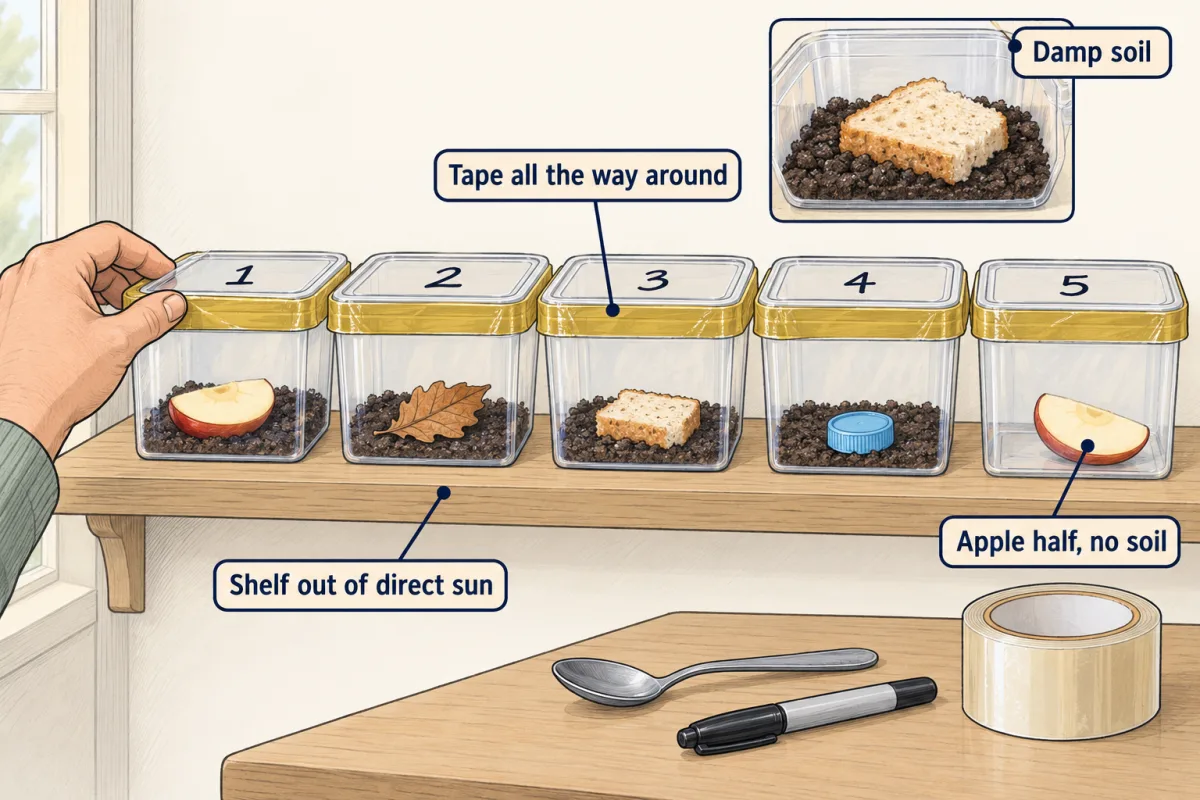
- Set up. Number five containers with the marker. Put 2 or 3 spoonfuls of damp soil in containers 1 to 4. The soil should feel like a wrung-out sponge. If it is dry, add a teaspoon of water. If you find worms or bugs that are safe to handle, gently return them to the spot where you found them. Leave any biting, stinging or unfamiliar animal alone and use different soil.
- Add the things. You put half of the apple slice in container 1, the leaf in container 2, the bread in container 3, and the bottle cap or foil in container 4. Container 5 gets the other half of the apple slice and no soil. Close each lid and tape it all the way around, or seal each bag and tape the top. Say, “These lids stay shut. We are detectives, so we look through the sides.”
- Predict before you look. Ask your child, “Which one will change first? Which one do you think will still look the same at our last check?” Write their guesses on the sheet. Any guess is fine. Your child can check it against the drawings at the end.
- Draw day one. Your child draws each container as it looks now. Older children can note color, size and shape. Ask, “What do you notice about each one today?”
- Check twice a week. Put the containers on a shelf out of direct sun. Look at them twice a week for 3 to 4 weeks. Look for fuzz, spots, color changes, liquid and shrinking. Bread often grows fuzzy mold within one to two weeks, sooner for plain bread without preservatives. Store bread with preservatives can take longer. Ask, “What is different since last time?”
- Compare the apples. Ask, “Is the apple with soil changing in a different way than the apple without soil?” Both usually rot, since mold spores are in the air and on the fruit. The two may look different.
- Wrap up and debrief. After 3 or 4 weeks, line up the drawings from first to last. Check the guesses on the sheet, then ask two closing questions:
- “What changed fast? What changed slowly? What did not change?”
- “Who did the rotting inside our sealed containers?” Read Say it together aloud again. Then you bag the containers and throw them out, unopened.
Questions to ask while you do it
Ask your child to guess first, then check.
- “I wonder which one will get fuzzy first. Why do you think so?”
- “What do you think the fuzz is? Is it alive?”
- “What will happen to the bottle cap? Will it look different in a month?”
- “I wonder if the apple without soil will rot. What could make it rot with no soil?”
- “Where do you think the apple goes when it gets smaller?”
- “What would happen in the woods if nothing ever rotted?”
What children often think
-
A child might say “Things just disappear when they rot.”
You could try Ask, "Where could the apple have gone? The lid never opened." The apple is being eaten by tiny living things and turned into gases, water and bits that go back into the soil.
-
A child might say “Mold is dirt.”
You could try Ask, "Does dirt grow bigger each time we look?" Track one spot over a week. Mold is a living fungus. It grows from tiny spores that float in the air and land on food.
-
A child might say “Rotting is bad. We should stop it.”
You could try Ask what the woods would look like if no leaf or log ever rotted. Rotting in food is a problem for us, but outdoors it clears away dead things and feeds the soil.
-
A child might say “Everything rots, even plastic.”
You could try Let the bottle cap answer. After a month, ask, "Did it change?" Most decomposers cannot use plastic as food. It can last a very long time, which is why litter matters.
Why it works
Bacteria and molds feed by releasing chemicals that break food down outside their bodies, then taking in the small pieces. Mold spores are everywhere in air and soil, so a slice of apple soon carries some. In a warm, damp, sealed space they grow fast.
Soft, wet foods like bread and apple are easy to break down. A leaf is tougher. It has stiff fibers and waxy layers, so on a forest floor it can take months to years to break down fully. Outdoors, bacteria, fungi, earthworms and pill bugs all work on it together. A sealed jar holds mostly the tiny ones.
Plastic is made of very long chains too, but they are built in a way that most decomposers cannot break apart or use as food. It breaks into smaller pieces over many years, but it does not rot like food. Foil is a metal and does not rot either.
Easier and harder
Ages 5 to 7
Use three containers: bread, apple and bottle cap. Your child draws each one on day one and again at the end. Ask one question each visit: “Fast, slow or no change?” Let your child sort the final drawings into those three groups. Use the words “rot” and “tiny living things” before you introduce mold and decomposers.
Ages 8 to 10
Use all five containers. On each check, measure the widest patch of mold in centimeters through the side with a ruler and record it in a table. Plot the bread mold size on a line graph. Then plan a fair test with one thing changed, such as damp versus dry bread, keeping everything else the same.
If it doesn’t go as planned
If nothing grows after two weeks, the soil may be too dry or the room too cold. Set up new containers with damper soil in a warmer room. Keep them at normal room temperature, away from heaters, radiators and sunny windows. Store bread may take three weeks to show mold. If one container leaks or the tape comes loose, bag it and throw it away. Do not reseal it.
Observation sheet
Here is what one filled-in row can look like:
| Date | Apple with soil | Apple, no soil | Leaf | Bread | Bottle cap |
|---|---|---|---|---|---|
| Week 2 | Color change | Spots | Barely changed | Fuzzy mold | No change |
Observation sheet
Rot detectives
NameDate
Look through the side. Never open the containers. Draw or write what you see.
| Date | Apple with soil | Apple, no soil | Leaf | Bread | Bottle cap |
|---|---|---|---|---|---|
What changed fast?
What changed slowly or not at all?
stemhop.com · Biology Together
The three stories, told aloud Side Hops: three stories that go with this lesson Side Hops
Three playful ways to explain decomposers
1:52 · Narration: an AI narrator voice (Kokoro, af_heart).
Read the transcript
If your child is peering at those taped tubs and wondering why nothing is happening yet, here are three fun ways to talk through what is going on inside.
First, right after you scoop damp soil into the tubs, try saying, "A spoonful of garden soil can hold hundreds of millions of tiny living things, too small to see." Soil scientists estimate that a teaspoon of healthy soil can hold one hundred million to one billion bacteria. Some of those bacteria, along with fungi, help break down dead leaves and food.
Second, once fuzzy spots show up on the bread behind the sealed plastic, grab a dry kitchen sponge at the sink. You can explain that we put food inside our bellies to digest it, while mold does it the other way around. Like other fungi, mold releases digestive juices straight onto food to break it down outside its body, then soaks up the tiny nutrients right through its surface like a sponge. Just keep those tub lids taped shut and wash hands after every look.
Third, take the hunt outside together. With your child right beside you, gently lift a damp fallen leaf or a garden stone, and leave alone anything that might sting or bite, and any unknown mushrooms. If you spot a pill bug curled into a tiny ball, wait for it to uncurl, then count its legs. A grown-up pill bug has seven pairs. These harmless bugs eat mostly rotting plant bits. They are cousins of crabs and lobsters. They breathe air with tiny lung-like parts underneath, and they hide in damp places so they stay moist. Gently set the leaf back down when you finish, and you have just met the outdoor cleanup crew.
The idea underneath them. You seal an apple slice, a leaf, a piece of bread and a bottle cap in clear containers with a little damp soil, then your child checks them twice a week for three to four weeks.
Your notes
Select any text in the lesson to highlight it or add a note to it. Your highlights and notes are saved in this browser and collected in your notebook.
This browser is not letting the site save anything (a private window or strict privacy settings), so highlights and notes will be lost when you leave the page.
Where this lesson fits
Before thisReview first
- Alive or Not?This course · Lesson 1
Your child needs to know what living things do, so tiny rotting helpers can count as alive.
- Who Eats Whom?This course · Lesson 21
It shows who eats whom in a meadow, which helps your child see where rotting fits in.
After thisStudy next
- Soil ShakeThis course · Lesson 23
Your child looks closer at soil, where rotted leaves and food end up.
- Adopt a TreeThis course · Lesson 25
Your child can follow what happens to a tree's fallen leaves through the year.
- Hidden Leaf ColorsThis course · Lesson 27
Your child looks further at fall leaves, the same leaves that rot on the ground.
Elsewhere on the siteFilms, simulations and method films in other courses
- The Leaf Pile That Stops GrowingFilm · Life Science
It shows how fungi and bacteria break down fallen leaves so a leaf pile stops growing.
- A forest floor over five yearsSimulation · Life Science
A forest floor over five years shows decomposers clearing away dead leaves.
Suggested by an AI model from the lessons themselves, then checked. How we use AI
Those are the stories. The idea under them is the one the lesson builds.
That is the film. The rest of the activity is the fun part.
The rest of the activity is here when you want it.
Finish line
Test yourself
4 questions
Questions to talk over together.
Next · Lesson 23
Soil Shake
Is dirt just dirt? Shake some soil in a jar of water and watch it sort itself into layers.
Continue →Rewritten on : new text and film. Notes and highlights stay, but the text around them may have moved.