Biology Together · Unit 4: Flowers, seeds and life cycles
Mealworms to Beetles
Rewritten on : new text and film. Your notes and highlights stay, but the text around them may have moved.
Is a mealworm a worm? Raising a few shows a child what it turns into.
Three real-life stories behind this activity, about 2 minutes aloud, or read them below.
The film, 4 minutes, and the safety notes, for the grown-up to look at before the activity.
The hands-on part, done with a child: about 25 minutes, then a few quick looks later.
Pause when the reading reaches a film, and offer to play it. Saved on this device.
Watch the film now, or keep listening
That is the end of the reading
This idea at other levels
An activity for ages 5 to 10 about metamorphosis. Next, for an older child: Habitat and Niche (grade 7).
See every levelHide the levels
Metamorphosis
Some animals change body form completely as they grow up, like a mealworm becoming a beetle.
Three levels here: ages 5 to 10, grade 7 and a first college course. The lesson at grade 7 was picked by hand for this lesson.
College, a first course · the level you chose
Hormones and the Endocrine System
The hormones in charge of a bug's moult and a tadpole's change.
Organismal Biology · about 20 min · 3 practice questions
No lesson on metamorphosis at high school yet.
Grade 7 · the level you chose
Habitat and Niche · also at this level, picked for this lesson
Life Science · about 40 min · Virginia LS.6 d
Ages 5 to 10 · the level you chose
Mealworms to Beetles · this lesson
Raise mealworms and record each stage: larva, pupa, beetle.
Biology Together · about 25 min · film 3:44 · Virginia 2.4 a, 4.3 c, K.7 b
Next door to metamorphosis
- Programmed cell deathRebuilding a body means removing old cells as well as adding new ones.Nearest lesson: Cell Death and Clearance (college core)
- AdaptationsEach stage of the life cycle has its own body for its own job.Nearest lesson: Fur, Feathers and Scales (ages 5 to 10)
Short versions inside this lesson
The grade 7 version · about 1 minute to read
In grade 7 Life Science, children separate two ideas: an animal’s habitat, the place where it lives, and its niche, the job it does there and everything it needs. A mealworm’s niche changes a little as it grows. The larva and the beetle both eat grain in the same bedding, but the pupa eats nothing, and only the beetle mates and lays eggs. A frog shows a bigger change: a tadpole lives in water and eats plants, and a frog lives on land and eats insects. Different kinds of living things can also share one place by having different niches.
The plainest version · about 1 minute to read
A mealworm is not a worm. It is a baby beetle. It eats and grows and sheds its skin over and over. Then it stops eating and turns into a still, pale pupa. Inside, its body is changing. One to three weeks later a beetle climbs out. Beetles lay tiny eggs, and new mealworms hatch from them. Kittens look like small cats, but baby beetles look nothing like their parents.
Find an idea: every idea, searchable
Which lessons teach an idea, and the notes on each level, were written by AI models from the lessons and checked by a second model. A person has not yet read every one. How we use AI
About this activity what is in it
Builds on:Alive or Not? (read)Like Their Parents, Not the Same (read)Why these?
Rewritten on : new text and film. Notes and highlights stay, but the text around them may have moved.
Before you start
- Hands-on time
- About 25 minutes, then 5 to 10 minutes, two or three times a week, for about 4 to 10 weeks
- Where
- Indoors
- Ages
- 5 to 10, with an easier and a harder version below
- Grown-up
- Stay with your child whenever the tub is open, and keep the lid on between visits. You decide where the insects go when the project ends.
What you need
- 10 to 20 ordinary mealworms from a bait shop or pet store (not giant or king mealworms)
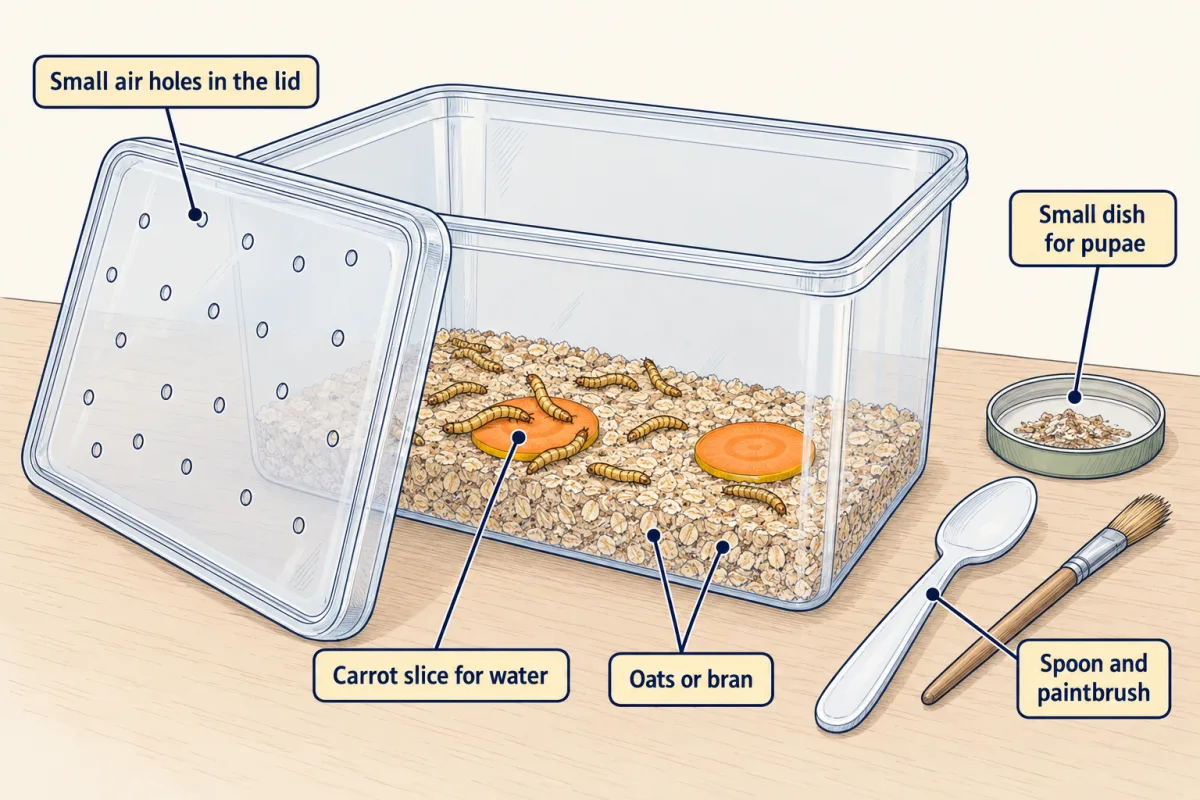
- A clear plastic tub with smooth sides, about the size of a shoebox, with a lid
- A nail or skewer to poke small air holes in the lid (adult only)
- Rolled oats or wheat bran, enough to fill the tub 3 to 5 cm deep (see the safety box if anyone in the home has a wheat allergy)
- A few thin slices of carrot or potato
- A plastic spoon and a soft paintbrush for moving them
- A small dish or jar lid for pupae
- A hand lens and a ruler marked in centimetres
- A notebook or the printed observation sheet below
Virginia science standards SOL 2.4 aSOL 4.3 cSOL K.7 b
In this activity. You and your child set up a tub of mealworms from a bait shop or pet store and check on them a few times a week for about 4 to 10 weeks.
The film
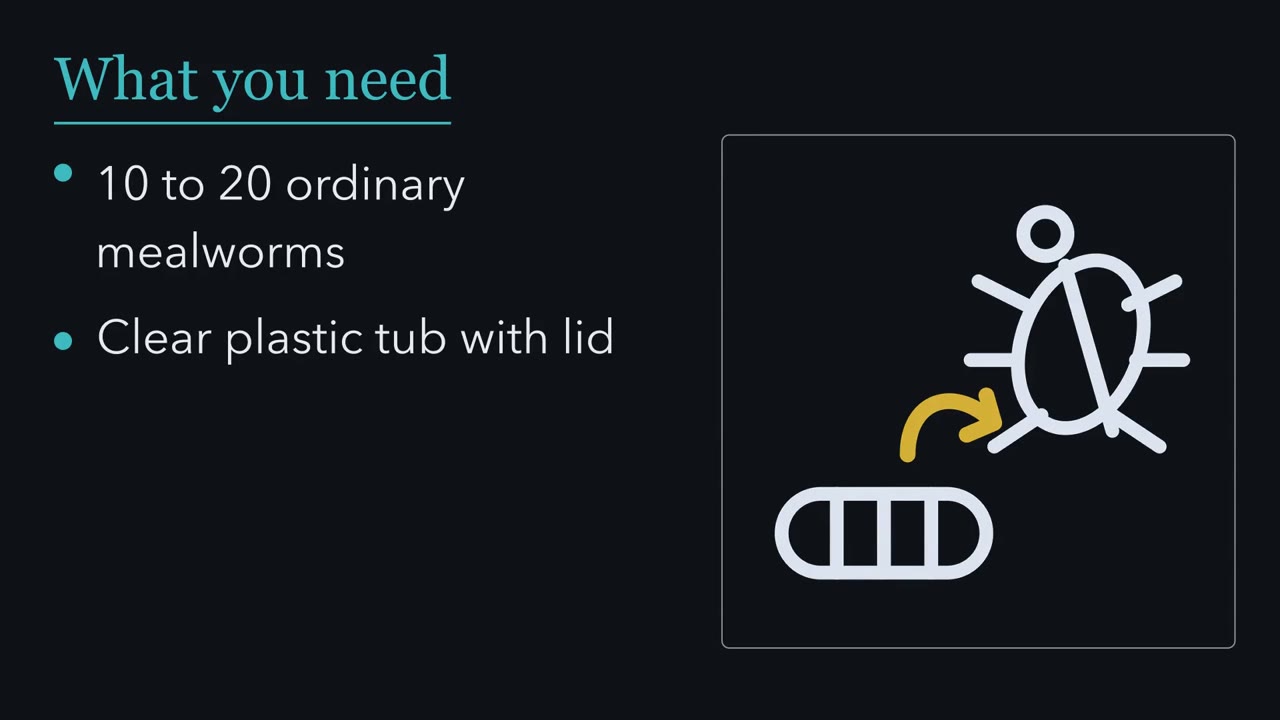 ▶ Watch Mealworms to Beetles: Parent Guide · 3:44
Read the transcript of “Mealworms to Beetles: Parent Guide”
Film transcript: Mealworms to Beetles: Parent Guide
Is a mealworm a worm? It looks like one. But keep a few in a tub for some weeks, and something else climbs out. A kitten looks like a small cat from birth. A mealworm changes into a beetle. At each visit, your child counts and records what they see. Over time, they can check what changed. You need ten to twenty ordinary mealworms from a bait shop or pet store, not giant ones. Add a clear plastic tub with a lid, rolled oats or wheat bran, and a carrot or potato. Stay with your child whenever the tub is open. Keep the lid on between visits. Keep insects, bedding, and vegetable slices away from children under four. Call nine one one if a child is choking.
Keep everything out of mouths. Wash hands with soap after each visit. If your child has asthma or a shellfish or dust mite allergy, ask their doctor first. For wheat allergy, use only bedding their allergist approves. Skip if in doubt. Open the tub away from faces. If breathing is hard, call nine one one. With the lid flat, poke ten to twenty small air holes. Add oats or bran three to five centimeters deep. Cut two thin carrot slices and lay them on top. They provide water. Tip the mealworms onto a plate. Use a hand lens to count legs together. Ask, 'What do you think it will turn into?' Record the guess. Measure two or three mealworms. Then spoon all the mealworms into the tub.
Keep the tub at room temperature and out of direct sun. Visit two or three times a week. Look for shed skins. Count and record each stage. Replace the carrot every two or three days. The first pupae often appear within a few weeks. A pupa is pale, curled, and still. Use a soft brush to move it to a small dish with a little bran. This keeps the other insects from chewing on it. Picture the pale pupa in its dish. Your child sees it sitting still and wonders what will happen next. What do you think will come out?
After about one to three weeks as a pupa, a pale beetle comes out. Once it darkens, move it back into the main tub. Check the first guess together. Measure the beetle and compare it with your mealworm measurements. Look for tiny mealworms in the bedding after a few weeks. Draw the four stages together: egg, larva, pupa, and adult beetle. Ask, 'Which looks like its parent from the start, a kitten or a mealworm?' Make a plan with your child at the start. Never release the insects outdoors.
Offer them to an animal keeper. If nobody takes them, an adult chills them in a sealed container in the fridge for a few hours. Then the adult freezes them in a sealed bag for at least three days before disposal. Look back at the drawing and the notes together. Ask, 'What changed before the beetle came out?' Your child can point to what they saw.
Before you start
- Hands-on time
- About 25 minutes, then 5 to 10 minutes, two or three times a week, for about 4 to 10 weeks
- Where
- Indoors
- Ages
- 5 to 10, with an easier and a harder version below
- Grown-up
- Stay with your child whenever the tub is open, and keep the lid on between visits. You decide where the insects go when the project ends.
What you need
- 10 to 20 ordinary mealworms from a bait shop or pet store (not giant or king mealworms)
- A clear plastic tub with smooth sides, about the size of a shoebox, with a lid
- A nail or skewer to poke small air holes in the lid (adult only)
- Rolled oats or wheat bran, enough to fill the tub 3 to 5 cm deep (see the safety box if anyone in the home has a wheat allergy)
- A few thin slices of carrot or potato
- A plastic spoon and a soft paintbrush for moving them
- A small dish or jar lid for pupae
- A hand lens and a ruler marked in centimetres
- A notebook or the printed observation sheet below
Virginia science standards SOL 2.4 aSOL 4.3 cSOL K.7 b
The big idea
A kitten looks like a small cat from the day it is born. A mealworm looks nothing like the beetle it will become. Watching that change over a few weeks lets your child see a whole insect life cycle up close. Your child counts mealworms, pupae and beetles and records what changes between visits.
Say it together (read aloud): “A mealworm is not a worm. It is a baby beetle. It eats and grows, rests as a still pupa, and then a beetle climbs out.”
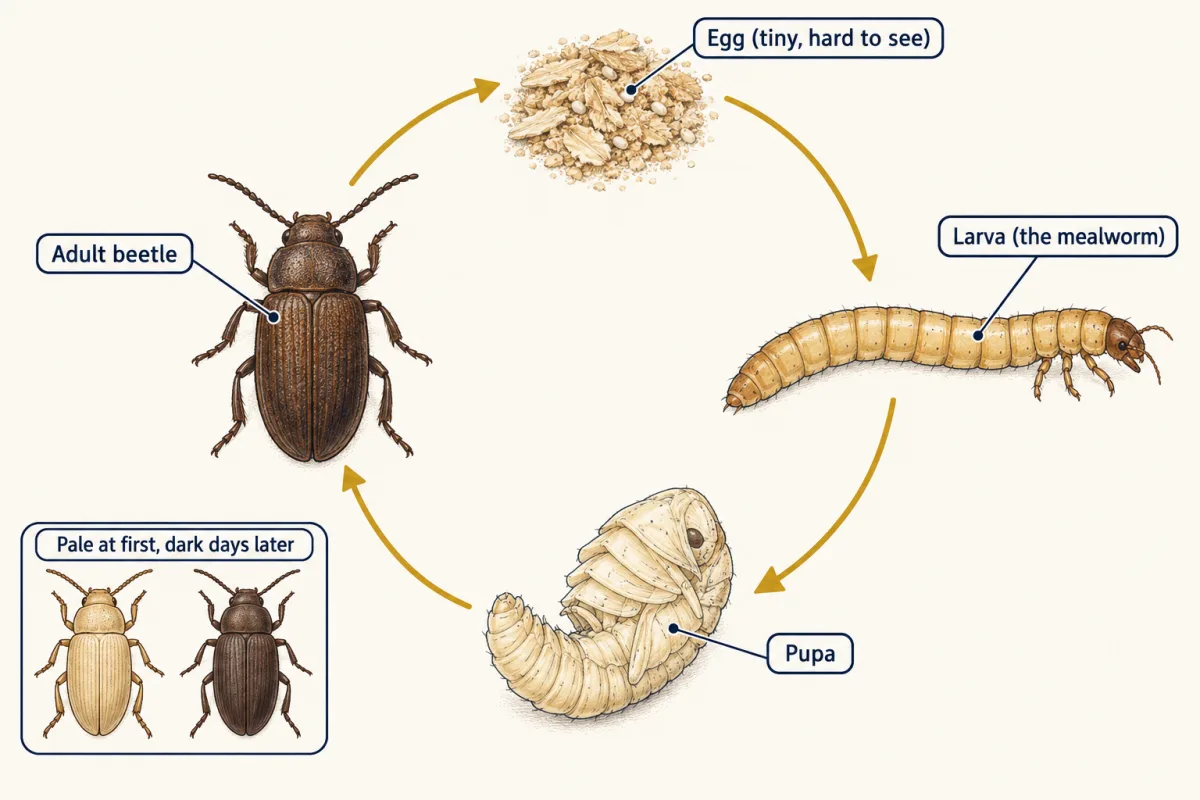
Mealworms are the young of a darkling beetle. They go through four stages: egg, larva (the mealworm, which eats and grows), pupa (a still stage that does not eat while the body is rebuilt) and adult beetle. This kind of life cycle, with a pupa in the middle, is called complete metamorphosis. Butterflies, ladybugs and bees grow up the same way.
For teachers (Virginia standards)
Virginia’s grade 2 standard asks children to compare a life cycle like this with one like a kitten’s, where the young look like the parents from birth. The grade 4 standard adds that what an animal does and needs can change from one life stage to the next. The usual example there is the tadpole and frog, and the mealworm shows a smaller version of the same idea in a tub.
What to do
-
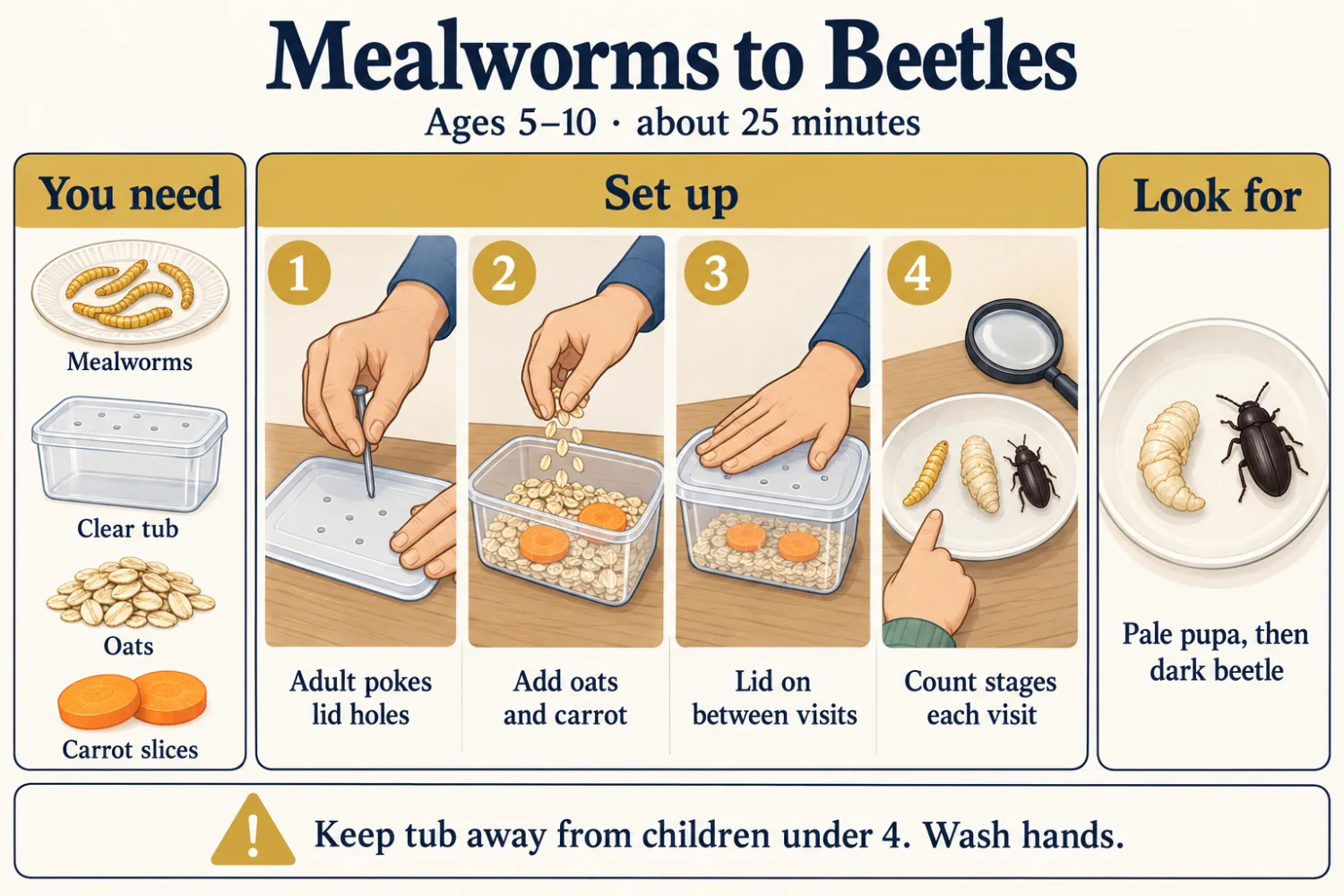
Set up the tub. Say, “These are mealworms. We are going to watch them for a few weeks and see what happens.” You poke 10 to 20 small holes in the lid. Spread oats or bran 3 to 5 cm deep. You cut two thin slices of carrot or potato and lay them on top. The slices give the mealworms water, so no water dish is needed.
-
Meet the mealworms. Tip the mealworms onto a paper plate. With the hand lens, your child counts legs and body parts. Ask, “Is this a worm? What do you think it will turn into?” Write down their guess. Keep it: you will check it when the first beetle appears.
-
Measure and settle them. Measure two or three mealworms in centimetres, then move all the mealworms into the tub with the spoon. Put the lid on and keep the tub at room temperature, out of direct sun, away from heaters and out of the fridge.
-
Visit two or three times a week. Look for shed skins, which are thin and see-through. Count larvae, pupae and beetles, and write the numbers in the table. Swap in fresh carrot every few days.
-
Spot the pupae. Most store mealworms are already large, so the first pupae often appear within a few weeks. A pupa is pale cream and curled. Its legs are folded tight against its body, and it cannot walk. Move each one gently into the small dish with a little bran. Before you look each time, ask, “What do you think the pupa will look like next?”
-
Meet the beetles. After about 1 to 3 weeks as a pupa, a beetle comes out. It starts pale cream or tan and darkens to dark brown or black over a few days. Once a beetle has turned dark, move it back to the main tub. Measure one and compare it with the mealworms you measured. Go back to the guess from the first day: “You thought it would turn into a ___. What did it turn into?”
-
Look for the next round. Beetles lay tiny eggs in the bedding that are very hard to see. After a few weeks, look for very small mealworms. If you see them, the circle is complete.
-
Compare with a mammal. Draw the four stages in a circle. Next to it, draw a kitten growing into a cat. Ask, “Which one looks like its parent from the start?”
-
Debrief. Ask two closing questions:
- “Is a mealworm a worm? How do you know?”
- “Does a baby beetle look like its parent?”
Read Say it together aloud again.
Cool rooms slow everything down. Below about 20 °C (68 °F), the whole project can take two or three months.
With a class, use one tub per table and a shared chart of how many larvae, pupae and beetles there are each week.
Questions to ask while you do it
Ask your child to guess first, then check.
- “I wonder what this thin, empty skin is. Where did it come from?”
- “How many legs do you think a mealworm has? Let’s count.”
- “Is the pupa alive? What could we watch for to find out?”
- “What do you think the beetle will look like when it first comes out?”
- “Do you think the beetle will be bigger or smaller than the mealworm?”
- “What do you think will happen if the tub gets too wet?”
What children often think
-
A child might say “Mealworms are worms.”
You could try Count the legs together with a hand lens. Earthworms have none, and mealworms have six, near the head. A mealworm is a young insect, a beetle larva, so the name is a little misleading.
-
A child might say “The pupa is dead. It doesn’t move.”
You could try Ask, "What would happen if we wait?" A pupa does not eat and barely moves, but its body is changing inside. Some pupae wiggle a little if the dish is tilted. Keep watching for a beetle. A pupa that turns dark all over and goes soft or shrivelled has died, and an adult removes it.
-
A child might say “A beetle came and ate the mealworm.”
You could try Ask your child to watch one pupa every day. They will see the same pupa change into the beetle, often with the old pupa skin left behind. The beetle and the mealworm are the same animal at different ages.
-
A child might say “Grown-up insects get bigger.”
You could try Ask your child to measure a big mealworm and a beetle. The beetle is usually shorter. In insects like this, the larva does all the growing. The adult does not grow any more.
Why it works
An insect has a hard outer skeleton that cannot stretch. To grow, a mealworm splits its old skin and crawls out in a new, larger one. This is called molting, and a mealworm may molt 9 to 20 times, sometimes more, before it is fully grown.
When the larva is big enough, it molts into a pupa. Inside, much of the larval body is broken down and rebuilt as an adult with legs, wings and new mouthparts. The adult beetle does not grow any more. Its job is to mate and lay eggs.
Temperature controls the pace. Mealworms take the temperature of their surroundings, so, up to a point, warmth speeds them up and cold slows them down. In warm rooms a pupa may become a beetle in about a week. In cool rooms it can take three weeks or more. Some “giant” mealworms are raised with a hormone that keeps them from turning into beetles, so ordinary mealworms work better.
Easier and harder
Ages 5 to 7
Keep just five mealworms so counting stays easy. Use picture tallies: draw a worm, a curl and a beetle. At every visit, add a mark under the matching picture for each one you count. Focus on two questions: “Does it look like its parent?” and “What changed?” Let your child hold the hand lens while you move the insects.
Ages 8 to 10
Keep a weekly table of how many larvae, pupae and beetles there are, then make a bar graph for each week. Measure in centimetres at each stage. Try a fair test: set up two tubs the same way, one in a warm spot and one in a cooler room. Change only the temperature and record which tub has pupae first.
If it doesn’t go as planned
If no pupae appear after five or six weeks, the room may be cool, or the mealworms may be a “giant” kind. Move the tub somewhere warmer, around 24 to 27 °C (75 to 80 °F). A smell or fuzzy mould means the bedding is too wet: an adult replaces it outdoors and uses thinner slices. Larvae and beetles sometimes chew on pupae, which is why the pupae get their own dish.
Observation sheet
If you start with five mealworms, here is how to record that first count:
| Date | Mealworms (larvae) | Pupae | Beetles |
|---|---|---|---|
| First visit | 5 | 0 | 0 |
Observation sheet
Mealworms to beetles
NameDate
Each visit, count how many you see of each.
| Date | Mealworms (larvae) | Pupae | Beetles |
|---|---|---|---|
The mealworm was ___ cm long. The beetle was ___ cm long.
Does a baby beetle look like its parent?
stemhop.com · Biology Together
The three stories, told aloud Side Hops: three stories that go with this lesson Side Hops
Three playful ways to talk about mealworms and beetles
1:38 · Narration: an AI narrator voice (Kokoro, af_heart).
Read the transcript
Hi there! If a tub of mealworms is sitting on your counter, here are three playful ways to talk about what is going on inside it.
First, the empty skins. When your child finds a thin, see-through skin in the oats, let them guess where it came from. Then ask a silly question: could you pull a bigger winter coat on underneath a tight sweater? It sounds impossible, but a mealworm does just that. Its hard outside cannot stretch, so it builds a soft, roomy new one inside, splits the old one open and wriggles out. It does this many times, often around fifteen, before it is ready for the next stage.
Second, the big day. When your first beetle climbs out, try cheering, "Welcome to the biggest club on Earth!" Scientists have named more than three hundred eighty thousand kinds of beetles. That is about one out of every four kinds of animals anyone has named. So the little beetle in your tub has an enormous family.
Third, take the idea outside. On a walk, with you close by, look on leafy garden plants for ladybug babies. Many ladybug larvae have six legs and look like tiny spiny alligators, nothing like the round spotted beetles they turn into. Keep it eyes only, and never touch bugs you do not know.
Three small moments, no quiz needed. Just you and your child noticing how strange and wonderful growing up can be when you are a beetle.
The idea underneath them. You and your child set up a tub of mealworms from a bait shop or pet store and check on them a few times a week for about 4 to 10 weeks.
Your notes
Select any text in the lesson to highlight it or add a note to it. Your highlights and notes are saved in this browser and collected in your notebook.
This browser is not letting the site save anything (a private window or strict privacy settings), so highlights and notes will be lost when you leave the page.
Where this lesson fits
Before thisReview first
- Alive or Not?This course · Lesson 1
It teaches that living things grow and change, which helps you ask whether the pupa is alive.
- Like Their Parents, Not the SameThis course · Lesson 3
It shows young that look like their parents, the contrast to compare with mealworms.
After thisStudy next
- Fur, Feathers and ScalesThis course · Lesson 15
It carries on comparing animal bodies, now asking how body coverings help each animal live.
Suggested by an AI model from the lessons themselves, then checked. How we use AI
Those are the stories. The idea under them is the one the lesson builds.
That is the film. The rest of the activity is the fun part.
The rest of the activity is here when you want it.
Finish line
Test yourself
4 questions
Questions to talk over together.
Next · Lesson 15
Fur, Feathers and Scales
Why does a bird have feathers and a fish have scales? Feeling the real thing helps a child find out.
Continue →Rewritten on : new text and film. Notes and highlights stay, but the text around them may have moved.