Biology Together · Unit 5: Animal bodies, homes and adaptations
The Blubber Glove
Rewritten on : new text and film. Your notes and highlights stay, but the text around them may have moved.
How does a seal stay warm in icy water with only short hair? A shortening-filled mitten lets a child feel the answer.
Three real-life stories behind this activity, about 2 minutes aloud, or read them below.
The film, 3 minutes, and the safety notes, for the grown-up to look at before the activity.
The hands-on part, done with a child: about 30 minutes.
Pause when the reading reaches a film, and offer to play it. Saved on this device.
Watch the film now, or keep listening
That is the end of the reading
This idea at other levels
An activity for ages 5 to 10 about adaptations. Next, for an older child: Adaptations for Survival (grade 7).
See every levelHide the levels
This lesson also teaches one more idea; its ladder is below.
Adaptations
An adaptation is a body part or behavior that helps a living thing survive where it lives.
Taught at two levels: ages 5 to 10 and grade 7.
Grade 7 · the level you chose
Body or behavior, always for one setting: the hare that stays white too long.
Life Science · about 40 min · film 3:22 · Virginia LS.7 b
Ages 5 to 10 · the level you chose
Feel feather, fur, scale and shell, then guess where each animal lives.
A grown-up runs this one; its safety notes are in the guide.
Biology Together · about 30 min · film 3:24 · Virginia 1.5 b, 1.5 c, 1.5 a
Kitchen tools as beaks: each shape is good at one food.
A grown-up runs this one; its safety notes are in the guide.
Biology Together · about 35 min · film 3:47 · Virginia 3.4 b, 1.5 b, 3.4 a
The Blubber Glove · this lesson
Line one mitten with shortening, dip both in ice water, see which chills.
Biology Together · about 30 min · Virginia 3.4 b
Damp or dry, dark or light: count where the worms choose to go.
A grown-up runs this one; its safety notes are in the guide.
Biology Together · about 35 min · film 3:51 · Virginia 3.6 a, 3.4 b, 1.5 a, 3.5 b
Next door to adaptations
- Natural selectionSelection is how a population comes to have its adaptations.Nearest lesson: The Camouflage Hunt (ages 5 to 10)
- Keeping warm and keeping coolFur, fat and feathers are adaptations for holding heat.Nearest lesson: Heat Balance and Body Temperature (a first college course)
Keeping warm and keeping cool
Animals stay at a working temperature by balancing the heat they make and gain against the heat they lose.
Taught at three levels: ages 5 to 10, a first college course and upper-level college.
College, upper level · the level you chose
Skin, Sweat and Human Thermoregulation
Sweat cools only if it evaporates, and humid air sets a ceiling.
Physiology · about 30 min · film 2:29 · 3 practice questions
College, a first course · the level you chose
Heat Balance and Body Temperature
Heat made plus heat gained equals heat lost: lizards, mammals, fever, hibernation.
Organismal Biology · about 25 min · film 3:13 · 3 practice questions
No lesson on body temperature at high school yet.
Ages 5 to 10 · the level you chose
The Blubber Glove · this lesson
Dip a shortening-lined mitten in ice water and feel fat hold heat in.
Biology Together · about 30 min · film 3:18 · Virginia 3.4 b
Play the ladder · 3 films, about 9 min, from a first college course to upper-level college. Each film waits for you to press play.
Next door to body temperature
- Homeostasis and feedbackTemperature control is one feedback loop among many.Nearest lesson: Homeostasis in Action (high school)
- AdaptationsBlubber, fur and feathers are adaptations for the same job.Nearest lesson: Fur, Feathers and Scales (ages 5 to 10)
Short versions inside this lesson
The grade 7 version · about 1 minute to read
In grade 7 Life Science, children sort adaptations into physical ones, like blubber or white winter fur, and behavioral ones, like huddling together or migrating to warmer places. They look at trade-offs, such as a coat that hides an animal in snow but shows it up when snow melts early. They also learn that populations adapt over many generations, while single animals do not.
The plainest version · about 1 minute to read
Your body makes its own heat. Cold water pulls that heat away fast. Seals, whales and walruses have a thick layer of fat under their skin called blubber. Heat moves through fat slowly, so the blubber holds the animal's own warmth in. The fat does not make heat. It slows the heat from leaving, just like the shortening in your mitten.
Find an idea: every idea, searchable
Which lessons teach an idea, and the notes on each level, were written by AI models from the lessons and checked by a second model. A person has not yet read every one. How we use AI
About this activity what is in it
Builds on:Fur, Feathers and Scales (read)Why these?
Rewritten on : new text and film. Notes and highlights stay, but the text around them may have moved.
Before you start
- Hands-on time
- About 30 minutes
- Where
- Indoors
- Ages
- 5 to 10, with an easier and a harder version below
- Grown-up
- Stay with your child the whole time, and you set up and empty the ice water. Your child can pull a hand out at any moment, and every try stops at one minute.
What you need
- 4 gallon-size zip bags
- About 2 cups of solid white vegetable shortening (about one 16-ounce can)
- Duct tape or packing tape
- A large bowl or dishpan, cold water and 2 trays of ice cubes
- A timer or a clock with a second hand
- 2 towels and some paper towels
- For the harder version: an instant-read kitchen thermometer, 2 sandwich bags, warm tap water, cotton balls and craft feathers (optional)
- Paper and a pencil, or the printed observation sheet below
Virginia science standards SOL 3.4 b
In this activity. You build two plastic-bag mittens, one lined with a thick layer of vegetable shortening and one with nothing inside.
The film
 ▶ Watch The Blubber Glove: Parent Guide · 3:18
Read the transcript of “The Blubber Glove: Parent Guide”
Film transcript: The Blubber Glove: Parent Guide
Picture a seal swimming in icy water all day with only short hair. How does it stay warm? With four zip bags and vegetable shortening, your child can feel the answer at your kitchen table. In this thirty-minute activity, your child practices making a guess and checking it right away. They compare how their hands feel and check whether the result repeats after switching mittens. Stay with your child from setup through cleanup. Set out four matching gallon-size zip bags, tape, towels, a timer, and a bowl. Check the vegetable shortening label for food allergies. Put about two cups in one bag. Slip a second bag inside. Tape the folded rims together and leave the inner bag open.
Spread the shortening about a finger's width around the inner bag. Make a plain mitten with the other two bags and nothing between them. Squeeze out extra air so the fat is the only difference. Fill the bowl two-thirds with cold water, add two trays of ice, and wait five minutes. Have your child feel the shortening through the bag.
Ask, 'Does it feel warm or cool?' Ask, 'Which hand will feel cold first?' Write down the guess. Have your child dip both mittens to the wrists, with the openings above water. Start the timer. Have your child say which hand feels cold as soon as they notice it. Record the time when each hand first feels cold. Stop at one minute, anytime your child wants, or at the first sign of discomfort. Dry and gently warm both hands. Wait about five minutes, until both hands feel normal. Then swap mittens and repeat. After the test, ask your child, 'Where did that warmth come from?' Many kids say the shortening made heat, or blocked the cold from getting in.
Pause for a moment and picture it yourself. Which way is heat actually moving? Heat always flows from warm places to cold ones. Cold never moves into the hand. Your child's hand made the warmth, and the fat slowed its escape. A seal has a thick layer of fat under its skin called blubber. That layer slows heat loss. Stop for stinging, tingling, numbness, pain, or unusual skin color. Never leave a child alone with the bowl. Empty it right afterward. Keep bags and ice away from children under four. Call nine one one if choking. Never use dry ice. If your child skips cold water, or wants a harder test, try the guide's thermometer version. Then look at a seal together and ask where its mitten is.
Ask what they noticed and how it helps explain why a seal loses heat more slowly.
Before you start
- Hands-on time
- About 30 minutes
- Where
- Indoors
- Ages
- 5 to 10, with an easier and a harder version below
- Grown-up
- Stay with your child the whole time, and you set up and empty the ice water. Your child can pull a hand out at any moment, and every try stops at one minute.
What you need
- 4 gallon-size zip bags
- About 2 cups of solid white vegetable shortening (about one 16-ounce can)
- Duct tape or packing tape
- A large bowl or dishpan, cold water and 2 trays of ice cubes
- A timer or a clock with a second hand
- 2 towels and some paper towels
- For the harder version: an instant-read kitchen thermometer, 2 sandwich bags, warm tap water, cotton balls and craft feathers (optional)
- Paper and a pencil, or the printed observation sheet below
Virginia science standards SOL 3.4 b
The big idea
In about 30 minutes, your child feels how fat slows heat loss in cold water. They practice guessing first, timing a fair test with one change, and checking the result by swapping hands.
Say it together: “Your body makes its own heat, and cold water pulls heat away fast. Seals, whales and walruses have a thick layer of fat under their skin called blubber. Blubber does not make heat. It slows warmth from leaving.”
Ask your child: “How would your finger feel in ice water? How does a seal swim in water that cold all day?”
Cold water pulls body heat away much faster than cold air. Blubber does not make heat or “keep the cold out”—it keeps heat in. It is a physical adaptation, a body feature that helps an animal survive where it lives. A behavioral adaptation is something an animal does, like a seal hauling out onto a rock to rest.
For teachers: Virginia standard (SOL 3.4 b)
Virginia’s grade 3 Science standard (SOL 3.4 b) asks children to tell physical adaptations, like blubber, from behavioral ones, like a seal hauling out onto a rock to rest.
What to do
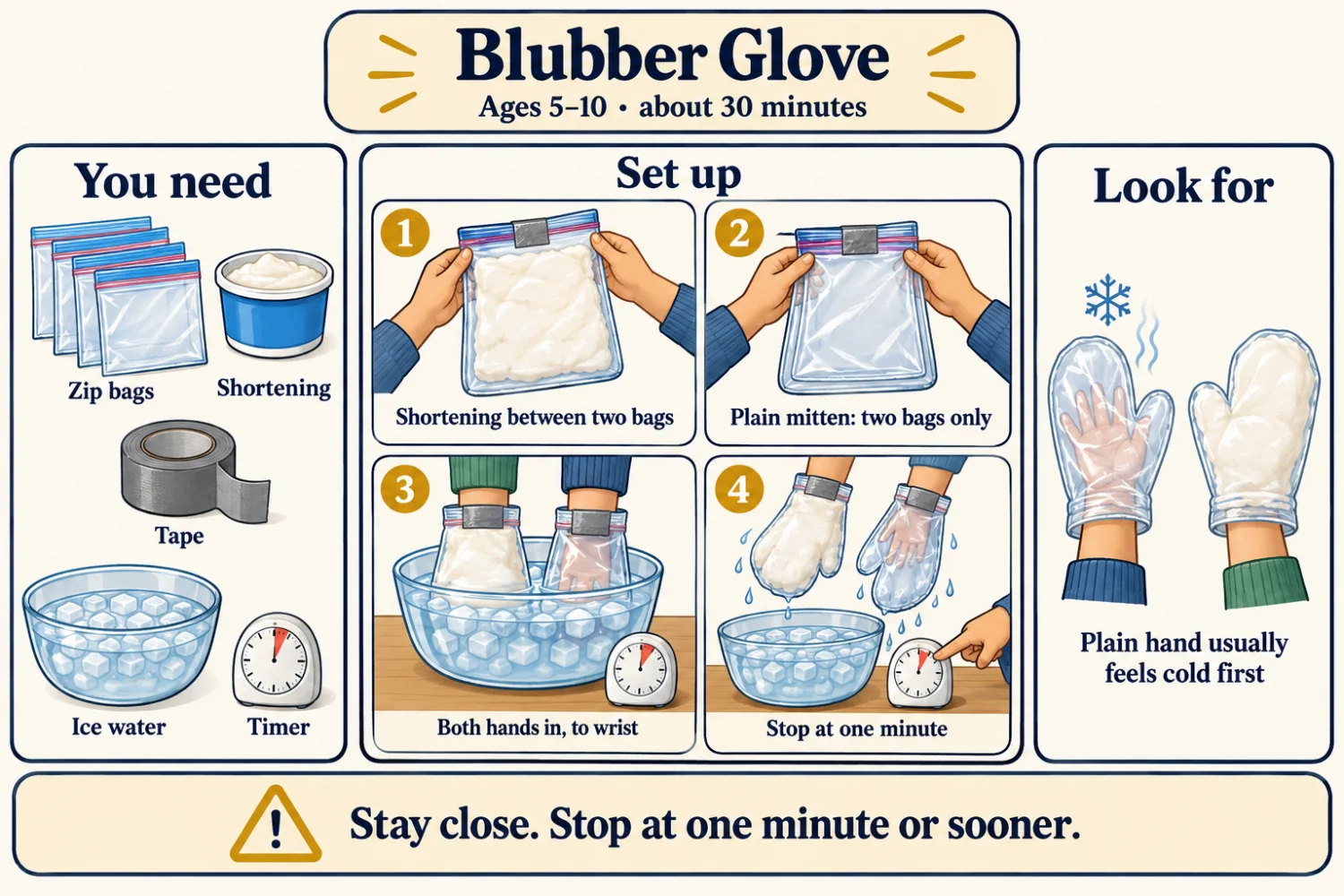
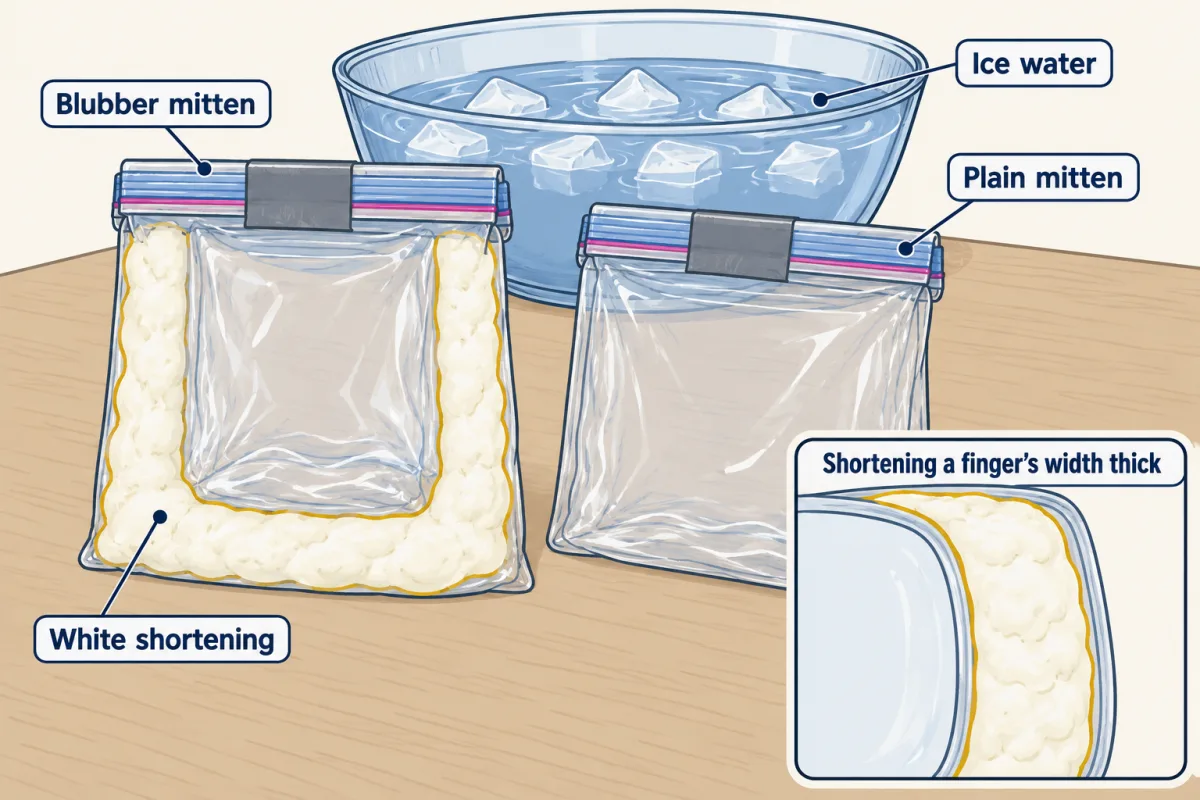
- Build the blubber mitten. Scoop about 2 cups of shortening into a gallon zip bag. Slide a second gallon bag inside, openings lined up. Fold and tape the tops so the inner bag stays open. Have your child squish the shortening about a finger’s width thick around the inner bag.
- Build the plain mitten. Repeat with the other two bags and nothing between them. Squeeze out extra air. Say: “Count the bags in each mitten. Both have two bags, so the fat is the only difference.”
- You chill the water. Fill the bowl about two-thirds with cold water and add 2 trays of ice. Wait 5 minutes. Ice water sits close to 0 °C (32 °F).
- Touch before dipping. Have your child feel the shortening bag. Ask: “Does it feel warm, or cool like the room?” They will notice it feels cool—it does not make heat.
- Predict, then check. Ask: “What do you think will happen? Which hand will feel cold first, and after how many seconds?” Write down the guesses.
- Dip and time. Your child slips one hand into each mitten and lowers both to the wrist, keeping the open tops above the water. Start the timer. They call out “cold” when a hand first feels cold. Note the seconds and stop at 60 seconds or sooner. Usually the plain hand feels cold well before the blubber hand; times will vary.
- Warm up, predict and swap. Dry both hands and warm them gently—no hot water, no heater, no hard rubbing. Wait about 5 minutes until they feel normal. Ask: “What do you think will happen if we swap mittens to the other hands?” Swap and test again to check whether one hand is less sensitive. Empty the bowl as soon as you finish.
- Two-question debrief. Ask your child two questions about what happened.
- “Where did the warmth in the blubber hand come from—the shortening or your own hand?”
- “Look at a picture of a seal or whale. Where is its ‘mitten,’ and what does it do?”
Questions to ask while you do it
Ask your child to guess first, then check.
- “Which hand do you think will feel cold first? Why?”
- “I wonder where the warmth in the blubber hand came from. Did the shortening make it?”
- “What do you think would happen with a thinner layer of fat? A thicker one?”
- “A seal is in the water all day. What would happen to a seal with no blubber?”
- “What would happen if we put fluffy fur in the mitten and it got wet?”
What children often think
-
A child might say “The fat is warm. It makes heat.”
You could try Have your child touch the shortening first and ask, "Does it feel warm?" It feels cool, like the room. The warmth came from their hand; fat only slows heat from leaving.
-
A child might say “The blubber keeps the cold out.”
You could try Ask, "Which way does warmth move—from your hand to the water, or the other way?" Heat moves from warm to cold. Cold does not move in; blubber slows heat leaving.
-
A child might say “Fur would work just as well in the water.”
You could try Test dry cotton, then wet cotton with the thermometer version. Most fur loses its trapped air when soaked. That air slows heat loss. Most seals rely on blubber; sea otters have no blubber, but their dense fur holds tiny air bubbles.
-
A child might say “My hand got cold because the plain bag is thinner.”
You could try Great fair-test thinking. Count the bags in each mitten together. Both use two identical bags, so the fat is the only difference.
Why it works
Heat always flows from warmer places to colder ones. Water draws heat from skin many times faster than air at the same temperature, which is why a cold swim chills you faster than a cold day. Fat conducts heat poorly, so a thick layer slows that flow. In a living seal, blood vessels inside the blubber narrow in cold water, sending less warm blood near the surface.
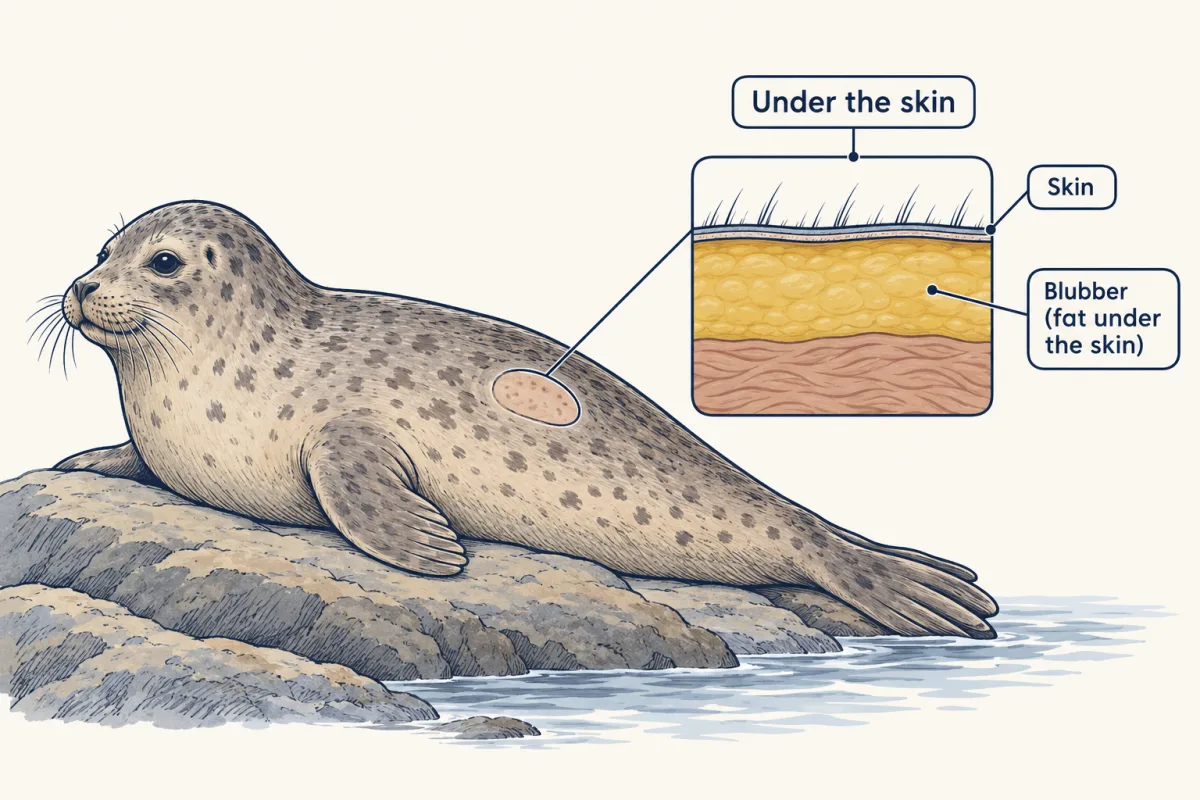
Blubber stores energy the animal can use when food is scarce. It is lighter than seawater, which helps the animal float. Weddell seals in Antarctica can carry more than 5 cm of blubber. Bowhead whales in the Arctic can carry 43 to 50 cm.
Polar bears have both thick fat and thick fur. On ice, thick, dry fur traps air and helps keep the polar bear warm. In cold water, wet fur holds less air, so the fat layer matters more. Sea otters have no blubber—their very dense fur traps tiny air bubbles instead.
Easier and harder
Ages 5 to 7
Do one round only. Keep the timer running yourself so the try stops at 1 minute. Your child calls out which hand feels cold first while you count out loud together, then points to the blubber on a seal picture. Set the bowl on a low, steady table so they reach in without leaning, and keep any child under 4 away.
For older children (8 to 10)
Run the thermometer version as a fair test. You fill and seal two sandwich bags with equal warm tap water (comfortably warm on your wrist, well below 49 °C or 120 °F) and handle the thermometer probe to confirm both start at the same temperature. Place one inside each mitten in the ice water, read temperatures every 2 minutes for 10 minutes, and draw a line graph. Ask what they predict for other linings, then test cotton balls, craft feathers, wet cotton and nothing.
If it doesn’t go as planned
- Both mittens feel the same: Squeeze trapped air out of the plain mitten before dipping; air insulates too.
- Water leaks in: End the try at once. Dry and warm the hand. Empty or replace the wet bag. Keep the openings farther above the water next time.
- Shortening is stiff: Leave cold shortening at room temperature before spreading.
- Cleanup: Throw used shortening in the trash, not down the sink.
Observation sheet
Worked example. Write a guess for each hand and which hand you think will feel cold first. Record the time when each hand first feels cold. If a hand is still comfortable at the end, write that beside the stop time. For example, write still comfortable at 60 seconds for the blubber hand if it never felt cold. If your child stops early, record when and why. Record the two tries separately. Times will vary.
Observation sheet
The blubber glove
NameDate
Guess first. Then count the seconds until each hand feels cold. Stop at 60.
| Try | Hand with blubber (seconds) | Hand with no blubber (seconds) | Which felt cold first? |
|---|---|---|---|
| My guess | |||
| Try 1 | |||
| Try 2 (hands swapped) |
The blubber helped because:
stemhop.com · Biology Together
The three stories, told aloud Side Hops: three stories that go with this lesson Side Hops
Three playful ways to talk about blubber
1:32 · Narration: an AI narrator voice (Kokoro, af_heart).
Read the transcript
Getting ready for the Blubber Glove? Here are three easy ways to keep the chat playful while those mittens go into the ice water. First, before you even chill the bowl, share one quick line: water passes heat along about twenty-five times better than air, so cold water pulls warmth from your body much faster than air that is just as cold. Suddenly every seal and whale looks like it needs serious gear. Second, if your child decides the shortening must be warm, grab a puffy winter coat from a cool closet and let them slip a hand into the empty sleeve. It feels chilly at first, and then it warms up from their own hand. A beluga whale wears a built-in coat like that, with blubber making up as much as forty percent of its body weight. Third, after the mitten test, as you dry and warm their hands, toss out a question with no wrong answer: a walrus cannot take off its blubber, so how does it cool down on a sunny rock? Kids love to guess splashing or hiding in the shade. Cheer whatever they invent, then share the surprise: walrus skin looks pale in cold water and turns pink in warm air, which scientists think shows blood flow near the skin shifting to let heat out. Coat or blubber, the warmth comes from the body, and the trick is keeping it in. The walrus shows the flip side: sending more blood to its skin may be a way to let extra heat out.
The idea underneath them. You build two plastic-bag mittens, one lined with a thick layer of vegetable shortening and one with nothing inside.
Your notes
Select any text in the lesson to highlight it or add a note to it. Your highlights and notes are saved in this browser and collected in your notebook.
This browser is not letting the site save anything (a private window or strict privacy settings), so highlights and notes will be lost when you leave the page.
Where this lesson fits
Before thisReview first
- Fur, Feathers and ScalesThis course · Lesson 15
Your child has already felt how fur, feathers and scales cover animals, so blubber is one more body covering.
After thisStudy next
- The Camouflage HuntThis course · Lesson 18
Another body feature that helps an animal survive where it lives, this time by hiding it.
Suggested by an AI model from the lessons themselves, then checked. How we use AI
Those are the stories. The idea under them is the one the lesson builds.
That is the film. The rest of the activity is the fun part.
The rest of the activity is here when you want it.
Finish line
Test yourself
4 questions
Questions to talk over together.
Next · Lesson 18
The Camouflage Hunt
Why are so many animals brown or green? A hungry-bird game lets a child find out which colours stay hidden.
Continue →Rewritten on : new text and film. Notes and highlights stay, but the text around them may have moved.