Taking Phosphates Off Opens the Door
Read the transcript of “Taking Phosphates Off Opens the Door”
Film transcript: Taking Phosphates Off Opens the Door
CREB is switched on by adding a phosphate. NFAT is switched on by taking phosphates off. In a resting T cell, NFAT stays in the cytoplasm. Its many phosphates hide its signal for import into the nucleus. When the T-cell receptor fires, calcium rises and stays high. Calcium and calmodulin switch on calcineurin, a protein phosphatase. Calcineurin strips the phosphates from NFAT. The import signal is exposed, and NFAT enters the nucleus. There it binds DNA beside a Fos-Jun pair, on genes such as interleukin-2. Cyclosporin A and FK506 both shut T cells down. Each is held by a small helper protein. FK506 is held by FKBP12, and cyclosporin A by cyclophilin.
In 1991, Schreiber's group and collaborators reported that each drug, held by its helper, binds and inhibits calcineurin. But that was a test tube result. Is that why the T cell shuts down? In 1992, Neil Clipstone and Gerald Crabtree answered it. They made T cells produce extra calcineurin. Those cells were more resistant to both drugs, and NFAT-driven transcription went up. If more enzyme means more drug is needed, the enzyme is the target. Jam calcineurin, and NFAT keeps its phosphates and stays in the cytoplasm. So the interleukin-2 gene stays quiet.
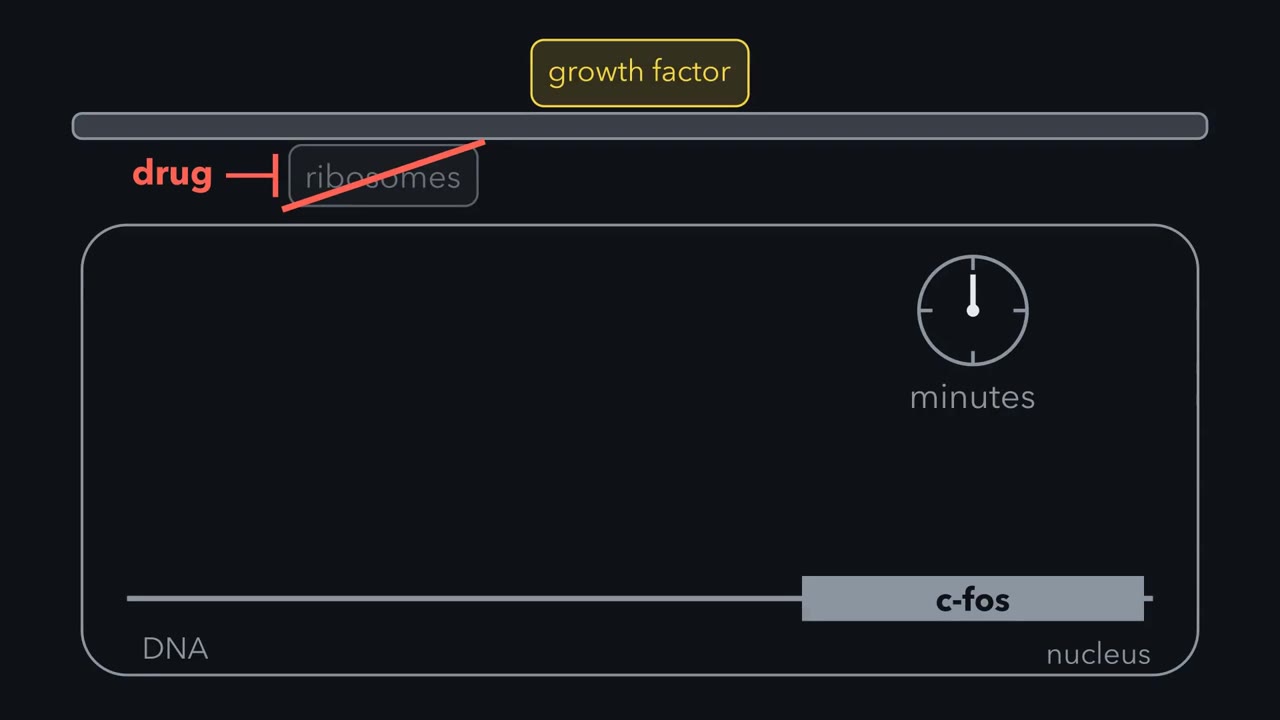
A resting cell starts transcribing c-fos within minutes of a signal, even with its ribosomes stopped. What was waiting in the nucleus?
Continue in the lesson: Signaling to the Nucleus: CREB, AP-1 and Immediate Early Genes →
1:59 · Free, with captions and a transcript. The lesson has the full text, the questions and the sources.
More films from this lesson
How this film was made. Narration: an AI narrator voice (ElevenLabs, Sarah) reading narration written from this lesson's text. Animation: AI-generated in code (Manim) by Claude, a schematic with no drawn molecular structures. Captions come from the narration script. See something wrong? Report it.