Centre Minus Surround
Read the transcript of “Centre Minus Surround”
Film transcript: Centre Minus Surround
Why does a ganglion cell answer a small spot better than light spread over the whole retina? In 1953, Stephen Kuffler recorded single ganglion cells in cats. He shone small spots of light onto the retina. A spot in the middle of the field made one cell fire faster. A spot on a ring around the middle made the same cell fall silent. When the light went off, it fired. That is an ON-centre cell. An OFF-centre cell does the mirror image. The centre comes from the bipolar cells that contact the ganglion cell. The surround comes from cells that act sideways. Horizontal cells do this in the outer retina, and amacrine cells add more in the inner retina. Both push the response the opposite way from the centre.
Now light the whole field, centre and surround together. More spikes than the best spot, fewer, or no change from the background? In this example, fewer: 45 spikes a second instead of 60. Its surround cancels only part of the centre. So the cell reports contrast, a spot brighter than its surroundings, more than overall light level. Now line up a row of ON-centre cells across an edge, where light meets dark. The cell right on the edge is not the winner. In this model, cells just on the bright side fire most. Their surrounds reach into the dark and subtract less. Cells just on the dark side fire least. The edge stands out across the population.
The same logic gives colour. One cone cannot tell a change in wavelength from a change in intensity. Compare two cones with overlapping curves, and their ratio changes with wavelength. Turn the light up, and the ratio holds. But in pigment models the ratio can repeat. Set two wavelengths to the same L catch, and their M catches match too. The S cone catches far more of the shorter one, so it tells them apart. Here is the whole rule. One receptor cannot separate wavelength from intensity. The circuit compares. The takeaway: ganglion cells send those comparisons to the brain as spikes.
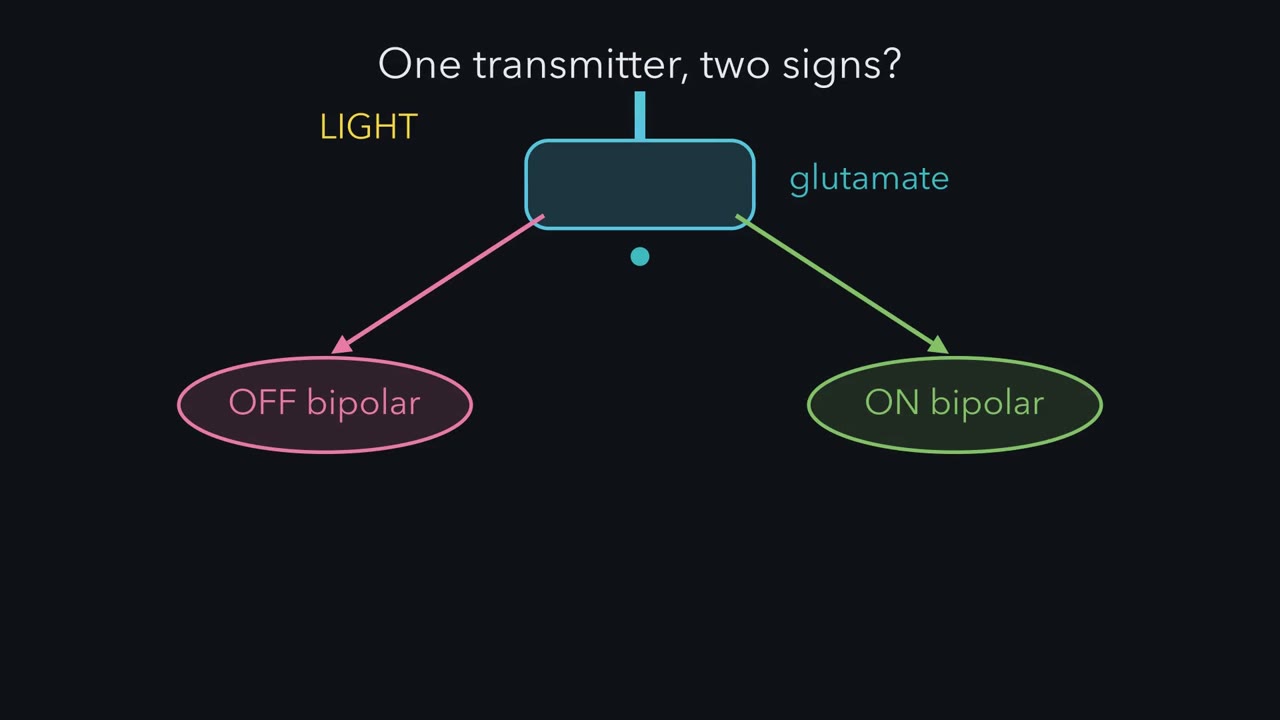
A rod in the dark is depolarized and releasing glutamate. A flash of light turns it down. How does quieting a cell let you see?
Continue in the lesson: The Retina →
2:31 · Free, with captions and a transcript. The lesson has the full text, the questions and the sources.
More films from this lesson
How this film was made. Narration: an AI narrator voice (Kokoro, af_heart) reading narration written from this lesson's text. Animation: AI-generated in code (Manim) by Claude, a schematic with no drawn molecular structures. Captions come from the narration script. See something wrong? Report it.