Press play to start at .
Which Line Has Moved?
From the film
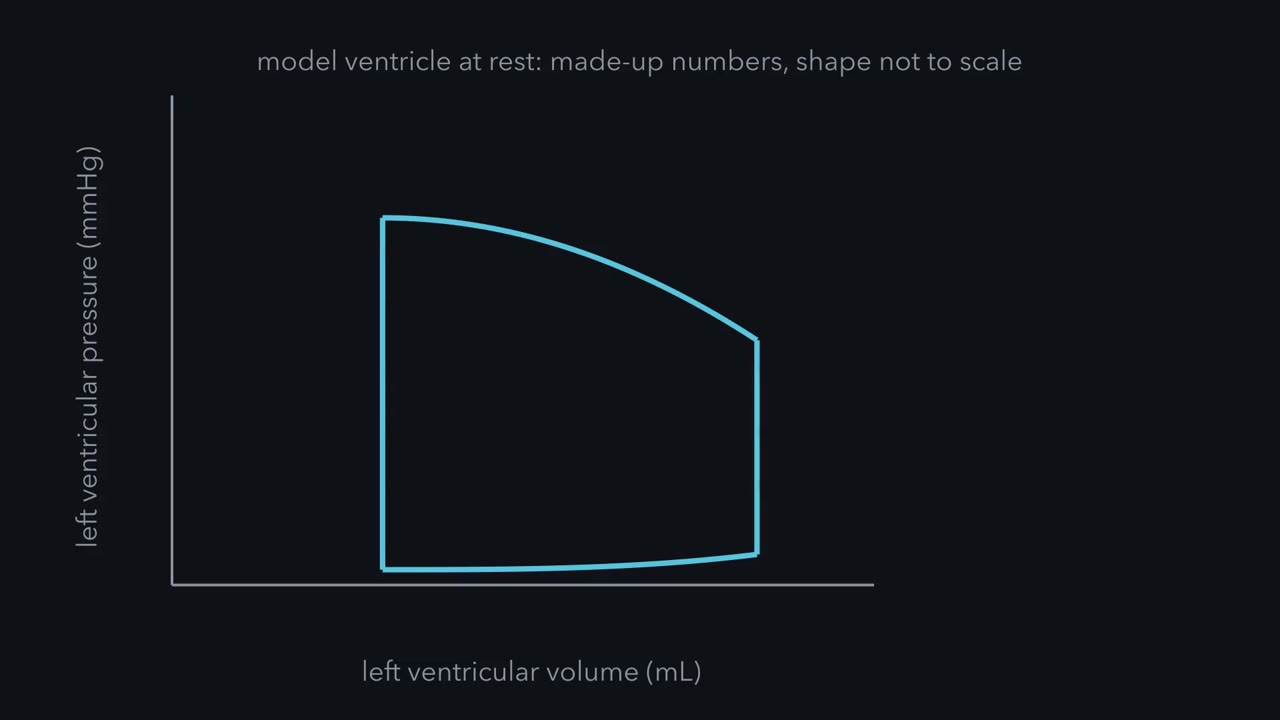
- Under the loop runs the passive filling curve, the end-diastolic pressure-volume relation; its slope indexes chamber stiffness.
- In heart failure with reduced ejection fraction, remodelling shifts the lines and the loop to the right, and the ventricle's line is usually flatter.
- In heart failure with preserved ejection fraction, the filling curve shifts up and to the left, so the same volume sits at a higher pressure.
- The ventricle's line belongs to the whole chamber: thick walls and passive stiffness can steepen it, so a steeper line need not mean stronger muscle.
- In aortic stenosis the narrowed valve adds to afterload and the top of the loop domes upward; a thickened wall can keep ejection fraction near normal until the ventricle starts to fail.
Read the transcript of “Which Line Has Moved?”
Film transcript: Which Line Has Moved?
Tap a sentence to play from there.
- 0:00 Last time, each beat ended where two lines crossed: the ventricle's line and the arteries' line. But a loop also has a floor.
- 0:10 When a heart fails, which line has moved?
- 0:16 Under the loop runs a third line, a soft curve.
- 0:20 It is the passive filling curve, the end-diastolic pressure-volume relation.
- 0:26 Once relaxation is complete, the bottom of the loop lies on it.
- 0:31 Its slope indexes chamber stiffness.
- 0:34 Start with heart failure with reduced ejection fraction.
- 0:38 Remodelling shifts the ventricle's line, the floor and the loop to the right.
- 0:44 The ventricle's line is usually flatter, its contractility index lower.
- 0:49 The result is a large chamber ejecting a small fraction of its volume.
- 0:55 So ask of every sick loop, not only how much it ejects, but which line has moved.
- 1:01 The ventricle's line tracks the squeeze.
- 1:04 The floor tracks filling.
- 1:07 The arteries' line tracks the load.
- 1:10 Now heart failure with preserved ejection fraction.
- 1:14 Here the floor moves.
- 1:17 Catheter studies found the filling curve shifted up and to the left.
- 1:22 Passive stiffness was higher, and relaxation was slower.
- 1:26 Fill this stiffer chamber to the same volume as a normal one.
- 1:30 What happens to the pressure at the bottom right corner, where filling ends?
- 1:40 It runs higher. On a floor shifted up and left, the same volume sits at a higher pressure. A catheter study of 70 people with this condition found stiffer chambers at rest. When handgrip raised afterload, their end-diastolic pressures rose more than in the comparison group.
- 2:01 The study did not show what causes the stiffness.
- 2:05 In a small catheter study, the ventricle's line was steeper too.
- 2:11 But that slope belongs to the whole chamber.
- 2:14 Thick walls and passive stiffness can steepen it.
- 2:18 In one community study, the slope was raised, yet contractility was depressed.
- 2:24 A steeper line need not mean stronger muscle.
- 2:27 In aortic stenosis, the narrowed valve adds to afterload.
- 2:32 Ventricular pressure climbs, and the top of the loop domes upward.
- 2:37 A thickened wall can keep ejection fraction near normal, until the ventricle starts to fail.
- 2:43 Reduced ejection fraction, preserved ejection fraction, a narrowed valve: each moves different lines. Read the loop for where the trouble sits, in the squeeze, the filling or the load.
The cardiac cycle: the same idea, other levels
A level is a place to start, not a rank. If this loses you, the rung below teaches the same idea, told more simply.
College, upper level · the level you chose
The Cardiac Cycle and Pressure-Volume Loops · this lesson
Where two lines meet: stroke volume from Ea and Ees, and why EF misleads.
Physiology · about 34 min · film 2:44 · 4 practice questions
Next door
- The electrocardiogram: The Edges of the Wave · 3:24 The electrical waves on a skin trace come just before each fill and squeeze step of the heartbeat.
- Cardiac output: Output Is Where the Curves Cross · 3:12 Each beat's volume, multiplied by heart rate, gives the blood the heart sends out each minute.
- Muscle contraction: Smooth muscle force is a balance · 2:42 Each squeeze of the heart is heart muscle shortening, using the same sliding filaments and calcium switch.
More films from this lesson
Continue in the lesson: The Cardiac Cycle and Pressure-Volume Loops →
Free, with captions and a transcript. The lesson has the full text, the questions and the sources.
How this film was made. Narration: an AI narrator voice (Kokoro, af_heart) reading narration written from this lesson's text. Animation: AI-generated in code (Manim) by Claude, a schematic with no drawn molecular structures. Captions come from the narration script. See something wrong? Report it.