Around the Loop, and Out of It
Read the transcript of “Around the Loop, and Out of It”
Film transcript: Around the Loop, and Out of It
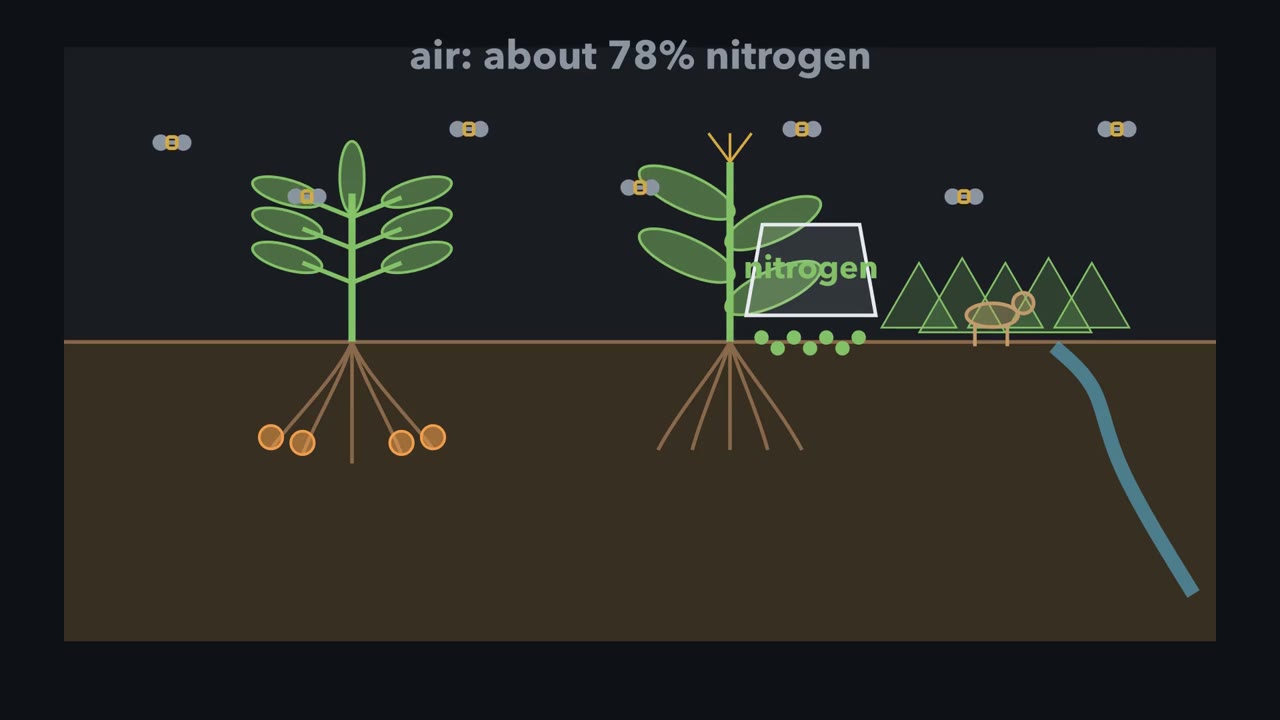
Follow one nitrogen atom. Once it is part of a soybean leaf, is it there for good? Or does it keep on moving? In the first film, nitrogen gas stayed locked until a changer opened it. Now follow one atom that a nodule changed. Here is our atom, one half of a grey pair in the air. A nodule changes it into usable nitrogen. The plant builds it into a protein in a leaf. A white-tailed deer wanders over and eats the leaf. The deer digests the leaf's proteins. Our atom becomes part of a protein in the deer's body. Animals get nitrogen by eating plants or other animals. Later, the deer dies in the woods. Is its nitrogen gone for good, or not? Pause and decide.
No, it is not gone. Decomposers go to work. A decomposer is a living thing, such as a fungus or a bacterium, that breaks down dead things and wastes. Decomposers break down the deer's body and its droppings. Our atom returns to the soil as usable nitrogen, one green dot in the soil water. A corn root reaches it and takes it up. Same atom, second plant. The corn builds our atom into a brand new protein in one of its leaves. Later, the corn plant dies.
Decomposers return our atom to the soil as one usable form. In soil with oxygen, other bacteria change it into a second usable form. Then heavy rain soaks the soil, and little oxygen is left. Different bacteria change that second form back into nitrogen gas. Our atom rises into the air again. This loop, from the air, through the soil and living things, and back to the air, is the nitrogen cycle. At every step, our atom changed form. It was never made, and never destroyed. Now a second case. A farmer spreads far more fertilizer than the corn can take up. The pool of green dots fills, and then overflows. Then a heavy rain falls. Water moving over and through the soil carries the extra green dots into a stream.
The stream flows toward the Chesapeake Bay. In the Bay, the extra nitrogen feeds an algal bloom, a fast growth of algae in the water. The water near the surface turns thick and green. So nitrogen goes around the loop, changing form, and is never used up. But water can carry it out of a field, and into the Bay.
If the air is mostly nitrogen, why does a cornfield need nitrogen added while the soybeans next door often do not?
Continue in the lesson: Nitrogen for Life →
3:09 · Free, with captions and a transcript. The lesson has the full text, the questions and the sources.
More films from this lesson
How this film was made. Narration: an AI narrator voice (Kokoro, af_heart) reading narration written from this lesson's text. Animation: AI-generated in code (Manim) by Claude, a schematic with no drawn molecular structures. Captions come from the narration script. See something wrong? Report it.