Who Selects the Breeders?
Read the transcript of “Who Selects the Breeders?”
Film transcript: Who Selects the Breeders?
The first film showed birds and bark sorting inherited moth colours. Can people shift a trait by choosing who reproduces? Keep the parent row, offspring row and changing trait frequency. The population picture still works.
Replace the moths with a row of plants that vary in an inherited trait. Some show the wanted form strongly. Others show it less. Their colours match the first film's map. Each plant keeps its inherited version of the trait. A farmer marks the plants with the wanted trait and saves seeds from those plants. The choice is deliberate. The choice changes who contributes offspring.
Plants without the mark may grow, but their seeds are not used here. If the farmer repeats that choice, what should happen to the wanted inherited trait over generations? Watch the empty offspring rows before they fill. The next row has a larger share of the wanted form. The selected form came from the starting variation. No plant changed its own inherited trait. The population changed because selected plants contributed more offspring to the next generation. Repeat the cycle: inherited variation, chosen breeders, then offspring. Across generations, the wanted trait becomes more common. The trait shifts without any organism choosing to change.
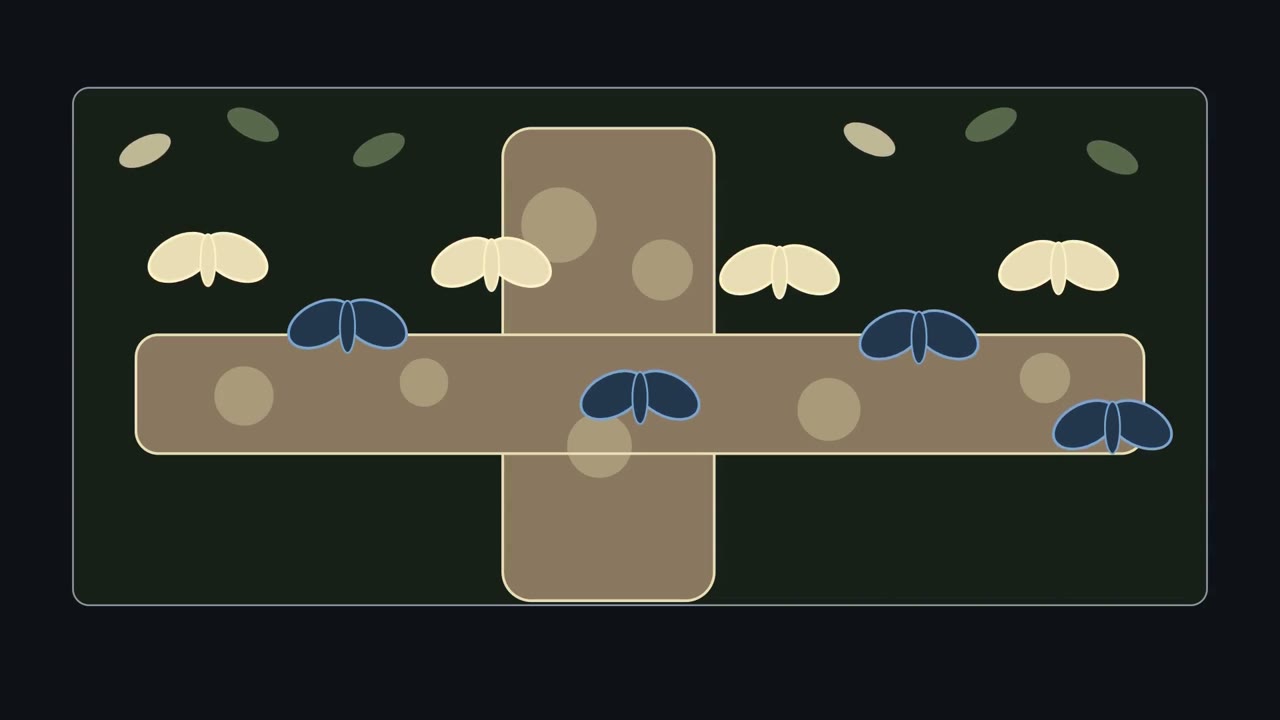
This is artificial selection, when people choose which plants or animals breed. Bring back the moth filter. In natural selection, conditions such as predators affect which inherited traits help organisms reproduce. In artificial selection, people choose the breeders. Both can shift inherited traits across generations.
Neither process changes an organism during life. Both processes can shift a population in a few generations, while big changes usually take many. Inherited variation must be present, or first appear by chance, before selection can sort it. Natural selection also produces adaptations.
An adaptation is a structure, function or behaviour shaped by natural selection that helps survival and reproduction. Its value depends on the environment around the organism. Evolution is change in a population's inherited traits from one generation to the next. Natural selection is one cause of evolution. It is the cause that produces adaptations.
Big changes usually build across many generations. The shared pattern is unequal reproduction followed by inherited change. The important difference is what causes that unequal reproduction. In artificial selection, the cause is a person's choice. People shift inherited traits by choosing which organisms reproduce.
Why did nearly black peppered moths become common in smoky industrial areas, and then become rare again once the air got cleaner?
Continue in the lesson: Natural Selection in Action →
3:30 · Free, with captions and a transcript. The lesson has the full text, the questions and the sources.
More films from this lesson
How this film was made. Narration: an AI narrator voice (Kokoro, af_heart) reading narration written from this lesson's text. Animation: AI-generated in code (Manim) by Claude, a schematic with no drawn molecular structures. Captions come from the narration script. See something wrong? Report it.