Films · Genetics and Molecular Biology
Two Whites Make Purple
Read the transcript of “Two Whites Make Purple”
Film transcript: Two Whites Make Purple
Can two white flowers have a purple child? Over a century ago, William Bateson, Edith Saunders and Reginald Punnett bred sweet peas to test Mendel's rules. They crossed two white-flowered strains. Each strain bred true, giving only white flowers on its own. Yet every hybrid had purple flowers. How can two white parents have a purple child?
Here is the simplest model that fits. Suppose colour is made in two steps. Each step needs a working allele of a different gene. One white strain is broken at step one. The other is broken at step two. Neither can finish the pigment on its own. The hybrid gets one working copy of each step, one from each parent. One copy of each is enough, so the hybrid makes colour. Each parent brings the step the other one lacks. Next they let the hybrids pollinate themselves.
Now the deal covers two genes. The genes are unlinked, so each hybrid makes four kinds of gamete, equally often. Pair them, and you get sixteen equally likely boxes. Nothing about the deal has changed. Light up every box with at least one working copy of both genes. Those boxes glow coloured. Each of the other boxes lacks a working copy for one step, or for both. Those boxes are white. Their real flowers came close to this split of coloured to white. Their third report explained it as two genes that both need a dominant allele for colour. Some coloured plants were red, not purple; that took a further gene, which our model sets aside. They found the same in chickens.
Two comb shapes crossed gave a third, and the next generation held four kinds of comb. One character can depend on two genes at once. Notice what did not change. These are the ordinary sixteen boxes. The pathway never touched the deal. How the genes act only decided which boxes share a label. Change how the genes act, and the same grid regroups. If a dominant allele at either gene is enough, only the box with none looks different. Bateson later used the word epistatic for a gene that hides the effect of another. Look at the second generation of a cross like this one. There, a ratio in sixteenths with fewer than four classes is a clue. Two unlinked genes may be acting on one trait.
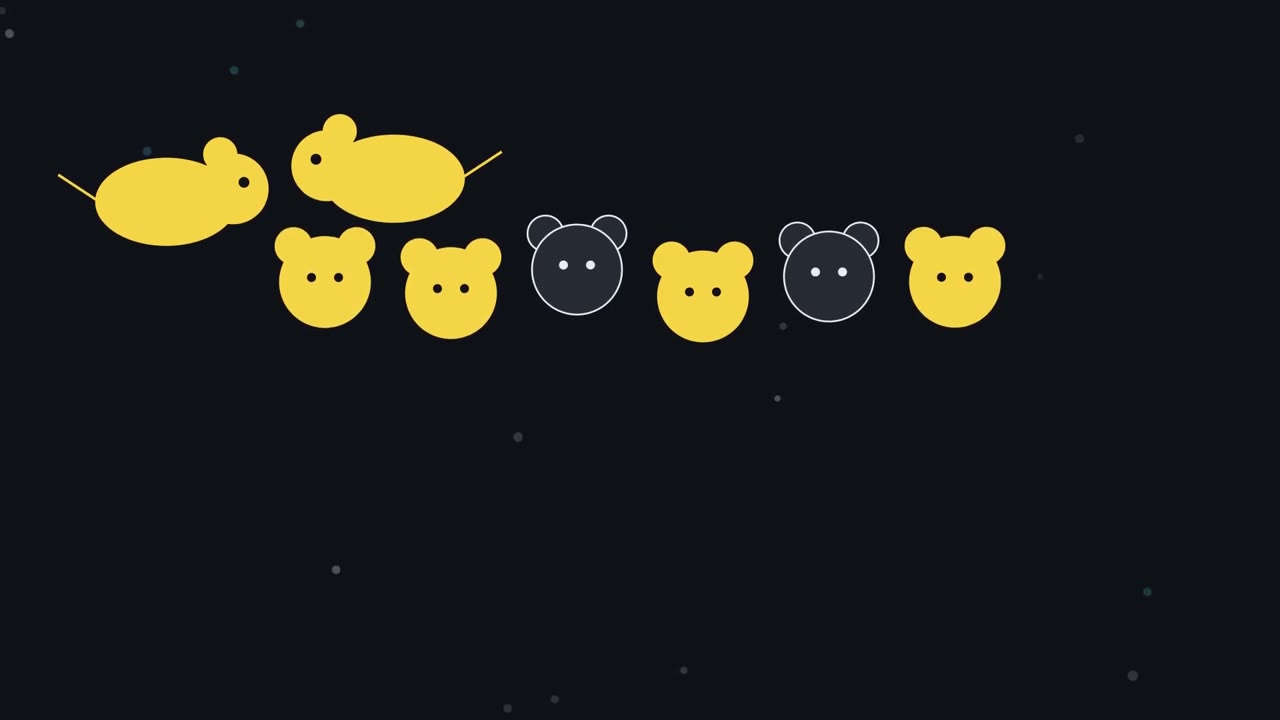
Mate two yellow mice as often as you like: you will never get a yellow mouse that breeds true. Why?
Continue in the lesson: Extending Mendel: Dominance, Multiple Alleles and Gene Interaction →
3:04 · Free, with captions and a transcript. The lesson has the full text, the questions and the sources.
More films from this lesson
How this film was made. Narration: an AI narrator voice (Kokoro, af_heart) reading narration written from this lesson's text. Animation: AI-generated in code (Manim) by Claude, a schematic with no drawn molecular structures. Captions come from the narration script. See something wrong? Report it.