Films · Genetics and Molecular Biology
How One Strand Specifies Another
Read the transcript of “How One Strand Specifies Another”
Film transcript: How One Strand Specifies Another
The first film traced inherited information to DNA. How can DNA make a copy? The clue is not the helix shape by itself. It is the matching rule inside a duplex. We will carry the first film's blue DNA into a picture made only of labelled blocks.
Start with base composition, the percentages of adenine, thymine, guanine and cytosine. Across double-stranded samples, adenine lies close to thymine, while guanine lies close to cytosine. A model must explain both matches while allowing different samples to carry different base sequences. Place two blue rails side by side, running in opposite directions. In canonical Watson-Crick pairing, adenine pairs with thymine, and guanine pairs with cytosine. The paired blocks explain the whole-duplex ratios. The rails are schematic, not molecular structures. Now unzip one short rail, leaving its partner positions empty. The old blocks remain blue. New blocks will arrive with green outlines.
Predict the new partner for the sequence shown on screen. Remember, adenine selects thymine, and guanine selects cytosine. Which blocks fill the empty rail? Each position admits its complementary block. The second rail is therefore specified by the first, not guessed. Reverse the reading direction, because the two strands are antiparallel. When both old rails separate, each can guide one new partner. One duplex can therefore become two matching duplexes. That is a copying proposal, not yet an experiment. It predicts that every daughter duplex keeps one old strand and receives one new strand. Give old strands a heavy marker and new strands a light marker.
Their combined density can reveal which strands stay together. Before transfer, DNA forms a heavy band. After one generation in light nitrogen, every duplex should contain one heavy and one light strand. That gives one hybrid band. After another generation, half the duplexes remain hybrid, while half contain two light strands. If parental strands stayed together, separate heavy and light bands would appear after the first generation. If old material dispersed through both strands, one band would shift gradually. The observed hybrid band, followed by hybrid and light bands, matched strand retention. The pattern, not exact density, is the test.
Pairing does two jobs in this model. It explains why complementary bases match across a duplex, and it lets each old strand specify a new sequence. The density bands test whether each daughter keeps one parental strand. They do not test every enzyme step. Structure supplied a rule; experiment tested its consequence.
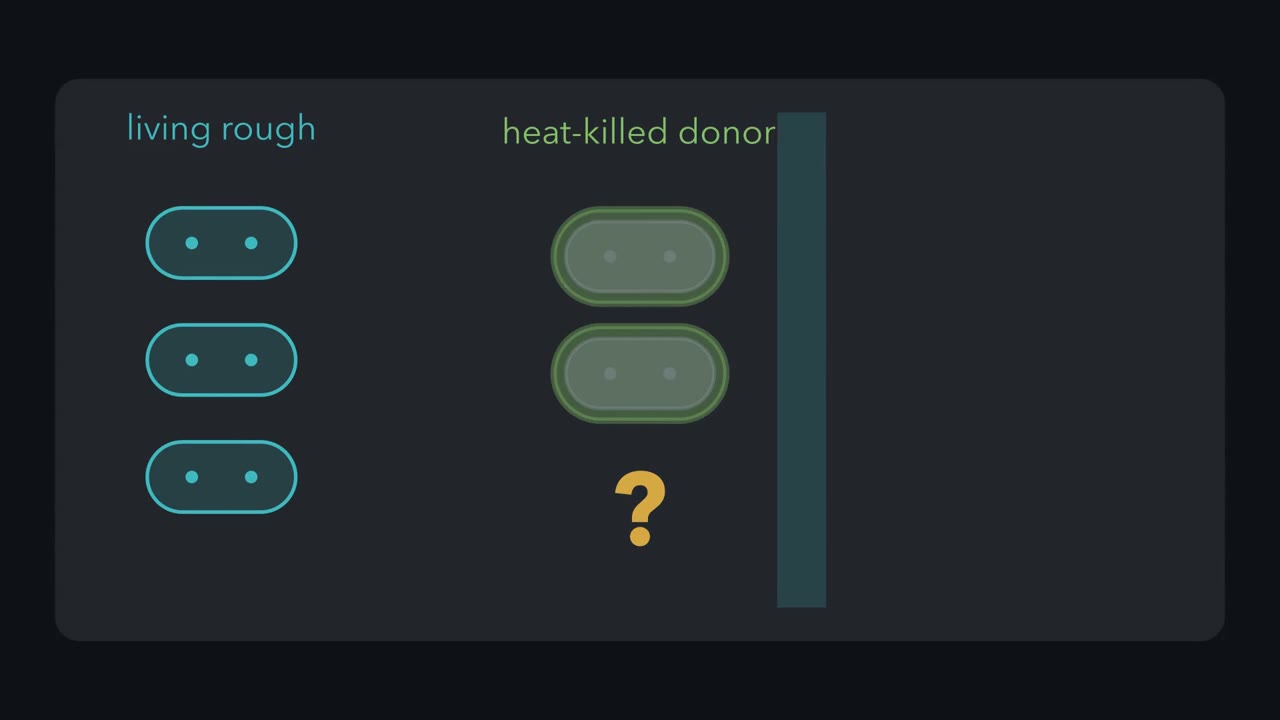
Dead bacteria changed living ones into the dead donor's type. What crossed between them?
Continue in the lesson: DNA Is the Genetic Material →
3:32 · Free, with captions and a transcript. The lesson has the full text, the questions and the sources.
More films from this lesson
How this film was made. Narration: an AI narrator voice (Kokoro, af_heart) reading narration written from this lesson's text. Animation: AI-generated in code (Manim) by Claude, a schematic with no drawn molecular structures. Captions come from the narration script. See something wrong? Report it.