Biology Together · Unit 5: Animal bodies, homes and adaptations
Beak Buffet
Rewritten on : new text and film. Your notes and highlights stay, but the text around them may have moved.
Why don't all birds have the same beak? A timed kitchen-tool buffet lets a child find out.
Three real-life stories behind this activity, about 2 minutes aloud, or read them below.
The film, 4 minutes, and the safety notes, for the grown-up to look at before the activity.
The hands-on part, done with a child: about 35 minutes.
Pause when the reading reaches a film, and offer to play it. Saved on this device.
Watch the film now, or keep listening
That is the end of the reading
This idea at other levels
An activity for ages 5 to 10 about adaptations. Next, for an older child: Adaptations for Survival (grade 7).
See every levelHide the levels
Adaptations
An adaptation is a body part or behavior that helps a living thing survive where it lives.
Taught at two levels: ages 5 to 10 and grade 7.
Grade 7 · the level you chose
Body or behavior, always for one setting: the hare that stays white too long.
Life Science · about 40 min · film 3:22 · Virginia LS.7 b
Ages 5 to 10 · the level you chose
Feel feather, fur, scale and shell, then guess where each animal lives.
A grown-up runs this one; its safety notes are in the guide.
Biology Together · about 30 min · film 3:24 · Virginia 1.5 b, 1.5 c, 1.5 a
Beak Buffet · this lesson
Kitchen tools as beaks: each shape is good at one food.
Biology Together · about 35 min · film 3:47 · Virginia 3.4 b, 1.5 b, 3.4 a
Line one mitten with shortening, dip both in ice water, see which chills.
A grown-up runs this one; its safety notes are in the guide.
Biology Together · about 30 min · Virginia 3.4 b
Damp or dry, dark or light: count where the worms choose to go.
A grown-up runs this one; its safety notes are in the guide.
Biology Together · about 35 min · film 3:51 · Virginia 3.6 a, 3.4 b, 1.5 a, 3.5 b
Next door to adaptations
- Natural selectionSelection is how a population comes to have its adaptations.Nearest lesson: The Camouflage Hunt (ages 5 to 10)
- Keeping warm and keeping coolFur, fat and feathers are adaptations for holding heat.Nearest lesson: The Blubber Glove (ages 5 to 10)
Also at grade 7: Natural Selection in Action
Short versions inside this lesson
The grade 7 version · about 1 minute to read
In grade 7 Life Science, children explain why populations adapt and single animals do not. They sort adaptations into physical and behavioral, and they model how a trait becomes more common over many generations through natural selection. Real data, such as moth color on sooty and clean tree bark, show how the environment favors some traits over others. Your child's beak tests are the first step toward that idea.
The plainest version · about 1 minute to read
A bird has no hands and no teeth, so its beak does the job of a fork, a spoon and a straw. Different birds have different beaks. A cardinal's thick beak cracks seeds. A duck's flat bill lets water out and keeps food in. A heron's long, pointed bill grabs fish. Each beak shape works best for certain foods.
Find an idea: every idea, searchable
Which lessons teach an idea, and the notes on each level, were written by AI models from the lessons and checked by a second model. A person has not yet read every one. How we use AI
About this activity what is in it
Builds on:Fur, Feathers and Scales (read)Why these?
Rewritten on : new text and film. Notes and highlights stay, but the text around them may have moved.
Before you start
- Hands-on time
- About 35 minutes
- Where
- Indoors
- Ages
- 5 to 10, with an easier and a harder version below
- Grown-up
- Stay with your child the whole time. Keep small food items, sponge and foam away from children under 4, and wipe up spilled water right away.
What you need
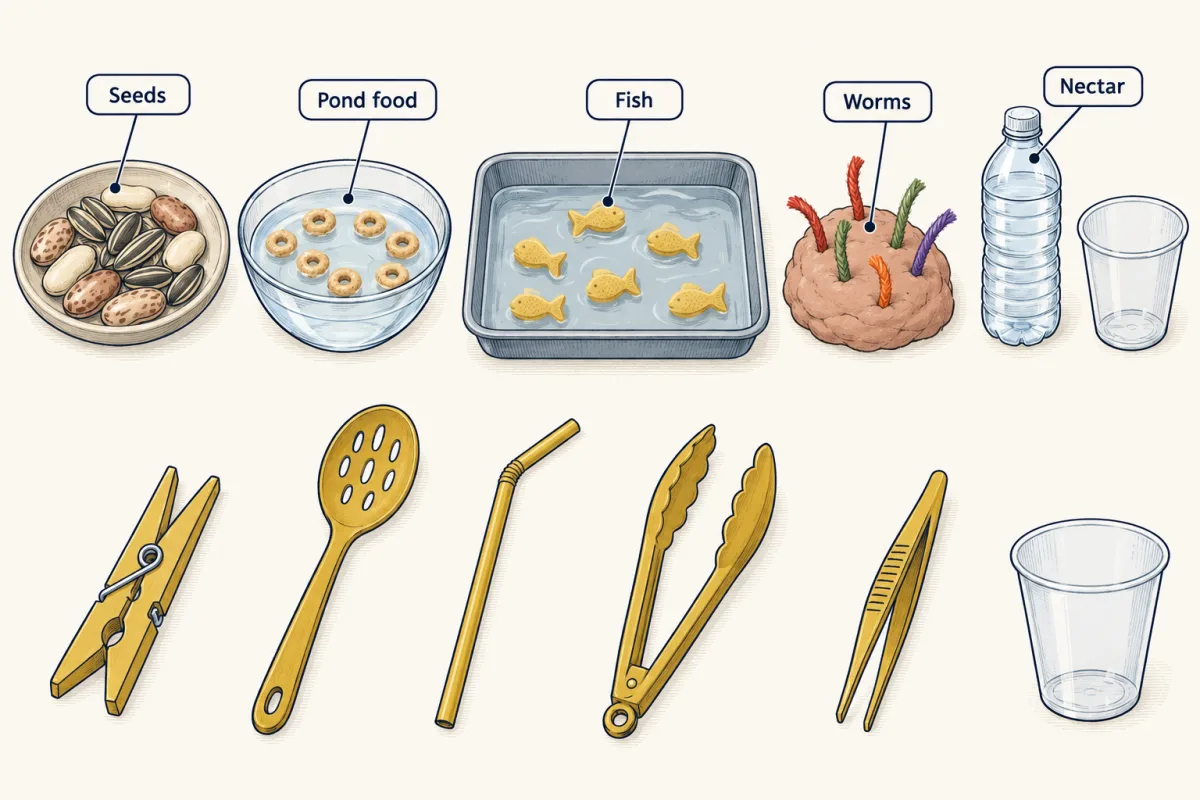
- Five "beaks": a spring clothespin, a slotted spoon or small strainer, a drinking straw (one per child), kitchen tongs or blunt-tipped chopsticks, and tweezers
- Seeds: a handful of large dry beans (lima or pinto, not red kidney) or sunflower seeds in the shell, in a shallow dish
- Pond food: a handful of cereal loops floating in a bowl of water
- Fish: 8 to 10 pieces of dry pasta or sponge cut into fish shapes, in a baking pan with 3 cm of water
- Worms: 8 to 10 short pieces of yarn pushed halfway into play dough or damp sand
- Nectar: water in a narrow plastic bottle or cup (not glass)
- A small cup for each child (the bird's "stomach") and an empty cup for the nectar
- A timer, and towels for spills
- Pictures of a northern cardinal, a mallard, a great blue heron, a ruby-throated hummingbird and a Carolina wren (optional)
Virginia science standards SOL 3.4 bSOL 1.5 bSOL 3.4 a
The main idea. Kitchen tools become bird beaks, and bowls around the table become a buffet of seeds, pond food, worms, fish and nectar.
The film
 ▶ Watch Beak Buffet: Parent Guide · 3:47
Read the transcript of “Beak Buffet: Parent Guide”
Film transcript: Beak Buffet: Parent Guide
How well can a clothespin pick up floating cereal? Give your child a chance to try it. Then see what happens when you offer a slotted spoon. In about thirty-five minutes at the table, your child tests five kitchen tools as bird beaks. They practice guessing first, counting fairly, and comparing results. They also connect simple kitchen models to real birds outside. Stay with your child throughout. Keep small pieces and water containers away from children under four. Small pieces can choke them. Call nine one one if choking. Check food allergies before setup. Skip red kidney beans. Keep all station items out of mouths. Set five stations around the table.
Put dry lima or pinto beans in a shallow dish. Float cereal loops in a bowl of water. Put pasta fish in a pan with three centimeters of water. Cut any sponge yourself. Press yarn halfway into play dough. Set out a clothespin, slotted spoon, straw, tongs, and tweezers. Every child needs their own straw. Fill a narrow plastic bottle with water. Set an empty cup beside it. Give your child a small cup to hold in one hand and a tool to hold in the other. Move food to the cup using only the tool. In this game the cup is the bird’s stomach. Start with pond food. Look at the clothespin and the slotted spoon. Which do you think will pick up more floating cereal in the same time?
At each station, have your child pick three tools. Ask, “Which beak do you think will get the most food?” Write down their guess. Try each tool for thirty seconds. Count what lands in the cup, then tip it back. Dip the straw in the bottle and cover the top with a finger. Lift it over the empty cup and uncover it. Count each strawful. The straw models a hummingbird’s reach. A hummingbird uses its tongue to collect nectar. Check the pond counts first. Circle the best tool for each food. Different beak shapes work well for different foods. A cardinal cracks seeds. A mallard strains food from water. A heron grabs fish. A hummingbird reaches nectar.
A wren picks insects off bark. If your child asks about changing beaks, try this. “Can you grow longer fingers to reach a high shelf?” A bird’s bill can grow and wear down during its life. A change in food cannot make one bird grow a different kind of bill. Over many generations, bill shapes can change across a group. How can you grow longer fingers to reach a high shelf? Keep straws out of mouths and tweezer tips down and away from faces.
Skip toothpicks and other sharp points. Wipe up spills and pick up dropped pieces right away. Empty the bowls and pan when you finish. Wash hands with soap and water. Ask, “What helped one tool work better?” Your child can use the counts to explain what they noticed. Watch how the tools move, too. A heron waits for a fish to come close.
Before you start
- Hands-on time
- About 35 minutes
- Where
- Indoors
- Ages
- 5 to 10, with an easier and a harder version below
- Grown-up
- Stay with your child the whole time. Keep small food items, sponge and foam away from children under 4, and wipe up spilled water right away.
What you need
- Five "beaks": a spring clothespin, a slotted spoon or small strainer, a drinking straw (one per child), kitchen tongs or blunt-tipped chopsticks, and tweezers
- Seeds: a handful of large dry beans (lima or pinto, not red kidney) or sunflower seeds in the shell, in a shallow dish
- Pond food: a handful of cereal loops floating in a bowl of water
- Fish: 8 to 10 pieces of dry pasta or sponge cut into fish shapes, in a baking pan with 3 cm of water
- Worms: 8 to 10 short pieces of yarn pushed halfway into play dough or damp sand
- Nectar: water in a narrow plastic bottle or cup (not glass)
- A small cup for each child (the bird's "stomach") and an empty cup for the nectar
- A timer, and towels for spills
- Pictures of a northern cardinal, a mallard, a great blue heron, a ruby-throated hummingbird and a Carolina wren (optional)
Virginia science standards SOL 3.4 bSOL 1.5 bSOL 3.4 a
The big idea
Which beak works best for each food? In about 35 minutes, your child can test five kitchen tools and compare what each one picks up. Give your child a clothespin and a bowl of floating cereal. See what happens before trying a different tool.
Say it together: “A bird has no hands and no teeth. Its beak does the job of a fork, a spoon and a straw. Each beak shape works best for a certain food.”
A beak picks up, cracks, grabs, strains or reaches for food. A beak shape that fits a bird’s food is a physical adaptation, a body feature that helps it survive. Test beak shapes first, then add how the bird uses them. Waiting still until a fish swims close is a behavioral adaptation, something the animal does.
Keep one more line clear if your child asks: a single bird does not grow a new beak because its food changed. Instead, populations—groups of the same kind of animal living in one place—can shift over many generations.
What to do
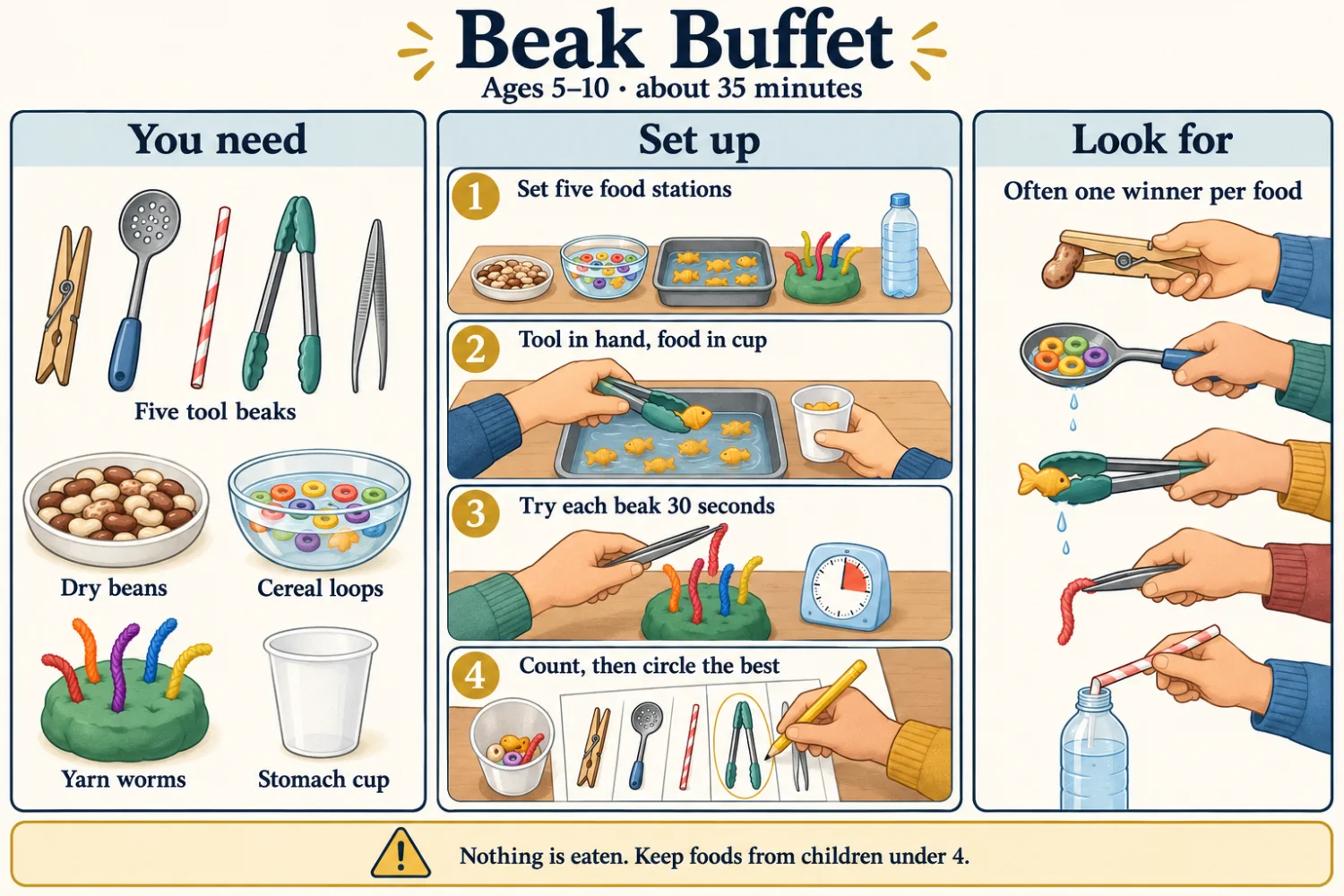
- Set the buffet. Put five stations around the table: seeds, pond food, fish, worms and nectar. Lay the five beak tools in a row.
- Teach one rule and try one practice move. Say: “A bird has no hands, so only your beak tool can touch the food.” (Some real birds, such as hawks and chickadees, also hold food with their feet.) Have your child hold the tool in one hand and the stomach cup in the other, and move one piece into the cup. Show the nectar move separately: dip the straw in water, cover the top with a finger, lift it over the empty cup, and lift the finger off.
- Predict first, then check. At each station, have your child pick three beaks. For pond food, include the clothespin and slotted spoon. Ask, “Which beak do you think will get the most food?” Write down the guess before you start the timer.
- Run timed trials. Try each chosen beak for 30 seconds. Count what lands in the cup, then tip it back before the next try. For nectar, count strawfuls. At the pond station, watch what each tool picks up and whether the water drains away. Compare the results with the guess.
- Find the winners. Circle the best beak for each food. Often the clothespin wins at seeds, the slotted spoon at pond food, tongs at fish, tweezers at worms and the straw at nectar. If your results differ, ask: “Why did that tool work well for you?”
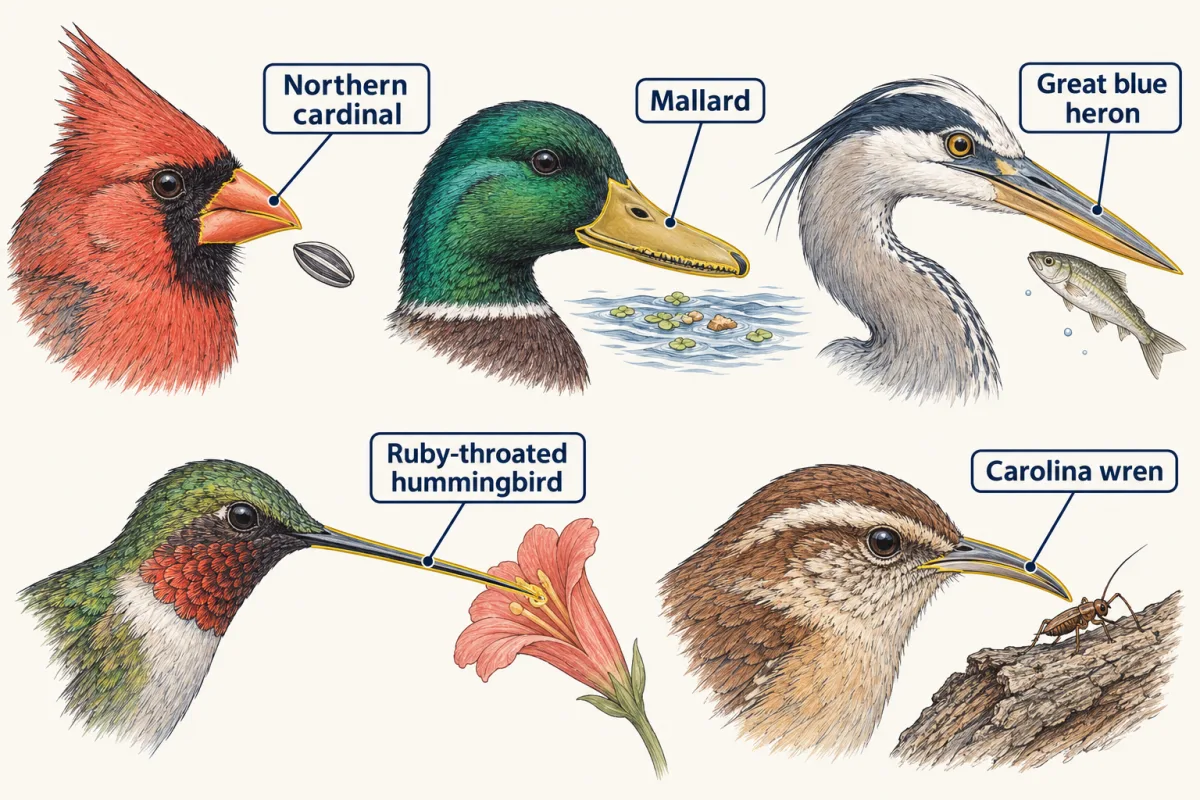
- Match shapes to real birds first. Show the bird pictures and pair each tool with a bill shape:
- Northern cardinal: thick, cone-shaped beak for cracking seeds.
- Mallard: flat bill with comb-like edges that strain food from water.
- Great blue heron: long, pointed bill for grabbing fish.
- Ruby-throated hummingbird: long, thin bill and a long tongue for nectar.
- Carolina wren: thin, slightly curved bill for picking insects off leaves and bark.
- Add behavior, then debrief. Now ask: “Shape is only half of it. How does each bird use its beak?” A heron stands still and waits. A mallard tips its tail up and reaches under water. A hummingbird hovers in front of a flower. Close with two quick questions to bring your child back to the big idea:
- “Was one beak the best for every food, or did each food need a different shape?”
- “If your beak worked like a slotted spoon, where would you look for dinner?”
Questions to ask while you do it
Ask your child to guess first, then check.
- “What do you think will happen if we try the clothespin on the floating cereal?”
- “I wonder which beak will be best at every food. Is there one?”
- “If all the seeds were gone, which bird would have a hard time? What could it do?”
- “What do you think a hummingbird would do at the seed station?”
- “Was it only the tool, or also how you used it? What helped?”
- “Birds don’t have teeth. What do you think happens to a seed after a cardinal swallows it?”
What children often think
-
A child might say “If a bird needs to eat different food, its beak will change.”
You could try Ask, "Can you grow longer fingers because you need to reach a high shelf?" A bird’s beak grows and wears a little with use, but one bird cannot grow a different kind of beak because its food changed. Over many generations, birds whose beaks suit the food may survive better and have more chicks, so the whole group slowly changes.
-
A child might say “One beak is the best for everything.”
You could try Test it. Have your child pick their favorite tool and try it at every station. Write the counts in a row. Most tools that win at one food struggle at another, just as real beaks do.
-
A child might say “Birds chew their food with teeth.”
You could try Look closely at a bird picture or watch a bird through a window. Ask, "Can you see any teeth?" No living bird has teeth. Birds cannot chew with teeth. Many crack, husk or tear food with their bill, then swallow it. A muscular part of the stomach called the gizzard grinds it, often with help from small stones the bird swallows.
-
A child might say “The straw is how a hummingbird drinks, like sipping a juice box.”
You could try Away from the stations, give your child a clean spoon with fresh drinking water. Ask them to lick the water quickly without sucking. A hummingbird’s bill is long and thin, not a tube, and the bird does not suck. Its long tongue laps nectar many times a second. The straw only stands in for that long reach.
Why it works
Beak shape and food fit together because of a long history. In any bird population, beaks vary a little. When food is scarce, birds whose beaks handle what is left are more likely to survive and raise chicks. Chicks tend to inherit their parents’ beak shape, so over many generations the average beak shifts. This is natural selection. Scientists watched it happen on a Galápagos island in 1977: a drought left mostly large, hard seeds, and medium ground finches with deeper beaks survived better.
Your tools are rough models. A clothespin picks up a seed, but a cardinal’s thick beak also cracks the hard shell open. A mallard’s bill has comb-like plates called lamellae along its edges that let water out and hold food in, much like your slotted spoon. Behavior matters too, and your child’s technique will change the counts.
For teachers (Virginia SOL 1.5 b, 3.4 a, 3.4 b): Virginia’s grade 3 standard connects beak shape (physical adaptation) and feeding habits (behavioral adaptation) to populations changing over many generations—not single animals changing on demand.
Easier and harder
Ages 5 to 7
Use three stations (seeds, pond food, fish) and three tools. Skip the timer and count to 20 out loud instead. Your child can draw the winning beak at each station instead of writing numbers. Show one real bird for each station.
Ages 8 to 10
Make it a fair test. Use the same time, the same amount of food and the same person for every trial. Run each trial twice and average the counts, then draw a bar graph for one station. Next, change one thing—such as removing all the beans—and ask which “bird” would go hungry first.
If it doesn’t go as planned
If counts are all close, the trials may be too long or the food too easy. Cut trials to 20 seconds or spread the food out more. If the cereal sinks or turns to mush, swap in fresh cereal or small foam pieces. If your child grabs food with their hands, remind them that in this game a bird uses only its beak. Then try one round “beak only” and one round with hands to see the difference.
Observation sheet
Before you start, fill in one example row together so your child sees how the chart works:
- Example row (imaginary counts): Food: Pond food | My guess: Clothespin | Beaks I tried: Clothespin, slotted spoon, tongs | How many for each?: 1, 5, 2 | Best beak: Slotted spoon
Observation sheet
Beak buffet
NameDate
Guess the best beak first. Then count what each beak picks up in 30 seconds.
| Food | My guess | Beaks I tried | How many for each? | Best beak |
|---|---|---|---|---|
| Seeds | ||||
| Pond food | ||||
| Fish | ||||
| Worms | ||||
| Nectar |
The beak that worked for the most foods was:
A real bird with a beak like that one:
stemhop.com · Biology Together
The three stories, told aloud Side Hops: three stories that go with this lesson Side Hops
Three playful ways to talk about bird beaks
1:50 · Narration: an AI narrator voice (Kokoro, af_heart).
Read the transcript
When you set up Beak Buffet at the kitchen table, you do not need any fancy science words to make the big idea click. A few silly comparisons do most of the work.
Before you start the timer, hold up a kitchen colander. A brown pelican scoops up fish and water in a stretchy pouch under its bill. That pouch can hold up to three gallons of water. The water runs out at the corners of its mouth, and the fish stay inside. Think of how a colander lets water go and keeps the food. Then the pelican swallows the fish.
Next, when one kitchen tool looks totally wrong for a bowl, have your child cross two fingers. Tell them a real bird called a red crossbill has beak tips that overlap just like that. It looks crooked, yet those crossed tips work like sideways pliers, prying tight pinecone scales apart so the bird's tongue can pull out the tiny seeds. Suddenly a goofy shape looks pretty clever.
Finally, if your child asks whether a cardinal could just grow a long straw beak when its food changes, tap your own fingernail. Tell them a bird's beak is covered in the same kind of stuff as fingernails, called keratin. The edges wear down as the bird uses its beak, and new keratin grows. A cardinal can try a different food with the beak it has. Changing dinner won't make it grow a straw-shaped beak. When food is hard to find, birds with beaks that work well for that food are more likely to raise chicks. Those chicks often grow beaks like their parents'. Over many generations, more birds in the group can have that kind of beak.
Have fun at the buffet, and keep the towels handy.
The idea underneath them. Kitchen tools become bird beaks, and bowls around the table become a buffet of seeds, pond food, worms, fish and nectar.
Your notes
Select any text in the lesson to highlight it or add a note to it. Your highlights and notes are saved in this browser and collected in your notebook.
This browser is not letting the site save anything (a private window or strict privacy settings), so highlights and notes will be lost when you leave the page.
Where this lesson fits
Before thisReview first
- Fur, Feathers and ScalesThis course · Lesson 15
Your child has already felt how a bird's feathers suit its life, so beaks are the next body part to compare.
After thisStudy next
- The Camouflage HuntThis course · Lesson 18
Your child sees another body feature that helps an animal survive, this time colour that hides it from hungry birds.
- The Blubber GloveThis course · Lesson 17
It gives your child another body feature that fits an animal's way of life, this time staying warm in cold water.
Elsewhere on the siteFilms, simulations and method films in other courses
- Why a White Coat Can Help—and HurtFilm · Life Science
It shows how a body feature that helps an animal survive in its home is called an adaptation.
- Share a tree with five kinds of birdsSimulation · Life Science
Birds with different beaks share one tree by eating different foods, which extends the buffet idea.
Suggested by an AI model from the lessons themselves, then checked. How we use AI
Those are the stories. The idea under them is the one the lesson builds.
That is the film. The rest of the activity is the fun part.
The rest of the activity is here when you want it.
Finish line
Test yourself
4 questions
Questions to talk over together.
Next · Lesson 17
The Blubber Glove
How does a seal stay warm in icy water with only short hair? A shortening-filled mitten lets a child feel the answer.
Continue →Rewritten on : new text and film. Notes and highlights stay, but the text around them may have moved.